Tuesday, March 31, 2009

M2, Money Supply Continues to Soar


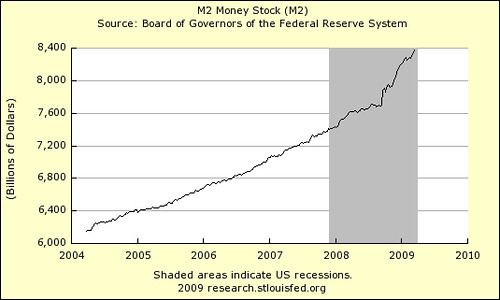
M2, Money Stock, St Louis Fred Graph, March 27, 2009.

M@ Money Stock 327Align Center


Money Supply as measured by M2 continues to soar. Does anybody really care?

Back in the early 1980s if M2 started rising, the bond vigilantes would have been out in force pushing interest rates higher. Now, not a "peep".

One can only wonder how long it is going to take for this surge in money to take effect. Commodities are at rock bottom as I am writing this.

One thing for sure, if the Fed has acted as it did in the 1930s we would all be eating rocks by now. Potato anyone?

Stay tuned, the fun is going to start very soon.

M2 includes a broader set of financial assets held principally by households. M2 consists of M1 plus:
(1) savings deposits (which include money market deposit accounts, or MMDAs);
(2) small-denomination time deposits (time deposits in amounts of lessthan $100,000);
and (3) balances in retail money market mutual funds(MMMFs).
Seasonally adjusted M2 is computed by summing savings deposits, small-denomination time deposits, and retail MMMFs, each seasonally adjusted separately, and adding this result to seasonally
adjusted M1.
Subscribe to All American Investor via Email

Google Ventures Fund set to Invest $100 Million


The newly formed Google Venture Capital Fund is set to invest $100 million this year. The fund is seeking investment opportunities to maximize returns rather than looking for investments that strictly fit with Google's strategic vision. This should be music to the ears of entrepreneurs.

Rich Miner said,
that Google Ventures will look at a wide variety of companies to invest in, including consumer Internet products, information technology, health care and biotech, among other areas.
The fund will focus primarily on companies seeking seed funding and early stage funding, and Google Ventures will have the ability to make investments ranging from tens of thousands to "several tens of millions" of dollars.

Early stage, across the board, this is really good news.

Here is the link to the Google Ventures page.
Subscribe to All American Investor via Email
Follow All American Investor on Twitter

S & P Case Shiller Home Price Indices Chart


Data through January 2009, released today by Standard & Poor’s for its S&P/Case-Shiller1 Home Price Indices, the leading measure of U.S. home prices, shows continued broad based declines in the prices of existing single family homes across the United States, with 13 of the 20 metro areas showing record rates of annual decline, and 14 reporting declines in excess of 10% versus January 2008.


SP Case Shiller Home Price Indices Chart


Follow All American Investor on Twitter
Subscribe to All American Investor via Email

Source: S&P/Case-Shiller Home Price Indices

Monday, March 30, 2009

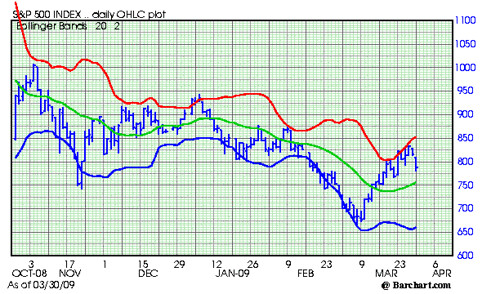
S & P 500 Correction or Rejection?


S & P 500 Chart, Daily Bar, March 30

S & P 500, Chart 3302
What to watch:
  • Half way back price is 833. This is an important technical retracement point.
  • The green line (the midpoint) is 756 and rising. Tomorrow it should be around the 764 area. The market should find good support at the line.
  • The first major support area is 740-752. From previous up and down moves.
  • The small gap from the opening is troublesome, and needs to be closed.
The S & P 500 is at a major turning point. I wrote earlier about the importance of establishing support below the market. This test of support is happening now. If the uptrend is good, this support will hold and the market will return to the upside resistance in the 825 area. If the market falls below 740 a test of the lows would be indicated.

It is always easier to be bullish once the market starts to establish support. This lets you know that there are willing buyers on in waiting.

I still favor the upside. But, it really is a coin toss right now.

Subscribe to All American Investor via Email

Bob DeMarco is a citizen journalist and twenty year Wall Street veteran. Bob has written more than 500 articles with more than 11,000 links to his work on the Internet. Content from All American Investor has been syndicated on Reuters, the Wall Street Journal, Fox News, Pluck, Blog Critics, and a growing list of newspaper websites. Bob is actively seeking syndication and writing assignments.

Follow All American Investor on Twitter

More from All American Investor


NVIDIA Introduces Industry’s Most Powerful Professional Graphics LineUp


Whether designing the next aircraft or delivering seven-day weather forecasts, today’s professionals seek a reliable, robust visualization platform designed to address their unique challenges and needs. Highlighting a decade of innovation, driven by the needs of the most demanding professionals, NVIDIA today introduced its most powerful and advanced top-to-bottom line of Quadro® professional GPU solutions in the Company’s history.
Subscribe to All American Investor via Email

“Our mission with Quadro is to help customers solve the world’s most challenging visual computing problems,” stated Dan Vivoli, executive vice president of marketing at NVIDIA. “We learn every day from them and are humbled by their brilliance. The new lineup, with the flagship Quadro FX 5800, sets the stage for the next ten years of innovation.”

Spanning from sub-$100 entry-level to standalone visual computing systems, this new series includes:

* NVIDIA Quadro FX 5800 – the industry’s first and only 4GB, ultra high-end solution delivers the highest visualization performance and capabilities, enabling professionals to work with large-scale models and datasets.
* NVIDIA Quadro FX 4800 – ultra high-end solution provides professionals with the most complete toolset to dramatically push the boundaries of realism, performance, and quality.
* NVIDIA Quadro FX 3800 – single slot solution with a robust feature set and added capabilities such as SLI Multi-OS and SDI support to enable a no-compromise, high-performance, interactive visualization experience.
* NVIDIA Quadro FX 1800 – mid-range solution offers the best price performance for workstation graphics and provides the optimal blend of quality, precision, performance, and programmability.
* NVIDIA Quadro FX 580 – best-in-class entry-level solution boosts productivity for a variety of industry-leading volume CAD and digital content applications.
* NVIDIA Quadro FX 380 – an affordable professional-class graphics solution extends energy efficiency while delivering 50-percent faster performance.
* The Quadro NVS 295 – capable of supporting up to two 30-inch digital displays at maximum resolutions, taking business graphics to a new level visual perfection.

“Once again, NVIDIA has set new graphics performance standards for professionals in the product design and development community,” said Laurent Laloy, director, 3DVIA User Experience, Dassault Systèmes. “This latest generation of Quadro professional solutions will allow our customers to drive innovation and design with unprecedented 3D visual quality.”

This new line-up also brings the introduction of NVIDIA® SLI® Multi-OS, a ground-breaking technology that enables, for the first time, 3D workstation virtualization on the Quadro GPU. With SLI Multi-OS, applications and users are able to optimize productivity and costs through the use of multiple Quadro GPU technologies from a single workstation in a virtualized environment. Users can also enable native SLI technology support on key partner platforms to accelerate application performance, scaling and higher image quality.

Availability
NVIDIA Quadro solutions are widely available through leading system manufacturers such as Dell, Fujistu-Siemens, HP and Lenovo; leading workstation system integrators; and NVIDIA channel partners PNY Technologies (US and EMEA), Leadtek (APAC) and Elsa (Japan). For additional information about the complete lineup of NVIDIA Quadro professional solutions, please visit: www.nvidia.com/quadro.

“The new family of powerful NVIDIA GPU solutions are an ideal match for the new HP Z Workstations, which have been totally reinvented from the core outward for breakthrough performance, value and serviceability,” said Jim Zafarana, Vice President and General Manager, HP Workstations. “This powerful combination can tackle the most challenging visual computing problems that exist for today’s demanding professionals.”

“As the worldwide leader in workstations, Dell looks to partner with only the best companies to deliver the solutions that workstation professionals demand,” said Greg Weir, senior manager, product group. “The power of Dell Precision and NVIDIA graphics represents a step-change in what customers can expect from a reliable, powerful and ISV-certified workstation with performance gains at levels beyond what customers could have imagined.”

About NVIDIA
NVIDIA (Nasdaq: NVDA) is the world leader in visual computing technologies and the inventor of the GPU, a high-performance processor which generates breathtaking, interactive graphics on workstations, personal computers, game consoles and mobile devices. NVIDIA serves the entertainment and consumer market with its GeForce® graphics products, the professional design and visualization market with its Quadro® graphics products and the high-performance computing market with its Tesla™ computing solutions products. NVIDIA is headquartered in Santa Clara, Calif. and has offices throughout Asia, Europe and the Americas. For more information, visit www.nvidia.com.

For further information, contact:
Derek Perez
NVIDIA Corporation
(408) 486-2512
dperez@nvidia.com


Bob DeMarco is a citizen journalist and twenty year Wall Street veteran. Bob has written more than 500 articles with more than 11,000 links to his work on the Internet. Content from All American Investor has been syndicated on Reuters, the Wall Street Journal, Fox News, Pluck, Blog Critics, and a growing list of newspaper websites. Bob is actively seeking syndication and writing assignments.

Follow All American Investor on Twitter
More from All American Investor


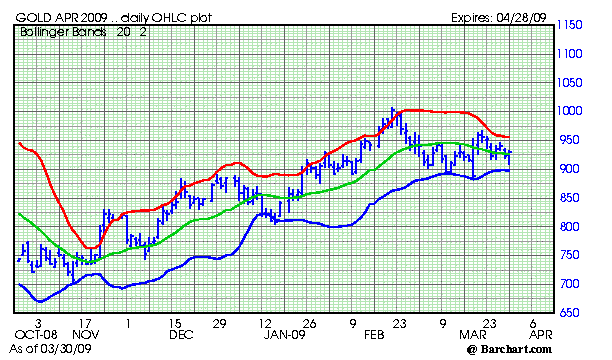
Gold Pops Twenty Bucks, What next? (Chart)


Gold Futures, Daily Chart.

Also see:

GoldCorp (GG) Twelve Times Your Money in Ten Years (Chart)


April Gold 330


Gold futures popped $20 off its lows this morning after stocks opened.

A look at the chart shows that price ranges are narrowing. Something is going to give soon.

From a seasonal demand perspective, the slowest period of demand for gold every year is from Spring into Summer (jewelry, industrial demand). Gold has a tendency to trend down during this period. If gold is going up from here it will take good investor demand for the physical. Demand could come from purchases by the gold exchange traded fund--GLD.

Gold made a monster run at the the end of 2008 into February 2009. The market has been moving sideways from the top.

The market continues to languish which is not a bad sign given the weak seasonal. This market should be watching closely as a breakout of this range is coming soon. The broader trend is still up.
Subscribe to All American Investor via Email
Follow All American Investor on Twitter

AIG chiefs pressed to donate to Dodd


As Democrats prepared to take control of Congress after the 2006 elections, a top boss at the insurance giant American International Group Inc. told colleagues that Sen. Christopher J. Dodd was seeking re-election donations and he implored company executives and their spouses to give.

Getty Images Sen. Christopher J. Dodd, chairman of the Senate Banking, Housing and Urban Affairs Committee, has lost some political standing heading into re-election because of his ties to American International Group Inc.

The message in the Nov. 17, 2006, e-mail from Joseph Cassano, AIG Financial Products chief executive, was unmistakable: Mr. Dodd was "next in line" to be chairman of the Senate Banking, Housing and Urban Affairs Committee, which oversees the insurance industry, and he would "have the opportunity to set the committee's agenda on issues critical to the financial services industry.
EXCLUSIVE: AIG chiefs pressed to donate to Dodd

Follow All American Investor on Twitter

Is Lorillard (LO) in Play?


Is Lorillard (LO) in play? This is an interesting story. From Barron's,
Lorillard's fans in the investment community say that the company is underappreciated on Wall Street -- partly because of its involvement in tobacco -- and that it is the most attractive takeover target in the consolidating global cigarette industry. There lately has been talk that Reynolds, maker of the Camel, Winston and Kool brands, might buy Lorillard for a sizable premium above the recent share price of $61. Reynolds and Lorillard declined to comment.

Deal or no deal, Lorillard looks appealing. Its shares trade at 11 times projected 2009 profit of $5.50 a share and provide a yield of 6%. Lorillard pays out 70% to 75% of its profit in dividends. The company, which was spun off by Loews (L) last year, has a great balance sheet, with more than $1 billion of cash at year end and no debt.
The dividend also gets my attention.
Subscribe to All American Investor via Email
Read the Article

Will Lorillard Meet Its Match?


Lorillard

Bob DeMarco is a citizen journalist and twenty year Wall Street veteran. Bob has written more than 500 articles with more than 11,000 links to his work on the Internet. Content from All American Investor has been syndicated on Reuters, the Wall Street Journal, Fox News, Pluck, Blog Critics, and a growing list of newspaper websites. Bob is actively seeking syndication and writing assignments.

Follow All American Investor on Twitter
More from All American Investor


Big Boys Buying Mortgages In Reaction to Treasury Plan


Big Boy Investors like PIMCO, TCW, and Fifth Third Asset Management are buying mortgage backed securities and favoring them over treasuries.
A March 23 Ried, Thunberg & Co. survey said fund managers overseeing $1.19 trillion cut their government securities holdings to the least this year while they increased mortgage assets.
This is in reaction to the Federal Reserves March 18 plan to buy Treasuries and $750 billion of mortgage-backed securities from Fannie Mae, Freddie Mac and Ginnie Mae.

So far the plan which is designed to lower consumer interest rates by taking supply out of the market seems to be working. A contrarian might ask? Is this front running or the makings of a trend that can be sustained over a long period of time?

Interest rate spreads are clearly narrowing across most quality preferences. The spread between the ten year Treasury and Fannie Mae’s current-coupon 30- year fixed-rate narrowed to 118 basis points last week, down from 232 basis points in November. The spread on industrial corporates narrowed from 557 basis points to 468 basis point since the announcement.

These narrowing in the interest rate spreads can also be seen as a vote of confidence for the recently announced Fed plan.

Follow All American Investor on Twitter

Sunday, March 29, 2009

Is the Barrons Cover the Kiss of Death for Jeff Bezos and Amazon (AMZN)?


Wow. Last night, just after midnight I wrote about Amazon (AMZN)--Amazon . Toast up 5000 percent since IPO (Chart).

Next thing I know, an article from Barron's pops into my reader--The World's Best Retailer. Ironic? Well, yeah.

Here is a note of caution. Jeff Bezos is on the cover of Barron's this week. Why is this important?

If you read my article, Amazon . Toast, all the way to the end you would have noticed that Jeff Bezos was named Time's person of the year in 1999. What happened next? The stock dropped from a split adjusted $113 a share, all the way down to $5.67. Yikes.

Is the Barron's cover the kiss of death for Jeff Bezos and Amazon?
Subscribe to All American Investor via Email

Jeff Bezos' Amazon.com is winning customers with competitive prices, wide selection, reliability -- and Kindle. It's winning shareholders, too.


The World's Best Retailer --Barron's

THIS MAY BE AN OPPORTUNE time to add shares of Amazon.com to your shopping cart and proceed to checkout.
Now, Amazon is taking that a step further by providing Web services, better known these days as "cloud computing." What is cloud computing? It is the outsourcing of information-technology and data-center operations to third parties, mostly by small- and medium-sized companies that choose not to spend their resources to deal with these tasks themselves. (The name cloud derives from the remote ether-like computer space where the outsourced operations take place.) Amazon, which has spent more than $2 billion on its systems in the last decade, has divided these services into several parts, including: Amazon Simple DB (databases), Amazon Elastic Compute Cloud (computing capacity) and Amazon Simple Storage (data storage).

Price believes these services could eventually generate hundreds of millions of dollars annually -- and investors are getting them for almost nothing.
The second kicker is Kindle, a digital-reading device. Its original version was generally well received, but its recently released 2.0 edition has become a hit with consumers. Wall Street analysts estimate the company has sold 350,000 of the devices, which got a plug from Oprah Winfrey last fall.
Bob DeMarco is a citizen journalist and twenty year Wall Street veteran. Bob has written more than 500 articles with more than 11,000 links to his work on the Internet. Content from All American Investor has been syndicated on Reuters, the Wall Street Journal, Fox News, Pluck, Blog Critics, and a growing list of newspaper websites. Bob is actively seeking syndication and writing assignments.

Follow All American Investor on Twitter

Go See Kindle

Bear Markets Revisited 1929-1933


This is a update of an article I put up on March 18. Since then, the current bear market rally that started on March 9, around 676 area has extended itself to about 20 percent. In the chart below you will notice that bear market rallies averaged 30 percent from 1929-1933. The bear market rallies averaged about two months in duration. It is always interesting and educational to study the past. A friend of mine pointed out that the market dropped like a lead brick many times during that period, and that the low made in 1929 was not the low of the bear market.

File this under food for thought, and looking beyond the obvious.

The following lists the bear market rallies, and the duration, from 1929-1933.


The following list the bear market rallies, and the duration, from 2007- to the present.

Good information and perspective that I picked up over on FT Alphaville.
Subscribe to All American Investor via Email

Follow All American Investor on Twitter

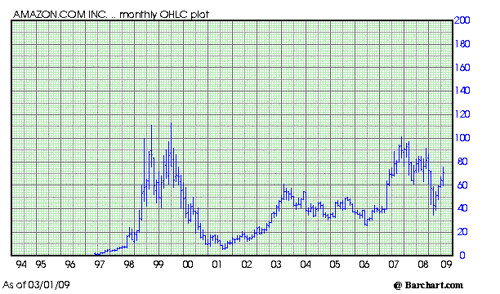
Amazon . Toast up 5000 percent since IPO (Chart)


Amazon (AMZN), Ten Year Chart, Monthly.

In May, 1997 Amazon (AMZN) was labeled Amazon.toast and Amazon.bomb by Forrester Research and Barron's. Since then it has risen more than 5,000 percent.

Amazon Chart Ten Year 328Align Center

Highlights:
  • Amazon was founded in 1994, and went public in 1997.
  • In 1997, Amazon was labeled Amazon.toast and Amazon.bomb by Forrester Research and Barron's.
  • By 1999, cumulative losses at Amazon exceeded $550 million.
  • In December, 1999, Jeff Bezos was chosen as Time magazine's person of the year (see Cover).
  • In December 1999, Amazon reached its highest raw price in history at $113 a share.
  • In the summer of 2000, an analyst at Lehman Brothers warned investors that the company might run out of cash and advised them to avoid its stock.
  • In September 2001, Amazon dropped to its lowest raw price in history--$5.67 a share.
  • In October, 2007 Amazon traded over $100 a share for the third time, and the first time since 1999.
  • The split adjusted price of Amazon dating back to 1997 is $1.31 a share.
  • On March 23, 2009 Amazon closed at $75.61 a share, its highest price since falling to $34.68 a share in November, 2008.
  • Amazon is currently up more than 50 times its adjusted initial public offering price, or 5,700 percent.

A month after Jeff Bezos' was named Time's person of the year, the company fired 150 workers as part of an internal reorganization. Just five days later, Amazon reported a loss of $323 million for the holiday fourth quarter and promised that future losses would be lower. (The company, however, would later exceed that amount by more than $200 million).

Follow All American Investor on Twitter
Subscribe to All American Investor via Email
Saturday, March 28, 2009

Trade Weighted Dollar Index Chart


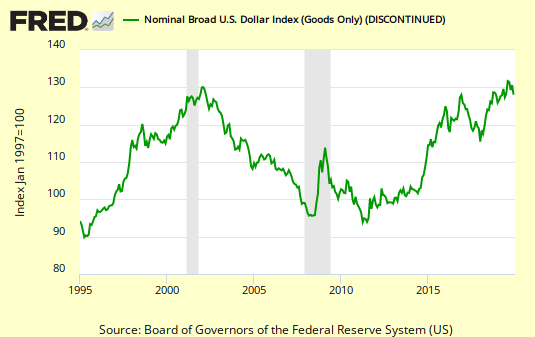
Trade Weighted Exchange Index.

Link to the chart.

Through March 20, 2009. Current value 110.0347. Looks like a top is in. Would expect dollar to weaken making exports cheaper.

A weighted average of the foreign exchange value of the U.S. dollar against the currencies of a broad group of major U.S. trading partners.
Broad currency index includes the Euro Area, Canada, Japan, Mexico, China, United Kingdom, Taiwan, Korea, Singapore, Hong Kong, Malaysia, Brazil, Switzerland, Thailand, Philippines, Australia, Indonesia, India, Israel, Saudi Arabia, Russia, Sweden, Argentina, Venezuela, Chile and Colombia.

Follow All American Investor on Twitter
Subscribe to All American Investor via Email

Non Financial Commercial Paper Chart


Non financial Commercial Paper Chart

Link to the chart.

I am having some blog glitches and due to this problem I can only supply the link to the chart at this time.

Follow All American Investor on Twitter

Ten Year Treasury Chart, 1962 to the present


Ten Year Treasury Constant Maturity

Link to the Chart.

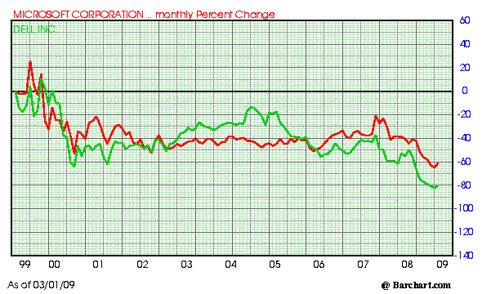
Microsoft and Dell, Dead Money, Chart and Comparison


Microsoft (MSFT) and Dell (Dell) , Ten Year Comparison, Percent Change, Chart

Microsoft versus Dell 328


Both of these stocks peaked near the end of the Internet Stock boom. Both stocks have been dead money.

In defense of Microsoft, they have paid out some tasty dividends and the chart does not reflect this.

Did you own these dogs?
Subscribe to All American Investor via Email
Follow All American Investor on Twitter

APPLE (AAPL) or NVIDIA (NVDA) which was the Better Buy? (Chart)


Chart, APPLE (AAPL) versus NVIDIA (NVDA), Ten Year Chart, Comparison, Monthly Percent Change.

Apple Versus Nvidia percent change 328


From 2000 to late 2003, Apple traded sideways in a tight range. You had plenty of time to understand the implications of the MAC and the IPod. Kids were begging for the IPod long before the stock took off to the upside.

For most of the decade, NVDA would have been the better buy.

Apple was clearly the better buy over the entire ten year period. However, compared to the market return of most stocks over this same time frame, both Apple and Nvidia were good buys. Of late NVDA is taking off to the upside.
Subscribe to All American Investor via Email
Follow All American Investor on Twitter

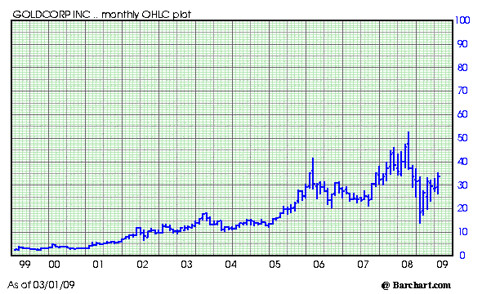
GoldCorp (GG) Twelve Times Your Money in Ten Years (Chart)


Gold Corp (GG), Ten Year Chart, Monthly (not dividend adjusted).

Goldcorp 10 Year 328


You don't hear much about Gold Corp (GG). The gold stock has risen from the $2.50 area in 1999 to a high of $52.65 during July, 2008 (prices are adjusted for stock splits).

The stock closed Friday at $33.76. GoldCorp dropped to a low in the $14.00 area in October, 2008 and is now moving up again.

If you had invested $10,000 in GoldCorp in 1999, it would now be worth more than $125,000. This does not include adjustments for dividends. 12.5 times your money in ten years, not bad.
Subscribe to All American Investor via Email


Bob DeMarco is a citizen journalist and twenty year Wall Street veteran. Bob has written more than 500 articles with more than 11,000 links to his work on the Internet. Content from All American Investor has been syndicated on Reuters, the Wall Street Journal, Fox News, Pluck, Blog Critics, and a growing list of newspaper websites. Bob is actively seeking syndication and writing assignments.


Follow All American Investor on Twitter

More from All American Investor


Friday, March 27, 2009

Vehicle Sales Plunge--Ugly Chart


Subscribe to All American Investor via Email
Personal Income and Expenditures (Numbers and Charts)


Personal Consumption Expenditures tick up. A positive factor for first Quarter GDP.


Personal income
  • decreased $29.1 billion, or 0.2 percent
  • disposable personal income (DPI) decreased $10.5 billion, or 0.1 percent

Personal consumption expenditures (PCE)
  • increased $17.2 billion, or 0.2 percent. In January, personal
  • income increased $20.5 billion, or 0.2 percent
  • DPI increased $164.6 billion, or 1.6 percent
  • PCE increased $94.8 billion, or 1.0 percent, based on revised estimates.
Real disposable income
  • decreased 0.4 percent in February, in contrast to an increase of 1.3 percent in January.
Real PCE
  • decreased 0.2 percent, in contrast to an increase of 0.7 percent.
  • The price index for PCE increased 0.3 percent, the same increase as in January.

Source: Bureau of Economic Analysis (more details and pres release)

Subscribe to All American Investor via Email

Disposable Personal Income ticks up.


Bob DeMarco is a citizen journalist and twenty year Wall Street veteran. Bob has written more than 500 articles with more than 11,000 links to his work on the Internet. Content from All American Investor has been syndicated on Reuters, the Wall Street Journal, Fox News, Pluck, Blog Critics, and a growing list of newspaper websites. Bob is actively seeking syndication and writing assignments.


Follow All American Investor on Twitter


Roubini Says Geithner Plan Won’t Prevent Bank Nationalizations


Roubini Says Geithner Plan Won't Stop Nationalizations
Watch the Video version.

Read Roubini Says Geithner Plan Won’t Prevent Bank Nationalizations

Thursday, March 26, 2009

S and P 500 Looks good as forecast be careful now (Chart)


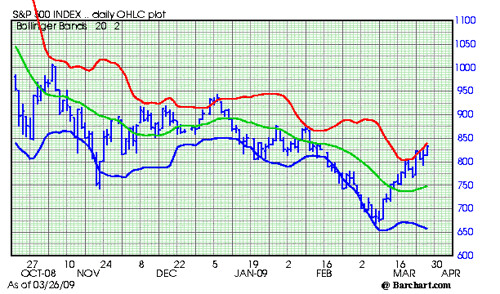
S and P 500 March 26 Close
S and P 500 Chart 3262


On March 7, we showed the Monthly Chart of the S and P 500 and wrote,
You can see the slope of the market is very severe. This cannot be sustained much longer. When a market index trades down at a sharp angle like the one above, the market always rallies sharply when it reverses directions. This rally could start at any time.
The Market closed at 676.53 on March 6, and the big rally started the next day. On March 22 we wrote, Stocks Don't Fight the Tape, and the market blasted off the next day.

The market looks very good and continues to hug the red line on the way up (two standard deviations above the line). However, any sharp rally tomorrow will be met with stiff resistance. We will update the numbers in the morning.

Also, a note of cautions. The slope of the uptrend is getting too severe and the market will be subject to a sharp correction if this continues.

Subscribe to All American Investor via Email


Bob DeMarco is a citizen journalist and twenty year Wall Street veteran. Bob has written more than 500 articles with more than 11,000 links to his work on the Internet. Content from All American Investor has been syndicated on Reuters, the Wall Street Journal, Fox News, Pluck, Blog Critics, and a growing list of newspaper websites. Bob is actively seeking syndication and writing assignments.

Follow All American Investor on Twitter
More from All American Investor


Text of Tim Geithner’s Testimony on Regulating Risk


This is the full text of Geithner's statement. It is separated by section to make it easy to navigate and to locate parts of greatest interest.

Credit Default Swaps and Other OTC Derivatives

Let me be clear: the days when a major insurance company could bet the house on credit default swaps with no one watching and no credible backing to protect the company or taxpayers from losses must end.

In our proposed regulatory system, the government will regulate the markets for credit default swaps and over-the-counter derivatives for the first time.
Subscribe to All American Investor via Email


Text of Geithner’s Testimony on Regulating Risk


Text of U.S. Treasury Secretary Timothy Geithner’s testimony on regulating financial risk before the House Financial Services Committee on Thursday.

Introduction
Thank you Chairman Frank, Ranking Member Bachus, and other members of the Committee. I appreciate the opportunity to testify about the critical topic of financial regulatory reform.

Over the past 18 months, we have faced the most severe global financial crisis in generations. Some of the world’s largest financial institutions have failed. Equity and real estate prices have fallen sharply, eroding the value of our savings. The supply of credit has tightened dramatically. Confidence in the overall financial system, in the protections it is supposed to afford for investors and consumers, has eroded. These financial pressures have intensified the recession now underway around the world.

And as in any financial crisis, the damage falls on Main Street. It affects the vulnerable. It affects those who were conservative and responsible, not just those who took too much risk.

Our system is wrapped today in extraordinary complexity, but beneath all that, financial systems serve an essential and basic function. Financial institutions and markets transform the earnings and savings of American workers into the loans that finance a home, a new car or a college education. They exist to allocate savings and investment to their most productive uses.

Our financial system does this better than any other financial system in the world, but our system failed in basic fundamental ways. The system proved too unstable and fragile, subject to significant crises every few years, periodic booms in real estate markets and in credit, followed by busts and contraction. Innovation and complexity overwhelmed the checks and balances in the system. Compensation practices rewarded short-term profits over long-term return. We saw huge gains in increased access to credit for large parts of the American economy, but those gains were overshadowed by pervasive failures in consumer protection, leaving many Americans with obligations they did not understand and could not sustain. The huge apparent returns to financial activity attracted fraud on a dramatic scale. Large amounts of leverage and risk were created both within and outside the regulated part of the financial system.

These failures have caused a great loss of confidence in the basic fabric of our financial system, a system that over time has been a tremendous asset for the American economy.

To address this will require comprehensive reform. Not modest repairs at the margin, but new rules of the game. The new rules must be simpler and more effectively enforced and produce a more stable system, that protects consumers and investors, that rewards innovation and that is able to adapt and evolve with changes in the financial market.

On February 25, after meeting with the banking and financial services leadership from Congress, President Obama directed his economic team to develop recommendations for financial regulatory reform and to begin the process of working with the Congress on 1
new legislation. The Treasury Department has been working with the President’s Working Group on Financial Markets (PWG) to develop a comprehensive plan of reform. This effort has been and will be guided by principles the President set forth earlier this year and in his speech as a candidate at Cooper Union in March 2008.

Financial institutions and markets that are critical to the functioning of the financial system and that could pose serious risks to the stability of the financial system need to be subject to strong oversight by the government. Our financial system and the major centralized markets must be strong and resilient enough to withstand very severe shocks and the failure of one or more large institutions. We need much stronger standards for openness, transparency, and plain, common sense language throughout the financial system. And we need strong and uniform supervision for all financial products marketed to consumers and investors, and tough enforcement of the rules to ensure full accountability for those who violate the public trust.

Financial products and institutions should be regulated for the economic function they provide and the risks they present, not the legal form they take. We can’t allow institutions to cherry pick among competing regulators, and shift risk to where it faces the lowest standards and constraints.

And we need to recognize that risk does not respect national borders. We need to prevent national competition to reduce standards and encourage a race to higher standards. Markets are global and high standards at home need to be complemented by strong international standards enforced more evenly and fairly. These are global markets and challenges. Building on these principles, we want to work with Congress to put in place fundamental reforms that create a stronger, more stable system, with much stronger protections for consumers and investors, and a more streamlined, consolidated, and simple oversight framework.

I want to begin that process today by focusing on proposals that are essential to creating a more stable system, with stronger tools to prevent and manage future crises. In this context, my objective is to concentrate on the substance of the reform agenda, rather than the complex and sensitive questions of who should be responsible for what.

Over the next few weeks we will outline proposals in the areas of consumer and investor protection and for reform of regulatory oversight arrangements.

We start with systemic risk, not just because of its obvious importance to our future economic performance, but also because these issues require more cooperation globally, and they will be at the center of the agenda at the upcoming Leaders’ Summit of the G-20 in London on April 2.

These proposals reflect a range of complex and consequential policy choices. They will require careful work and drafting. It is important that we get this right. We recognize there will be many alternative models put forth to achieve the objective we all share of creating a more stable system. And we look forward to working with the Federal Reserve, with the agencies that make up the President’s Working Group on Financial Markets, and with the Congress on a package of reforms that we can all support.

The Crisis and Its Fundamental Causes
The current crisis had many causes.

Two decades of sustained economic growth bred widespread complacency among financial intermediaries and investors, lowering borrowing costs and weakening lending standards.

A global boom in savings resulted in large flows of capital into the United States and other markets, pushing down long-term interest rates and pushing up asset prices. The rising market hid Ponzi schemes and other flagrant abuses that should have been detected and eliminated.

In that environment, institutions and investors looked for higher returns by taking on greater exposure to the risk of infrequent but severe losses.

A long period of home price appreciation encouraged borrowers, lenders, and investors to make choices that could only succeed if home prices continued to appreciate. We had a system under which firms encouraged people to take unwise risks on complicated products, with ruinous results for them and for our financial system.

Market discipline failed to constrain dangerous levels of risk-taking throughout the financial system. New financial products were created to meet demand from investors, and the complexity outmatched the risk-management capabilities of even the most sophisticated financial institutions. Financial activity migrated outside the banking system, relying on the assumption that liquidity would always be available.

Regulated institutions held too little capital relative to the risks to which they were exposed. And the combined effects of the requirements for capital, reserves and liquidity amplified rather than dampened financial cycles. This worked to intensify the boom and magnify the bust.

Supervision and regulation failed to prevent these problems. There were failures where regulation was extensive and failures where it was absent.

Regulators were aware that a large share of loans made by banks and other lenders were being originated for distribution to investors through securitizations, but they did not identify the risks caused by explosive growth in complex products based on these products.

Investment banks, large insurance companies, finance companies, and the GSEs were subject to only limited oversight on a consolidated basis, despite the fact that many of those companies owned federally insured depository institutions or had other access to explicit or implicit forms of support from the government. Federal law allowed many institutions to choose among regulatory regimes for consolidated supervision and, not surprisingly, they avoided the stronger regulatory authority applicable to bank holding companies. Those companies and others were highly leveraged or used short-term borrowing to buy long-term assets, yet lacked strong federal prudential regulation and routine access to central bank liquidity.

And while supervision and regulation failed to constrain the build up of leverage and risk, the United States came into this crisis without adequate tools to manage it effectively. Until the Housing and Economic Recovery Act and the Emergency Economic Stabilization Act were passed in the summer and fall of 2008, the executive branch had effectively no ability to provide the capital or guarantees necessary to contain the damage caused by the crisis.

And as I discussed before this committee on Tuesday, U.S. law left regulators without good options for managing failures of systemically important non-bank financial institutions.

Regulation of a financial system as complex and dynamic as our system is inherently difficult and challenging. But that difficulty has been compounded by a U.S. regulatory structure that is unnecessarily complex and fragmented. The complexity has sometimes resulted in a failure to assign clear responsibility for achievement of some public policy objectives, notably for financial stability.

Toward a More Stable and Resilient Financial System
Our comprehensive framework for regulatory reform will cover four broad areas: systemic risk, consumer and investor protection, eliminating gaps in our regulatory structure; and international coordination.

In the coming weeks, I will present detailed frameworks for each of these areas. Today, I will discuss in greater detail the need to create tools to identify and mitigate systemic risk, including tools to protect the financial system from the failure of systemically important financial institutions.

Second, weaknesses in our consumer and investor protections harm individuals, undermine trust in our financial system, and can contribute to systemic crises that shake the very foundations of our financial system. The choice of what home mortgage to get or how to save for retirement are some of the most important financial decisions that households make. It is crucial that when households make choices we have clear rules of the road that prevent manipulation and abuse. We must restore integrity to our financial system and strengthen these protections. Consumer and investor protection is a critical component of the President’s regulatory reform plan. We are developing a strong, comprehensive plan for consumer and investor regulation to simplify financial decisions for households and to protect people from unfair and deceptive practices.

We must end the practice of allowing banks and other financial companies to choose their regulator simply by changing their charters; regulators must choose who to regulate. Moreover, our regulatory system must be comprehensive and eliminate gaps in coverage. Our regulatory structure must assign clear regulatory authority, resources, and accountability for each of the key regulatory functions. We must not let turf wars or concerns about the shape of organizational charts prevent us from establishing a substantive system of regulation that meets the needs of the American people.

To match the increasing global markets, we must ensure that global standards for financial regulation are consistent with the high standards we will be implementing in the United States.

The Financial Stability Forum (FSF) has played an essential role in the effort, working with the world’s standard - setting bodies to study the underlying causes of the crises and address these weaknesses. Much progress is being made to enhance sound regulation, strengthen transparency, and reinforce international collaboration.

We have begun to work with international colleagues to reform and strengthen the FSF so that it can play a more effective role alongside the original Bretton Woods institutions in strengthening the financial system. We have already gotten agreement to expand the membership to include all G-20 countries, giving it a stronger mandate for promoting more robust standards consistent with the principles above, and working with the IMF and the World Bank to monitor the implementation of those standards.

In addition, we will launch a new, initiative to address prudential supervision, tax havens, and money laundering issues in weakly regulated jurisdictions. President Obama will underscore in London on April 2 at the Leaders’ Summit the imperative of raising standards across the globe and encouraging a race to the top rather than a race to the bottom.

Reducing Systemic Risk
The crisis of the past 18 months has exposed critical gaps and weaknesses in our regulatory system. As risks built up, internal risk management systems, rating agencies and regulators simply did not understand or address critical behaviors until they had already resulted in catastrophic losses.

This crisis has made clear that certain large, interconnected firms and markets need to be under a more consistent, and more conservative regulatory regime. These standards cannot simply address the soundness of individual institutions, but must also ensure the stability of the system itself. We need to strengthen our system of prudential supervision across the financial sector. We must require that firms build up capital during good economic times so that they have a more robust protection against losses in down times – and can continue to lend to America’s households and businesses big and small. We need to examine our accounting rules to see whether, consistent with investor protection, we can require firms to build up loan loss reserves that look forward and account for losses in downturns. 5

In addition, regulators must issue standards for executive compensation practices across all financial firms. These guidelines should encourage prudent risk-taking, incent a focus on long-term performance of the firm rather than short-term profits, and should not otherwise create incentives that overwhelm risk management frameworks.

The key elements of our plan to address systemic risk are:

First, we need to establish a single entity with responsibility for systemic stability over the major institutions and critical payment and settlement systems and activities.

Second, we need to establish and enforce substantially more conservative capital requirements for institutions that pose potential risk to the stability of the financial system, that are designed to dampen rather than amplify financial cycles.

Third, we should require that leveraged private investment funds with assets under management over a certain threshold register with the SEC to provide greater capacity for protecting investors and market integrity.

Fourth, we should establish a comprehensive framework of oversight, protections and disclosure for the OTC derivatives market, moving the standardized parts of those markets to central clearinghouse, and encouraging further use of exchange-traded instruments.

Fifth, the SEC should develop strong requirements for money market funds to reduce the risk of rapid withdrawals of funds that could pose greater risks to market functioning.

And sixth, we need to establish a stronger resolution mechanism that gives the government tools to protect the financial system and the broader economy from the potential failure of large complex financial institutions.

Systemically Important Financial Firms and Markets
To ensure appropriate focus and accountability for financial stability we need to establish a single entity with responsibility for consolidated supervision of systemically important firms and for systemically important payment and settlement systems and activities.

We can no longer allow major financial institutions to choose among consolidated supervision regimes and regulators or to avoid consolidated supervision entirely. That means we must create higher standards for all systemically important financial firms regardless of whether they own a depository institution, to account for the risk that the distress or failure of such a firm could impose on the financial system and the economy. We will work with Congress to enact legislation that defines the characteristics of covered firms, sets objectives and principles for their oversight, and assigns responsibility for regulating these firms.

In identifying systemically important firms, we believe that the characteristics to be considered should include: the financial system’s interdependence with the firm, the firm’s size, leverage (including off-balance sheet exposures), and degree of reliance on short-term funding, and the firm’s the importance of the firm as a source of credit for households, businesses, and governments and as a source of liquidity for the financial system.

In general, the design and degree of conservatism of the prudential requirements applicable to such firms should take into account the inherent inability of regulators to predict future outcomes.

Capital requirements for these firms must be sufficiently robust to be effective farther into the tails of potential outcomes than capital requirements for other financial firms. And they must be less pro-cyclical, requiring firms to build up substantial capital buffers in good economic times so that they can avoid deleveraging in cyclical downturns.

The single systemic regulator will also need to impose liquidity, counterparty, and credit risk management requirements that are more stringent than for other financial firms. For instance, supervisors should apply more demanding liquidity constraints; and require that these firms are able to aggregate counterparty risk exposures on an enterprise basis within a matter of hours.

The regulator of these entities will also need a prompt, corrective action regime that would allow the regulator to force protective actions as regulatory capital levels decline, similar to that of the FDIC with respect to its covered agencies.

Payment and Settlement Activities
Weaknesses in the settlement systems for key funding and risk transfer markets, notably overnight and short-term lending markets (such as those for tri-party repurchase agreements) and OTC derivatives, have been highlighted as a key mechanism that could spread financial distress between institutions and across borders. While some progress was made in the markets for CDS and other OTC derivatives while I was at the New York Fed, federal authority over such arrangements is incomplete and fragmented, and we have been forced to rely heavily on moral suasion to encourage market participants to strengthen these markets.

We need to give a single entity broad and clear authority over systemically important payment and settlement systems and activities. Where such systems or their participants are already federally regulated, the authority of those federal regulators should be preserved and the single entity should consult and coordinate with those regulators.

Hedge Funds and Other Private Pools of Capital
U.S. law generally does not require hedge funds or other private pools of capital to register with a federal financial regulator, although some funds that trade commodity derivatives must register with the CFTC and many funds register voluntarily with the SEC. As a result, there are no reliable, comprehensive data available to assess whether such funds individually or collectively pose a threat to financial stability. However, in the wake of the Madoff episode it is clear that, in order to protect investors, we must close gaps and weaknesses in regulation of investment advisors and the funds they manage.

Accordingly, we recommend that all advisers to hedge funds (and other private pools of capital, including private equity funds and venture capital funds) with assets under management over a certain threshold be required to register with the SEC. All such funds advised by an SEC-registered investment adviser should be subject to investor and counterparty disclosure requirements and regulatory reporting requirements. The regulatory reporting requirements for such funds should require reporting, on a confidential basis, information necessary to assess whether the fund or fund family is so large or highly leveraged that it poses a threat to financial stability. The SEC should share the reports that it receives from the funds with the entity responsible for oversight of systemically important firms, which would then determine whether any hedge funds could pose a systemic threat and should be subjected to the prudential standards outlined above.

Credit Default Swaps and Other OTC Derivatives
The current financial crisis has been amplified by excessive risk-taking by certain insurance companies and poor counterparty credit risk management by many banks trading Credit Default Swaps (CDS) on asset-backed securities. These complex instruments were poorly understood by counterparties, and the implication that they could threaten the entire financial system or bring down a company of the size and scope of AIG was not identified by regulators, in part because the CDS markets lacked transparency.

Let me be clear: the days when a major insurance company could bet the house on credit default swaps with no one watching and no credible backing to protect the company or taxpayers from losses must end.

In our proposed regulatory system, the government will regulate the markets for credit default swaps and over-the-counter derivatives for the first time.

We will subject all dealers in OTC derivative markets and any other firms whose activities in those markets pose a systemic threat to a strong regulatory and supervisory regime as systemically important firms.

We will force all standardized OTC derivative contracts to be cleared through appropriately designed central counterparties (CCPs). We will also encourage greater use of exchange-traded instruments.

The CCPs will be subject to comprehensive settlement systems supervision and oversight, consistent with the authority outlined above.

We will require that all non-standardized derivatives contracts be reported to trade repositories and be subject to robust standards for documentation and confirmation of trades, netting, collateral and margin practices, and close-out practices.

We will bring unparalleled transparency to the OTC derivatives markets by requiring CCPs and trade repositories to make aggregate data on trading volumes and positions available to the public and make individual counterparty trade and position data available on a confidential basis to federal regulators, including those with responsibilities for market integrity.

Finally, we will strengthen participant eligibility requirements and, where appropriate, introduce disclosure or suitability requirements, and we will require all market participants to meet recordkeeping and reporting requirements.

Money Market Mutual Funds (MMFs)
In the wake of Lehman Brothers’ bankruptcy, we learned that even one of the most stable and least risky investment vehicles - money market mutual funds - was not safe from the failure of a systemically important institution. These funds are subject to strict regulation by the SEC and are billed as having a stable asset value - a dollar invested will always return the same amount. But when a major prime MMF “broke the buck” - lost money - the event sparked sharp withdrawals across the entire prime MMF industry. Those withdrawals resulted in severe liquidity pressures, not only on prime MMFs but also on financial and non-financial companies that relied significantly on MMFs for funding. The vulnerability of MMFs to breaking the buck and the susceptibility of the entire prime MMF industry to sharp withdrawals in such circumstances remains a significant source of systemic risk.

We believe that the SEC should strengthen the regulatory framework around MMFs in order to reduce the credit and liquidity risk profile of individual MMFs and to make the MMF industry as a whole is less susceptible to runs.

Resolution Authority
As I discussed on Tuesday, we must create a resolution regime that provides authority to avoid the disorderly liquidation of any nonbank financial firm whose disorderly liquidation would have serious adverse effects on the financial system or the U.S. economy.

Please note that the draft resolution legislation we have submitted is a first step intended to address a significant void in today’s regulatory structure. This mechanism is intended to be a permanent authority and therefore, will also be a critical element of Treasury’s broader regulatory reform proposals. As we move forward on those proposals, we will need to align the draft legislation with the broader regulatory reform effort as it develops. At this point, however, I will focus on how the authority and mechanism would work within our current regulatory framework.

We must cover financial institutions that have the potential to pose systemic risks to our economy but that are not currently subject to the resolution authority of the FDIC. This would include bank and thrift holding companies and holding companies that control broker-dealers, insurance companies, and futures commission merchants, or any other financial firm posing substantial risk to our economy.

Before any of the emergency measures specified could be taken, the Secretary of the Treasury, upon the positive recommendations of both the Federal Reserve Board and the FDIC and in consultation with the President, would have to make a triggering determination that (1) the financial institution in question is in danger of becoming insolvent; (2) its insolvency would have serious adverse effects on economic conditions or financial stability in the United States; and (3) taking emergency action as provided for in the law would avoid or mitigate those adverse effects.

The Treasury and the FDIC would decide whether to provide financial assistance to the institution or to put it into conservatorship/receivership. This decision will be informed by the recommendations of the Federal Reserve Board and the appropriate federal regulatory agency (if different from the FDIC). The U.S. government would be permitted to utilize a number of different forms of financial assistance in order to stabilize the institution in question. These include making loans to the financial institution in question, purchasing its obligations or assets, assuming or guaranteeing its liabilities, and purchasing an equity interest in the institution.

This authority is modeled on the resolution authority that the FDIC has under current law with respect to banks and that the Federal Housing Finance Agency has with regard to the GSEs. Here, conservatorships or receiverships aim to minimize the impact of the potential failure of the financial institution on the financial system and consumers as a whole, rather than simply addressing the rights of the institution’s creditors as in bankruptcy.

Depending on the circumstances, the FDIC and the Treasury would place the firm into conservatorship with the aim of returning it to private hands or a receivership that would manage the process of winding down the firm. The trustee of the conservatorship or receivership would have broad powers, including to sell or transfer the assets or liabilities of the institution in question, to renegotiate or repudiate the institution’s contracts (including with its employees), and to deal with a derivatives book. A conservator would also have the power to fundamentally restructure the institution by, for example, replacing its board of directors and its senior officers. None of these actions would be subject to the approval of the institution’s creditors or other stakeholders.

The proposed legislation would create an appropriate mechanism to fund the appropriately limited exercise of the resolution authorities it confers. This could take the form of a mandatory appropriation to the FDIC out of the general fund of the Treasury (subject to all the restrictions on the use of appropriated funds, including apportionments under the Anti-Deficiency Act), and/or through a scheme of assessments, ex ante or ex 10 11

post, on the financial institutions covered by the legislation. The government would also receive repayment from the redemption of any loans made to the financial institution in question, and from the ultimate sale of any equity interest taken by the government in the institution. The Deposit Insurance Fund will not be used to fund such assistance.

Conclusion
The President has made clear that we will do what is necessary to stabilize the financial system and restore the conditions for economic growth. Working closely with the Congress, we have moved quickly and with forceful action to help get people back to work and the economy growing again. With your help we are also moving to repair the financial system so that it works for, rather than against, recovery.

Comprehensive regulatory reform is critical to these efforts. In the coming days and weeks, we will continue to lay out the steps we must take to protect against systemic risk. We will also lay out a detailed framework for stronger rules to protect consumers and investors against fraud and abuse.

Next week I will join President Obama in London for the G-20 leaders meeting to build support - with the help of other interested nations and strengthened international bodies -for higher global standards for financial regulation.

We are a strong and resilient country. We came into the current crisis without the authority and tools we needed to contain the damage to the economy from the financial crisis. We are moving to ensure that we are equipped with both in the future, and in the process, that we modernize our 20th century regulatory system meet 21st century financial challenges.

Bob DeMarco is a citizen journalist and twenty year Wall Street veteran. Bob has written more than 500 articles with more than 11,000 links to his work on the Internet. Content from All American Investor has been syndicated on Reuters, the Wall Street Journal, Fox News, Pluck, Blog Critics, and a growing list of newspaper websites. Bob is actively seeking syndication and writing assignments.

Follow All American Investor on Twitter
More from All American Investor