Thursday, November 26, 2009

How Little We Know: The Challenges of Financial Reform


Good read.

To read this article --go here.

Subscribe to All American Investor via Email

Kindle: Amazon's 6" Wireless Reading Device


Original content Bob DeMarco, All American Investor

Happy Thanksgiving to All


Happy Thanksgiving.

Bob

Original content Bob DeMarco, Alzheimer's Reading Room

Thursday, November 19, 2009

Medivation Starts New Clinical Trials for Alzheimer's -- Dimebon


I wanted to bring this into you awareness

Full disclosure: I am in the process of determining if my mother is a candidate for the Dimebon with Namenda clinical trial. Protocol Number: B1451006

No Dimebon clinical data exist yet in patients with disease that has advanced to the moderate-to-severe stage. Therefore, this study evaluates the safety and efficacy of Dimebon in patients with moderate-to-severe Alzheimer's disease who are receiving existing background therapy with memantine (namenda).
Subscribe to The Alzheimer's Reading Room--via Email


MDVN Starts New Alzheimer’s Trials

Earlier this month, Medivation, Inc. (MDVN - Analyst Report) and Pfizer, Inc. (PFE - Analyst Report) initiated two phase III studies, CONTACT and CONSTELLATION, with Dimebon in patients with moderate-to-severe Alzheimer's disease (AD). Dimebon is being developed in collaboration with Pfizer for the treatment of Alzheimer’s and Huntington diseases.

The CONTACT study will assess the potential benefits of adding Dimebon to ongoing treatment with Pfizer’s Aricept on neuropsychiatric symptoms and activities of daily living. Meanwhile, the CONSTELLATION study will evaluate the effects of adding Dimebon to Forest Lab’s (FRX - Analyst Report) Namenda, another standard of care, on cognition, memory and activities of daily living.

Preclinical studies indicate that Dimebon has the potential to protect brain cells from damage and enhance brain cell survival, by stabilizing and improving mitochondrial function. Dimebon’s mechanism is distinct from currently available Alzheimer’s medications.

Dimebon is currently in seven studies which are evaluating the safety and efficacy of the candidate across all stages of Alzheimer's disease, both as monotherapy as well as in combination with currently available Alzheimer's treatments, and in Huntington disease.

Dimebon’s unique mechanism of action and efficacy seen in clinical trials could make it a significant player in the worldwide Alzheimer’s market, which represents huge commercial potential. It is estimated that the market is currently worth about $5 billion.

Dimebon has successfully completed the first of two pivotal trials required to gain marketing approval in the U.S. for mild-to-moderate Alzheimer’s disease. A second confirmatory phase III study, CONNECTION, is currently ongoing. We expect to see top-line results from this study in the first half of 2010. Positive results should allow Medivation to go ahead with the filing of the new drug application (NDA) for the Alzheimer’s indication in 2011.

We currently have a Neutral recommendation on Medivation.

All of the above investment information is from Zacks investment research. It does not represent any opinion on our part.

To read more about Medivation and Dimebon -- go here.

Popular articles on the Alzheimer's Reading Room

The Alzheimer's Action Plan: The Experts' Guide to the Best Diagnosis and Treatment for Memory Problems


Bob DeMarco is the editor of the Alzheimer's Reading Room and an Alzheimer's caregiver. The Alzheimer's Reading Room is the number one website on the Internet for news, advice, and insight into Alzheimer's disease. Bob has written more than 950 articles with more than 8,000 links on the Internet. Bob resides in Delray Beach, FL.

Original content Bob DeMarco, Alzheimer's Reading Room

Wednesday, November 18, 2009

Housing Starts New Privately Owned Housing Units Started (Chart)


New Residential Construction. U.S. Department of Commerce. Thousand of units.

529,000 versus versus 2,207,000, February, 2005


Subscribe to All American Investor via Email
Kindle: Amazon's 6" Wireless Reading Device


Original content Bob DeMarco, All American Investor

50 Year Low Privately Owned Housing Starts: 5-Unit Structures or More (Chart)


48,000 units versus 1,000,000 March, 1973.


Subscribe to All American Investor via Email


Kindle: Amazon's 6" Wireless Reading Device


Original content Bob DeMarco, All American Investor

CONSUMER PRICE INDEX (Chart and Text) OCTOBER 2009


On a seasonally adjusted basis, the Consumer Price Index for All Urban Consumers (CPI-U) rose 0.3 percent in October, the U.S. Bureau of Labor Statistics reported today.

The index has decreased 0.2 percent over the last 12 months on a not seasonally adjusted basis.


Subscribe to All American Investor via Email


The seasonally adjusted all items increase largely reflected advances in the indexes for energy and for new and used motor vehicles. The energy index rose for the fifth time in the last six months, advancing 1.5 percent as the indexes for gasoline, fuel oil, natural gas, and electricity all increased.

The index for all items less food and energy rose 0.2 percent in October, the same increase as in September.

The indexes for used cars and trucks and for new vehicles both rose sharply and together they accounted for over 90 percent of the increase in the index for all items less food and energy.

The indexes for airline fares and medical care also increased, while the shelter index was unchanged and the indexes for apparel and recreation declined.

The food index also increased in October, rising 0.1 percent after declining in two of the previous three months. The index for food away from home increased slightly, while the food at home index was unchanged. Within the food at home group, the index for dairy and related products rose significantly, while the fruits and vegetables index declined for the fourth straight month.

Consumer Price Index Data for October 2009

Food

The food index rose 0.1 percent in October after declining 0.1 percent in September. The index for food away from home increased 0.1 percent while the food at home index was unchanged. Within the food at home group, the index for dairy and related products rose 1.0 percent in October after a 0.5 percent increase in September, and the index for other food at home advanced 0.3 percent. These increases were offset by a 0.7 percent decline in the fruits and vegetables index and 0.2 percent decreases in the indexes for meats, poultry, fish, and eggs and for nonalcoholic beverages. The index for cereals and bakery products was unchanged in October. Over the past 12 months, the food index has declined 0.6 percent with the food at home index down 2.8 percent.

Energy

The energy index rose 1.5 percent in October after increasing 0.6 percent in September. The index for energy commodities rose 1.9 percent, with the gasoline index increasing 1.6 percent. (Before seasonal adjustment, gasoline prices fell 0.8 percent in October.) The index for fuel oil rose 6.3 percent. The index for energy services, which increased 0.1 percent in September, rose 0.9 percent in October. The electricity index increased 0.6 percent while the index for natural gas rose 1.9 percent in October after declining 1.7 percent in September. Over the past 12 months, the energy index has fallen 14.0 percent with the gasoline index declining 17.9 percent.

All items less food and energy

The index for all items less food and energy rose 0.2 percent in October, the same increase as in September. Most of the advance was due to increases in transportation indexes. The new vehicles index rose 1.6 percent and the index for used cars and trucks rose 3.4 percent, its third consecutive substantial increase.

The index for airline fares rose for the fourth straight month, increasing 1.7 percent in October.

Outside of the transportation group, the changes within all items less food and energy were largely modest.

The medical care index rose 0.2 percent in October after increasing 0.4 percent in September.

The shelter index was unchanged in October, as it was in September. The rent index decreased 0.1
percent, the index for owners’ equivalent rent was unchanged, and the index for lodging away from home rose 0.4 percent.

Posting declines in October were the indexes for recreation and apparel, which both fell 0.4 percent. For the past 12 months, the index for all items less food and energy has risen 1.7
percent.

Kindle: Amazon's 6" Wireless Reading Device


Original content Bob DeMarco, All American Investor

Tuesday, November 17, 2009

Producer Price Index Graph 1117


The Producer Price Index for Finished Goods advanced 0.3 percent in October, seasonally adjusted, the U.S. Bureau of Labor Statistics reported today.

This increase followed a 0.6-percent decline in September and a 1.7-percent rise in August.

In October, at the earlier stages of processing, prices received by manufacturers of intermediate goods moved up 0.3 percent and the crude goods index increased 5.4 percent.

On an unadjusted basis, from October 2008 to October 2009, prices for finished goods fell 1.9 percent, the eleventh consecutive month of year-over-year declines.


Subscribe to All American Investor via Email

Kindle: Amazon's 6" Wireless Reading Device


Original content Bob DeMarco, All American Investor

Real Retail and Food Services Sales Still Dropping (Graph)


This should be disconcerting to investors. Could be an indication of storm clouds on the horizon.


Subscribe to All American Investor via Email

Kindle: Amazon's 6" Wireless Reading Device


Original content Bob DeMarco, All American Investor

Saturday, November 14, 2009

Ten Year Treasury Constant Maturity (Chart)


Subscribe to All American Investor via Email

Kindle: Amazon's 6" Wireless Reading Device


Original content Bob DeMarco, All American Investor

Friday, November 13, 2009

M2, Money Supply 11-13 (Graph)


Ready to go off the chart. I'll get some bigger chart paper.


M2 includes a broader set of financial assets held principally by households. M2 consists of M1 plus:

(1) savings deposits (which include money market deposit accounts, or MMDAs);
(2) small-denomination time deposits (time deposits in amounts of less than $100,000); (3) balances in retail money market mutual funds (MMMFs).

Seasonally adjusted M2 is computed by summing savings deposits, small-denomination time deposits, and retail MMMFs, each seasonally adjusted separately, and adding this result to seasonally adjusted M1.
Subscribe to All American Investor via Email


Kindle: Amazon's 6" Wireless Reading Device


Original content Bob DeMarco, All American Investor

U.S. IMPORT AND EXPORT PRICE INDEXES – OCTOBER 2009


The U.S. Import Price Index rose 0.7 percent in October, the U.S. Bureau of Labor Statistics reported today, led by a 1.8 percent increase in fuel prices.

The rise followed a 0.2 percent increase in September. U.S. export prices advanced 0.3 percent in October after decreasing 0.2 percent the previous month.

Subscribe to All American Investor via Email


All Imports: The increase in U.S. imports in October continued the recent upward trend for the index.

Import prices have risen in seven of the past eight months and were up 8.1 percent over that period. Despite the recent increases, import prices declined 5.7 percent for the year ended in October driven by a 12.8 percent drop in prices between October 2008 and January 2009.

Fuel Imports: Prices for import fuel advanced 1.8 percent in October after a 1.5 percent decline the previous month. A 24.1 percent increase in natural gas prices led the overall advance in October, while petroleum prices were also a contributing factor, advancing 0.9 percent.

However, the price indexes for natural gas and petroleum both declined over the past year, falling 46.4 percent and 12.2 percent, respectively.

All Imports Excluding Fuel: Nonfuel import prices rose 0.4 percent in October as higher prices for industrial supplies and materials, finished goods, and foods, feeds, and beverages all contributed to the advance. Prices for nonfuel imports rose between 0.4 percent and 0.5 percent in each of the past three months, the largest monthly advances since a 0.6 percent increase in July 2008.

The index declined 2.9 percent over the past 12 months as sharp decreases at the end of 2008 more than offset the recent rises.

Source of information BLS

Kindle: Amazon's 6" Wireless Reading Device


Original content Bob DeMarco, All American Investor

Wednesday, November 11, 2009

Monetary Policy Outlook -- RGE Monitor


While RGE leans towards the U-shaped camp, we do not expect risky assets to invert their course as long as the Federal Reserve commits to maintaining “exceptionally low levels of the federal funds rate for an extended period.” So the policy dilemma is one of having to maintain “exceptionally low rates” given the still very difficult real economic conditions, but with the danger of an increasing disconnect between risky asset valuations and the economy–which could eventually snap back and compromise economic and financial stability in the medium term.
Subscribe to All American Investor via Email

From the RGE Monitor


In this week’s note, we take a look at some recent monetary policy trends in advanced economies. This content is excerpted from a longer piece, “Global Monetary Policy Review,” which includes in-depth analysis of when the world’s emerging markets might shift interest rate strategy. This longer piece is available exclusively for the use of RGE’s clients.

Last week was a busy one for the Federal Reserve (Fed), the European Central Bank (ECB) and the Bank of England (BoE). Policymaking is tricky when different asset classes are sending very different signals about the economy. However, those different signals are themselves a byproduct of policy. In the U.S., bond markets are discounting a sluggish U-shaped recovery or even a double-dip recession, while risky markets are signaling a strong V-shaped recovery ahead. Which is right?

While RGE leans towards the U-shaped camp, we do not expect risky assets to invert their course as long as the Federal Reserve commits to maintaining “exceptionally low levels of the federal funds rate for an extended period.” So the policy dilemma is one of having to maintain “exceptionally low rates” given the still very difficult real economic conditions, but with the danger of an increasing disconnect between risky asset valuations and the economy–which could eventually snap back and compromise economic and financial stability in the medium term. While this environment reignites the debate on whether central banks should target asset prices or not, RGE maintains that Fed fund hikes are a story for end of 2010 or Q1 2011.

The Bank of England kept its rate on hold at 0.5% for the 8th consecutive month in November with another hold almost certain in December. As the UK economy failed to pull out of recession in Q3 2009, a rise in interest rates is unlikely to occur before Q2 2010; a view supported by evidence in the money markets. The Monetary Policy Committee did move to increase the program of quantitative easing, asking the Chancellor of the Exchequer, Alistair Darling, for an extra £25 billion to be pumped into the economy, bringing the total amount to £200 billion. With interest rates remaining at a historically low level and public finances precarious, quantitative easing has replaced traditional monetary and fiscal policy as the favoured tool of policy makers. The extra £25 billion is likely to act as the final push with the Bank of England attempting to revive an economy operating with spare capacity. It is unlikely that any further increase in quantitative easing will occur, barring a severe economic shock.

The ECB, meanwhile, stayed on hold at 1.0% in November. ECB president Jean-Claude Trichet expressed concern over the excess volatility and strength of the U.S. dollar. Nonetheless, further rate cuts seem unnecessary as signs of economic stabilization and a deceleration of deflation have emerged. Broad money supply growth continues to decelerate and credit to households and non-financial businesses is contracting. The ECB will continue conducting the QE operations it started July 6, but December may be the last tender for its 12-month refinancing operation. Trichet signaled as much, saying "not all our liquidity measures will be needed to the same extent as in the past."

While global monetary policy easing was synchronized, tightening does not need to be. Australia embarked on its rate tightening phase earlier than other developed world central banks. It raised rates twice, in October and November, by 25 basis points each. Australia avoided a recession in 2009 thanks to commodity restocking and prompt fiscal and monetary easing. Australia will likely remain on a gradual easing path, however, until the strength and sustainability of its recovery becomes clearer. Extra government subsidies for home purchases sparked a buying boom that raised Australia's mortgage debt level to a new high. The expiry of those subsidies at the end of 2009 and the increases in interest rates could restrain the recovery of domestic demand. On the other hand, recovering export demand and the expansion of a Treasury program to buy resident MBS may help offset the decline in direct support to home buyers.

Following in the footsteps of the Reserve Bank of Australia, which was the first among advanced economies to hike rates, Norges Bank (Norway's central bank) recently increased its key policy rate by 0.25 percentage points to 1.5%. The executive board's strategy sets the key policy rate interval at 1.25% - 2.25% until its meeting in March 2010. Given the Norwegian economy's mild downturn and strong recovery prospects, monetary tightening was expected. Norges Bank cautioned that a stronger krone could slow its expected pace of rate increases.

In October, the Bank of Japan (BoJ) adjusted its policy to reflect the modest improvements in credit markets and the economy. Due to thawing corporate credit markets and very weak demand at the BoJ's special facilities to purchase corporate bonds and commercial paper, the Bank of Japan decided to allow those programs to expire at the end of 2009 as planned. Further purchases would only distort corporate debt pricing as liquidity returns to the market. As a safety precaution against potential disruptions to corporate credit for businesses that cannot access market funding, the Bank of Japan extended until March 2010 its program to offer unlimited low interest rate loans to banks, collateralized with corporate debt. However, at the behest of the Ministry of Finance, the Bank of Japan will keep purchasing government debt. Like other central banks that engaged heavily in unconventional easing, the BoJ will roll back its targeted easing programs before resorting to the blunter tool of rate hikes. The BoJ reiterated its view that deflation will grip Japan until 2011, hence the policy rate will likely stay on hold throughout 2010. See Bank of Japan's Exit from Monetary Easing: Strategies and Timing.

After having to hike interest rates aggressively in the 2006– 2008 period, most central banks from emerging market economies had to undo them rapidly from the end of 2008 to Q3 2009, as output gaps widened significantly and inflation and inflation expectations collapsed as a result of the global crisis. Moreover, currencies experienced strong appreciating pressures from the end of Q1 2009 onwards, facilitating the dovish monetary policy reaction. Now that the worst of the global crisis seems to have past, macroeconomic policies are loose, and economic activities are healing, central banks are facing the difficult task of carefully implementing exit strategies, while avoiding exacerbating appreciative pressures on their currencies and trying to control asset inflation and bubbles.

Asian central banks will be the first among emerging markets to tighten monetary policy as capital inflows and loose policies since late 2008 are raising liquidity and asset inflation. But goods inflation will remain within the central banks’ target in most countries amid a slow recovery in domestic demand, weak credit growth in Asia ex-China, and an output gap. This will delay interest rate hikes into 2010, especially in the export-dependent economies, and constrain aggressive tightening until domestic and external demand improve further. Until then, Asian central banks will continue to fight credit and asset bubbles via liquidity absorption and regulatory and prudential measures, such as in real estate. Countries that are less export-dependent and have attractive asset markets—India, South Korea and Indonesia—will be the first ones to hike rates and allow currency appreciation. In November 2009, Taiwan banned foreign inflows in time deposits and might resort to further capital controls. If hot inflows maintain their momentum, other Asian countries might use enforcement or regulatory measures to manage capital flows.

In Latin America, there is a marked differentiation on the speed of the economic recovery; however, most countries will experience slow closing of the output gaps over the next year. Moreover, stable if not strong currencies (BRL, CLP, COP, MXN, and PEN) and limited upward wage pressures should help in containing probable external supply-side shocks emerging from commodity prices and limit inflationary pressures sparked by recovering domestic demand. Although inflation and inflation expectations will bounce back, central banks will most likely achieve their inflation targets in 2010. Nevertheless, monetary authorities will start moving away from a very loose monetary policy stance toward a neutral one in 2010 in order to safeguard medium-term inflation expectations once the recovery has gained momentum. In this light, central banks mainly will target the monetary policy rate. However, upward adjustment in other monetary policy instruments (reserve requirements and margin reserve requirements) will likely be implemented. Those central banks that have acted the most aggressively and face potential surprises to the upside in growth and inflation will initiate the mapping out of excessive accommodation sooner than the rest.

Rate hikes in Central and Eastern European (CEE) countries are expected to lag those in other emerging market regions given the particularly sharp downturn in the CEE and prospects for a weak recovery. Many central banks are still in easing mode, amid economic contractions and easing inflation. Uneven growth prospects across the region mean monetary policy paths will vary.

Aside from Israel, which in August became the first country globally to begin raising interest rates, Middle East and Africa will remain effectively on hold until late in 2010. Most of the GCC countries peg to the U.S. dollar and thus import U.S. monetary policy. Meanwhile despite the inflationary impact of a weak dollar, tight domestic credit conditions will restrain a liquidity surge.

* As of Sept. 30, only 100 billion yen of commercial paper (CP) was offered for the BoJ to purchase - just 3% of the 3 trillion yen allocated by the BoJ for the CP purchasing program. Only 300 billion yen of corporate bonds was offered for the BoJ to purchase - just 30% of 1 trillion yen allocated for the corporate bond purchasing program.

Kindle: Amazon's 6" Wireless Reading Device


Original content Bob DeMarco, All American Investor

Tuesday, November 10, 2009

Net Free or Borrowed Reserves, Beam Me Up Scotty (Graph)


FED continues to add fuel. $885 Billion is a new all time high.


The series is calculated by the Federal Reserve Bank of St.Louis.


Subscribe to All American Investor via Email


Kindle: Amazon's 6" Wireless Reading Device


Original content Bob DeMarco, All American Investor

Sunday, November 08, 2009

Bear Stearns Trash Still in the FED Roach Motel (Graph)


On June 26, 2008, the Federal Reserve Bank of New York (FRBNY) extended credit to Maiden Lane LLC under the authority of section 13(3) of the Federal Reserve Act. This limited liability company was formed to acquire certain assets of Bear Stearns and to manage those assets through time to maximize repayment of the credit extended and to minimize disruption to financial markets.


Subscribe to All American Investor via Email

Kindle: Amazon's 6" Wireless Reading Device


Original content Bob DeMarco, All American Investor

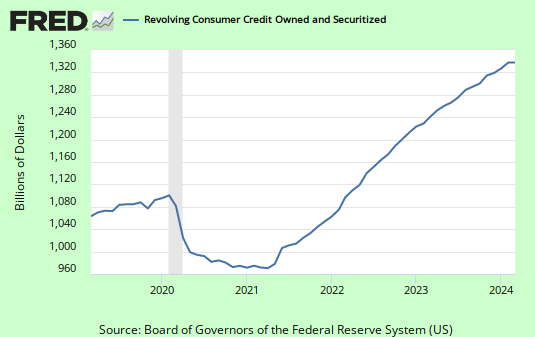
Consumer Credit -- Total Revolving Credit Outstanding (Graph)


Covers most short- and intermediate-term credit extended to individuals, excluding loans secured by real estate....

Subscribe to All American Investor via Email
Kindle: Amazon's 6" Wireless Reading Device

Unemployed for 27 Weeks or Longer Still Climbing (Graph)


5,594,000 versus 2,275,000 a year ago. In October, 35.6 percent of unemployed persons were jobless for 27 weeks or more.


Subscribe to All American Investor via Email


Bob DeMarco is a citizen journalist and twenty year Wall Street veteran. Bob has written more than 950 articles with more than 8,000 links to his work on the Internet. Content from All American Investor has been syndicated on Reuters, the Wall Street Journal, Fox News, Pluck, Blog Critics, and a growing list of newspaper websites. Bob is actively seeking syndication and writing assignments.

Kindle: Amazon's 6" Wireless Reading Device


Original content Bob DeMarco, All American Investor

Friday, November 06, 2009

Civilian Unemployment Rate Jumps to 10.2 Percent (Graph)


In October, the unemployment rate rose to 10.2 percent, the highest rate since April 1983, and nonfarm payroll employment declined by 190,000.

Since the start of the recession, payroll employment has fallen by 7.3 million.


Job losses have averaged 188,000 over the past 3 months.

The employment-population ratio continued to decline in October, falling to 58.5 percent.


Subscribe to All American Investor via Email
Kindle: Amazon's 6" Wireless Reading Device

Reserve Bank Credit (Graph) - Securities Held Outright - Federal Agency Debt Securities


Up, Up, and Away.


Note: The current face value of federal agency obligations held by Federal Reserve Banks. These securities are direct obligations of Fannie Mae, Freddie Mac, and the Federal Home Loan Banks.
Subscribe to All American Investor via Email
Kindle: Amazon's 6" Wireless Reading Device

Real Unemployment Jumps to 17.5 Percent (Explanation)


The U-6 (Table A-12: Alternative measures of labor under utilization) measures the real rate of unemployment in the United States.

Most news organizations report the more popular U.S. Department of Labor: Civilian Unemployment Rate. If you read the report today you learned that unemployment is 10.2 percent for September.

If you read Table 12 in the Bureau of Labor Statistics report you learned the real unemployment rate is 17.5 percent, not 10.2 percent.
You would also have noticed the real rate of unemployment is 17.5 percent versus 11.1 percent in September 2008.

Real Unemployment U-6 -- 17.5%

There are other groups of unemployed that are not counted in the more popular employment report. The Bureau of Labor Statistics U-6 report includes the unemployed, and those that have thrown in the towel.

The U-6 report includes:

  • Total unemployed
  • plus all marginally attached workers
  • plus total employed part time for economic reasons
In other words,
  • marginally attached workers are persons who currently are neither working nor looking for work, but indicate that they want and are available for a job, and have looked for work sometime in the recent past.
  • Discouraged workers, a subset of the marginally attached, have given a job-market related reason for not looking currently for a job.
The U-6 report counts everyone that is unemployed--officially and unofficially.
Here are some other statistics that you might find disconcerting.

  • About 2.4 million persons were marginally attached to the labor force in October,
    reflecting an increase of 736,000 from a year earlier. (The data are not sea-
    sonally adjusted.) These individuals were not in the labor force, wanted and
    were available for work, and had looked for a job sometime in the prior 12 months.
    They were not counted as unemployed because they had not searched for work in
    the 4 weeks preceding the survey.
  • Among the marginally attached, there were 808,000 discouraged workers in October,
    up from 484,000 a year earlier.
    (The data are not seasonally adjusted.) Dis-
    couraged workers are persons not currently looking for work because they believe
    no jobs are available for them. The other 1.6 million persons marginally attached
    to the labor force in October had not searched for work in the 4 weeks preceding
    the survey for reasons such as school attendance or family responsibilities.
  • The average workweek for production and nonsupervisory workers on private nonfarm
    payrolls was unchanged at 33.0 hours in October. The manufacturing workweek rose
    by 0.1 hour to 40.0 hours, and factory overtime increased by 0.2 hour over the
    month.
  • The number of long-term unemployed (those jobless for 27 weeks and over) was
    little changed over the month at 5.6 million. In October, 35.6 percent of
    unemployed persons were jobless for 27 weeks or more.
  • The civilian labor force participation rate was little changed over the month
    at 65.1 percent. The employment-population ratio continued to decline in
    October, falling to 58.5 percent.
To view this report and the numbers go here.

All of the statistics in this article were sourced from the Department of Labor--Bureau of Labor Statistics.
Subscribe to All American Investor via Email

Original content by Bob DeMarco, All American Investor

Unemployment Leaps to 10.2 Percent (Details)


In October, the unemployment rate rose to 10.2 percent, the highest rate since April 1983, and nonfarm payroll employment declined by 190,000.

Since the start of the recession, payroll employment has fallen by 7.3 million.


Job losses have averaged 188,000 over the past 3 months.

The employment-population ratio continued to decline in October, falling to 58.5 percent.

Since December 2007, payroll employment has fallen by 7.3 million.
Subscribe to EF Hutton via Email

Household Survey Data

In October, the number of unemployed persons increased by 558,000 to 15.7 million. The
unemployment rate rose by 0.4 percentage point to 10.2 percent, the highest rate since April 1983.

Since the start of the recession in December 2007, the number of unemployed persons has risen by 8.2 million, and the unemployment rate has grown by 5.3 percentage points. (See table A-1.)
Among the major worker groups, the unemployment rates for adult men (10.7 percent) and whites
(9.5 percent) rose in October. The jobless rates for adult women (8.1 percent), teenagers (27.6 percent), blacks (15.7 percent), and Hispanics (13.1 percent) were little changed over the month. The unemployment rate for Asians was 7.5 percent, not seasonally adjusted. (See tables A-1, A-2, and A-3.)

The number of long-term unemployed (those jobless for 27 weeks and over) was little changed over
the month at 5.6 million. In October, 35.6 percent of unemployed persons were jobless for 27 weeks or more. (See table A-9.)

The civilian labor force participation rate was little changed over the month at 65.1 percent.

The employment-population ratio continued to decline in October, falling to 58.5 percent. (See table A-1.)

The number of persons working part time for economic reasons (sometimes referred to as involuntary part-time workers) was little changed in October at 9.3 million. These individuals were working parttime because their hours had been cut back or because they were unable to find a full-time job. (See table A-5.)

About 2.4 million persons were marginally attached to the labor force in October, reflecting an
increase of 736,000 from a year earlier. (The data are not seasonally adjusted.) These individuals were not in the labor force, wanted and were available for work, and had looked for a job sometime in the prior 12 months. They were not counted as unemployed because they had not searched for work in the 4 weeks preceding the survey. (See table A-13.)

Among the marginally attached, there were 808,000 discouraged workers in October, up from 484,000 a year earlier. (The data are not seasonally adjusted.) Discouraged workers are persons not currently looking for work because they believe no jobs are available for them. The other 1.6 million persons marginally attached to the labor force in October had not searched for work in the 4 weeks preceding the survey for reasons such as school attendance or family responsibilities.

Establishment Survey Data

Total nonfarm payroll employment declined by 190,000 in October. In the most recent 3 months, job losses have averaged 188,000 per month, compared with losses averaging 357,000 during the prior 3 months. In contrast, losses averaged 645,000 per month from November 2008 to April 2009.

Since December 2007, payroll employment has fallen by 7.3 million. (See table B-1.)

Construction employment decreased by 62,000 in October. Monthly job losses have averaged 67,000 during the most recent 6 months, compared with an average decline of 117,000 during the prior 6 months. October job losses were concentrated in nonresidential specialty trade contractors (-30,000) and in heavy construction (-14,000). Since December 2007, employment in construction has fallen by 1.6 million.

Manufacturing continued to shed jobs (-61,000) in October, with losses in both durable and nondurable goods production. Over the past 4 months, job losses in manufacturing have averaged 51,000 per month, compared with an average monthly loss of 161,000 from October 2008 through June 2009.

Manufacturing employment has fallen by 2.1 million since December 2007.

Retail trade lost 40,000 jobs in October. Employment declines were concentrated in sporting goods, hobby, book, and music stores (-16,000) and in department stores (-11,000). Employment in transportation and warehousing decreased by 18,000 in October.

Health care employment continued to increase in October (29,000). Since the start of the recession, health care has added 597,000 jobs.

Temporary help services has added 44,000 jobs since July, including 34,000 in October.

From January 2008 through July 2009, temporary help services had lost an average of 44,000 jobs per month.

The average workweek for production and nonsupervisory workers on private nonfarm payrolls was
unchanged at 33.0 hours in October. The manufacturing workweek rose by 0.1 hour to 40.0 hours, and factory overtime increased by 0.2 hour over the month. (See table B-2.)

In October, average hourly earnings of production and nonsupervisory workers on private nonfarm
payrolls rose by 5 cents, or 0.3 percent, to $18.72. Over the past 12 months, average hourly earnings have risen by 2.4 percent, while average weekly earnings have risen by only 0.9 percent due to declines in the average workweek. (See table B-3.)

The change in total nonfarm payroll employment for August was rerevised from -201,000 to -154,000, and the change for September was revised from -263,000 to -219,000.

THE EMPLOYMENT SITUATION – OCTOBER 2009, PDF, 29 pages.

Follow All American Investor on Twitter


Kindle: Amazon's 6" Wireless Reading Device