Thursday, May 28, 2009

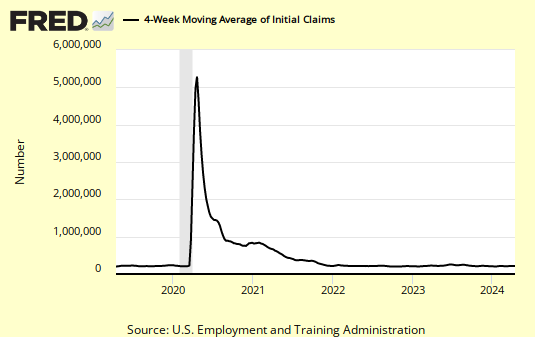
4 Week Average of Unemployment Claims Still Above 600,000 (Chart)


The four week average of unemployment claims remains above 600,000 at 626,750. This makes 16 weeks in a row that the average has remained above 600,000.

Next week we will be taking off 537,539. Any number below that figure will continue the downtrend in this series.


Subscribe to All American Investor via Email

Wednesday, May 27, 2009

Building Permits Drop 50 Percent Year over Year (Chart)


BUILDING PERMITS

Privately-owned housing units authorized by building permits in April were at a seasonally adjusted annual rate of 494,000.

This is 3.3 percent below the revised March rate of 511,000 and is 50.2 percent below the revised April 2008 estimate of 991,000.

Single-family authorizations in April were at a rate of 373,000; this is 3.6 percent above the revised March figure of 360,000.

Authorizations of units in buildings with five units or more were at a rate of 103,000 in April.
Subscribe to All American Investor via Email
Bob DeMarco is a citizen journalist and twenty year Wall Street veteran. Bob has written more than 500 articles with more than 11,000 links to his work on the Internet. Content from All American Investor has been syndicated on Reuters, the Wall Street Journal, Fox News, Pluck, Blog Critics, and a growing list of newspaper websites. Bob is actively seeking syndication and writing assignments.


Kindle: Amazon's Wireless Reading Device (Latest Generation)


Follow All American Investor on Twitter

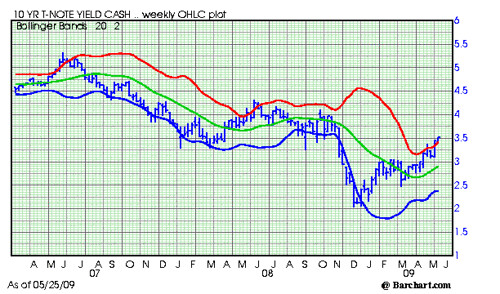
Ten Year Interest Rates Rising (Chart)


Ten Year, Interest Rate View, Chart, Monthly Bar Chart

Ten Year Note 527


The Ten Year Note interest rate continues to rise. Right now, it is somewhat overbought.

Long term interest are on the rise. The FED continues to try and hold interest rates down. This is reflected by the steepening of the yield curve.

The bad news here is that mortgage rates are driven by the ten year yield and are now above five percent.
Subscribe to All American Investor via Email


Bob DeMarco is a citizen journalist and twenty year Wall Street veteran. Bob has written more than 500 articles with more than 11,000 links to his work on the Internet. Content from All American Investor has been syndicated on Reuters, the Wall Street Journal, Fox News, Pluck, Blog Critics, and a growing list of newspaper websites. Bob is actively seeking syndication and writing assignments.


Kindle: Amazon's Wireless Reading Device (Latest Generation)


Follow All American Investor on Twitter

Tuesday, May 26, 2009

U.S.Home Prices Drop to 2002 Level (Chart)


Home prices continued on their record decline.

The S&P/Case-Shiller U.S. National Home Price Index which covers the United States,
  • recorded a 19.1% decline in the first quarter of 2009 versus the first quarter of 2008.
  • This was the largest decline in the 21-year history of tracking this series.
  • The 10-City and 20-City Composites recorded annual declines of 18.6% and 18.7%, respectively.
The chart below shows the index levels for the U.S. National Home Price Index, as well as its annual returns. As of March 2009, average home prices across the United States are at similar levels to what they were in the fourth quarter of 2002. From the peak in the second quarter of 2006, average home prices are down 32.2%.


Source: S&P/Case-Shiller Home Price Indices
Subscribe to All American Investor via Email
Bob DeMarco is a citizen journalist and twenty year Wall Street veteran. Bob has written more than 500 articles with more than 11,000 links to his work on the Internet. Content from All American Investor has been syndicated on Reuters, the Wall Street Journal, Fox News, Pluck, Blog Critics, and a growing list of newspaper websites. Bob is actively seeking syndication and writing assignments.


Kindle: Amazon's Wireless Reading Device (Latest Generation)

Sunday, May 24, 2009

Fed UP UP and Away (Chart)


Net Free and Borrowed Reserves Soaring. M2, Money Supply Soaring. Monetary Base Soaring. Fed Balance sheet Soaring. Nonperforming loans Soaring.

Long term interest rates rising. Mortgage interest rates rising. Stocks topping and weakening. Gold surging.

Bull market in stocks? Not likely in the short term. It is getting more risky by the week.


Subscribe to All American Investor via Email

Bob DeMarco is a citizen journalist and twenty year Wall Street veteran. Bob has written more than 500 articles with more than 11,000 links to his work on the Internet. Content from All American Investor has been syndicated on Reuters, the Wall Street Journal, Fox News, Pluck, Blog Critics, and a growing list of newspaper websites. Bob is actively seeking syndication and writing assignments.

More from All American Investor

Saturday, May 23, 2009

Fed Series M2, Money Supply Still Soaring (Chart)


Fed Data, M2, Money Stock, Chart


We wrote several months ago about how it takes 12-18 months for increases in money supply to effect interest rates and commodity prices. We are now in this window.

The dramatic increases in money supply, the Fed balance sheet, and the drop in the dollar are starting to weigh on investor confidence.

Stocks rarely rise when confidence dwindles. It now seems we are moving from what was growing confidence in the markets to growing uncertainty.

The risk of owning equities on a short term basis not outweighs the reward. The threat of rising interest rates has also risen dramatically. This weeks surge in Gold is another barometer of investor confidence.
Subscribe to All American Investor via Email

Bob DeMarco is a citizen journalist and twenty year Wall Street veteran. Bob has written more than 500 articles with more than 11,000 links to his work on the Internet. Content from All American Investor has been syndicated on Reuters, the Wall Street Journal, Fox News, Pluck, Blog Critics, and a growing list of newspaper websites. Bob is actively seeking syndication and writing assignments.Bob DeMarco, All American Investor, May 2009
Kindle: Amazon's Wireless Reading Device (Latest Generation)


Follow All American Investor on Twitter

Friday, May 22, 2009

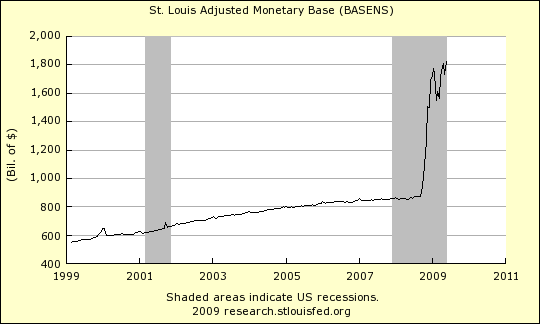
Monetary Base Gushes to New Record High (Graph)


Monetary Base, Chart

The monetary base soared up the last two weeks and is now at an all time high.

We have been discussing the potential for this series to create angst in the market for several months. It is now happening.

Increases in the base, Fed balance sheet, and the coming explosion in Treasury offerings has the market worried about inflation, higher interest rates, and the potential for the downgrade of U. S. debt rating. Uncertainty and angst is now creeping into the stock market and this is a negative development.

Thursday, May 21, 2009

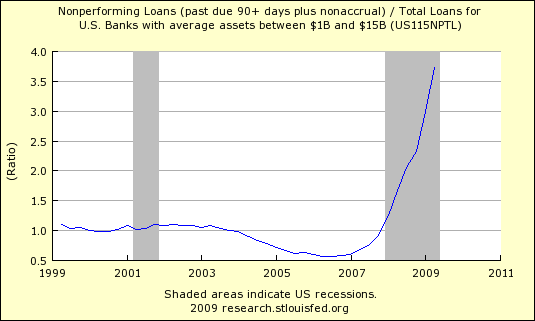
Nonperforming Loans Chart -- Get Under Your Desk


NonPerforming Loans, Banks, Chart

Non Performing Loans 521
Subscribe to All American Investor via Email
When I looked at this chart this thought came to my mind -- get under your desk.

Nonperforming loans have more than doubled, year over year.

Wonder why stocks are shaky and gold is soaring. This is one reason.

This is not the kind of information that creates confidence. When uncertainty creeps into the market, stocks go down.
Bob DeMarco is a citizen journalist and twenty year Wall Street veteran. Bob has written more than 500 articles with more than 11,000 links to his work on the Internet. Content from All American Investor has been syndicated on Reuters, the Wall Street Journal, Fox News, Pluck, Blog Critics, and a growing list of newspaper websites. Bob is actively seeking syndication and writing assignments.


Kindle: Amazon's Wireless Reading Device (Latest Generation)


Follow All American Investor on Twitter

Wednesday, May 20, 2009

Roubini on Gold, China, IMF Sales


Gold is a special commodity in that the fundamentals of physical supply and demand are minor influences on its price. Gold’s price is most often driven by speculative demand for a hedge against inflation or economic uncertainty. Many investors see gold as a substitute for fiat currencies. Consequently, gold prices sometimes track changes in central bank holdings of gold.

Gold markets largely ignored China’s surprise revelation that it had increased its gold reserves as much of this had already been priced in by speculators. Moreover, China produces its own gold. The increase in China's gold holdings is just a mere drop in the bucket of its total $1.9 trillion in foreign exchange reserves. Gold's share in China's foreign exchange reserves remains much lower than the global average and well below the U.S. share. But China's interest in gold is consistent with its taste for real assets to gradually diversify from its U.S. bond-heavy portfolio. If other central banks followed suit, gold demand could increase sharply.

IMF gold sales will likely have little impact on gold prices if it sells its gold to central banks rather than the free market. The European Central Bank Gold Agreement’s expiration in September 2009 may have more impact. The signatories are likely to renew the agreement and continue limiting central bank gold sales. Fears that monetization of rising public debts will erode currency values may spark demand for gold as an inflation hedge.
Source RGE Monitor Newsletter and RGE Monitor
Subscribe to All American Investor via Email
Bob DeMarco is a citizen journalist and twenty year Wall Street veteran. Bob has written more than 500 articles with more than 11,000 links to his work on the Internet. Content from All American Investor has been syndicated on Reuters, the Wall Street Journal, Fox News, Pluck, Blog Critics, and a growing list of newspaper websites. Bob is actively seeking syndication and writing assignments.

More from All American Investor

Kindle: Amazon's Wireless Reading Device (Latest Generation)


Follow All American Investor on Twitter

Tuesday, May 19, 2009

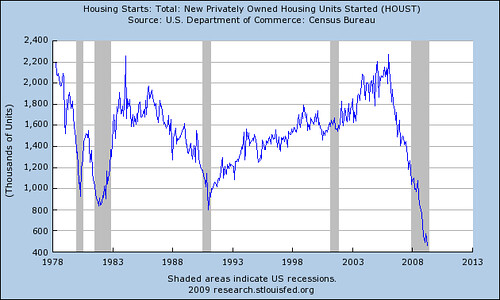
Housing Starts Disaster (Graph)


Housing Starts, Chart

Housing Starts 518

The chart shows the severity of the drop to 458,000 starts. The all time record low for this series dating back to 1959. The chart also compares this cycle to the previous four recession. Not a good picture.

On the hand, it is a disaster. On the other hand, is the glass half full?

The core level of custom houses being built is in the range of 200,000 -- 250,000. These houses are pre-ordered and built to buyer specifications. So, the number of houses being started by building companies is dwindling down toward the 200,000 area.

In the short run, this is bad for the economy. On the other hand, the overhanging supply of houses might get drawn down sooner than expected.
Subscribe to All American Investor via Email
Bob DeMarco is a citizen journalist and twenty year Wall Street veteran. Bob has written more than 500 articles with more than 11,000 links to his work on the Internet. Content from All American Investor has been syndicated on Reuters, the Wall Street Journal, Fox News, Pluck, Blog Critics, and a growing list of newspaper websites. Bob is actively seeking syndication and writing assignments.


Kindle: Amazon's Wireless Reading Device (Latest Generation)

Housing Starts Plunge Year over Year


HOUSING STARTS
  • Privately-owned housing starts in April were at a seasonally adjusted annual rate of 458,000. 
  • This is 12.8 percent below the revised March estimate of 525,000 and is 54.2 percent below the revised April 2008 rate of 1,001,000.
Single-family housing starts in April were at a rate of 368,000; this is 2.8 percent above the revised March figure of 358,000.

The April rate for units in buildings with five units or more was 78,000.

This is the lowest number on record. And, obviously a new low for the down move in housing starts.

Source Census Bureau
Subscribe to All American Investor via Email


Bob DeMarco is a citizen journalist and twenty year Wall Street veteran. Bob has written more than 500 articles with more than 11,000 links to his work on the Internet. Content from All American Investor has been syndicated on Reuters, the Wall Street Journal, Fox News, Pluck, Blog Critics, and a growing list of newspaper websites. Bob is actively seeking syndication and writing assignments.


Monday, May 18, 2009

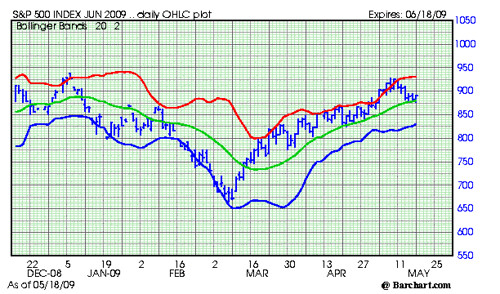
S and P Under Pressure, Holds the Green (Chart)


June S and P Future, Bar, Chart

June S and P Chart 518


The S and P is banging off the green line, the first area of major support. Overnight, the market hit 875.40 which is the top of a major swing point in the market (865 - 875).

The market remains vulnerable, but the hold at this level brings into question which way next.

On the way back up, 895-900 is the critical level. On the way down, 865 is critical.

Short term it appears that the market will remain under pressure for the next two weeks. 

Technical resilance is dwindling and this could be signaling a change in trend to the downside.

The risk reward ratio is not currently favoring short term long positions.
Subscribe to All American Investor via Email


Bob DeMarco is a citizen journalist and twenty year Wall Street veteran. Bob has written more than 500 articles with more than 11,000 links to his work on the Internet. Content from All American Investor has been syndicated on Reuters, the Wall Street Journal, Fox News, Pluck, Blog Critics, and a growing list of newspaper websites. Bob is actively seeking syndication and writing assignments.


More from All American Investor


Follow All American Investor on Twitter

Friday, May 15, 2009

Roubini on the U.S. Dollar and the Chinese Yuan


The Almighty Renminbi?

Now, imagine a world in which China could borrow and lend internationally in its own currency. The renminbi, rather than the dollar, could eventually become a means of payment in trade and a unit of account in pricing imports and exports, as well as a store of value for wealth by international investors. Americans would pay the price. We would have to shell out more for imported goods, and interest rates on both private and public debt would rise. The higher private cost of borrowing could lead to weaker consumption and investment, and slower growth.
Also see Roubini vs. Zhou on the U.S. Dollar and the Chinese Yuan
Subscribe to All American Investor via Email


Bob DeMarco is a citizen journalist and twenty year Wall Street veteran. Bob has written more than 500 articles with more than 11,000 links to his work on the Internet. Content from All American Investor has been syndicated on Reuters, the Wall Street Journal, Fox News, Pluck, Blog Critics, and a growing list of newspaper websites. Bob is actively seeking syndication and writing assignments.


More from All American Investor


Follow All American Investor on Twitter

Thursday, May 14, 2009

Eggs UP, Energy UP, Food UP, PPI UP, Claims UP


The price of fresh eggs jumped 44 percent, the most since records began in 1992.
Energy goods increased 0.7 percent.
The price of food jumped 1.5 percent.
Producer prices (PPI) rose .3 percent.
Initial jobless claims rose by 32,000 to 637,000 in the week ended May 9, from a revised 605,000 the prior week.
Subscribe to All American Investor via Email


The Producer Price Index for Finished Goods increased 0.3 percent in April, seasonally adjusted, the Bureau of Labor Statistics of the U.S. Department of Labor reported today. This rise followed a 1.2-percent decline in March and a 0.1-percent increase in February. At the earlier stages of processing, prices received by producers of intermediate goods moved down 0.5 percent following a 1.5-percent decrease a month earlier, and the crude goods index advanced 3.0 percent after declining 0.3 percent in March.

In the week ending May 9, the advance figure for seasonally adjusted initial claims was 637,000, an increase of 32,000 from the previous week's revised figure of 605,000. The 4-week moving average was 630,500, an increase of 6,000 from the previous week's revised average of 624,500.

The advance seasonally adjusted insured unemployment rate was 4.9 percent for the week ending May 2, an increase of 0.1 percentage point from the prior week's unrevised rate of 4.8 percent.

The advance number for seasonally adjusted insured unemployment during the week ending May 2 was 6,560,000, an increase of 202,000 from the preceding week's revised level of 6,358,000. The 4-week moving average was 6,337,250, an increase of 128,750 from the preceding week's revised average of 6,208,500.

Bob DeMarco is a citizen journalist and twenty year Wall Street veteran. Bob has written more than 500 articles with more than 11,000 links to his work on the Internet. Content from All American Investor has been syndicated on Reuters, the Wall Street Journal, Fox News, Pluck, Blog Critics, and a growing list of newspaper websites. Bob is actively seeking syndication and writing assignments.


More from All American Investor


Follow All American Investor on Twitter

Wednesday, May 13, 2009

Retail Sales a Picture Worth a Thousand Words--UGH (Chart)


Retail sales dropped .4 percent for the month and are down 10.1 percent year over year. Retail sales account for two thirds of GDP. This report is bearish on the market.

There is a strong relationship between GDP and stocks. This report really puts pressure on relative valuations. The risk of owning stocks is mounting as we pointed out last week in our article --They called me crazy, S and P 900-1000 (Part Two)
  • A major retracement to the downside is likely, and is imminent.
  • The bottom line. The risks out weigh the rewards at this level.
The S and P was trading near 925 when we wrote that. Now down 4 percent.

We will update the S and P numbers shortly.


Subscribe to All American Investor via Email
Bob DeMarco is a citizen journalist and twenty year Wall Street veteran. Bob has written more than 500 articles with more than 11,000 links to his work on the Internet. Content from All American Investor has been syndicated on Reuters, the Wall Street Journal, Fox News, Pluck, Blog Critics, and a growing list of newspaper websites. Bob is actively seeking syndication and writing assignments.


Follow All American Investor on Twitter

Trade Weighted Dollar Dropping (Graph)


You may be wondering why I put this chart up.

When the trade weighted value of the dollar drops the price we pay for imported goods goes up.

This helps explain why oil and commodity prices are now surging. When you look at this chart it might not seem like the current drop is severe. However, the trade weighted exchange value of the dollar has dropped about 4 percent in the last 45 days.

Take a look at how this is effecting oil, commodity prices, and interest rates.

We will keep you posted on this one.

Subscribe to All American Investor via Email
Bob DeMarco is a citizen journalist and twenty year Wall Street veteran. Bob has written more than 500 articles with more than 11,000 links to his work on the Internet. Content from All American Investor has been syndicated on Reuters, the Wall Street Journal, Fox News, Pluck, Blog Critics, and a growing list of newspaper websites. Bob is actively seeking syndication and writing assignments.


Follow All American Investor on Twitter

30 Year Conventional Mortgage Rate Ticks Up (Chart)


Slight up tick but still below 5 percent. Fed buying of mortgage backed securities and treasuries is still holding rates down.


Subscribe to All American Investor via Email


Follow All American Investor on Twitter

Retail Sales Drop Disconcerting


Retail sales account for two thirds of GDP. Unemployment, falling home values, and massive drops in personal net worth are clearly effecting consumer buying ability and attitudes. This should not come as a big surprise, but it did. The recent news on credit card defaults is also another dark cloud looming on the horizon.

The U.S. Census Bureau announced today that advance estimates of U.S. retail and food services sales for April, adjusted for seasonal variation and holiday and trading-day differences, but not for price changes, were $337.7 billion, a decrease of 0.4 percent (±0.5%)* from the previous month and 10.1 percent (±0.7%) below April 2008. Total sales for the February through April 2009 period were down 9.2 percent (±0.5%) from the same period a year ago. The February to March 2009 percent change was revised from -1.2 percent (±0.5%) to -1.3 percent (±0.3%).

Retail trade sales were down 0.4 percent (±0.7%)* from March 2009 and 11.4 percent (±0.7%) below last year. Gasoline stations sales were down 36.4 percent (±1.5%) from April 2008 and motor vehicle and parts dealers sales were down 20.7 percent (±2.3%) from last year.

Source Census Bureau
Subscribe to All American Investor via Email


Follow All American Investor on Twitter

Tuesday, May 12, 2009

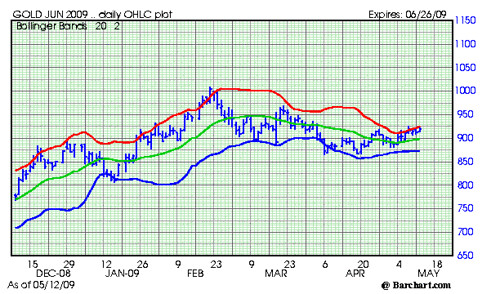
Is Gold Ready to Glitter? (Outlook, Chart)


June Gold, Bar, Chart


Gold has a tendency to be seasonally week from March through August. As a result, it is always risky to speculate in gold during this time frame.

In April, we wrote that gold was likely to test the 865 - 875 area. This happened, the market held, and made a very nice double bottom. This is now an area of major support.

Right now gold is running into resistance in the 827 area.

Any close over 827.50 would indicate that gold is ready to move higher.
Subscribe to All American Investor via Email
The market place is now starting to focus on the potential inflationary impact of the policies being carried out by the Federal Reserve and Treasury. The money supply, Fed balance sheet, and reserve balances are all soaring. The Treasury is buying mortgage backed securities and treasuries in an attempt to keep interest rates artificially low.

This is a big positive for gold. The marketplace is beginning to sense that a major increase in inflation is on the horizon. Gold is likely to discount this phenomena well in advance.

Gold, like all commodities, goes up when demand increases and supplies get tight. Both are happening right now.

What to watch:
  • Purchases of gold by the SPDR Gold Shares -- GLD. The ETF is now the sixth largest holder of gold in the world. When demand for the shares increase their purchases of physical gold increase.
  • Demand out of China. This includes buys by the Central Bank and demand for jewelry. Sooner or later demand from China is going to be explosive. While it is not well known, during the last big bull market in gold, much of the upside was fueled by purchases out of Hong Kong.
  • Any close over 827.50 basis June Gold.

Background:
  • Gold has a tendency to be weak on a seasonal basis at this time of year. This pattern usually persists until summer.
  • Industrial and jewelry demand for gold has been slow due to the weakness in the global economy.
  • The market experienced some jitters on a rumor of IMF gold sales. This is not happening.
  • The market also sold off on news out of India that demand for gold was dropping.
  • Seasonal demand patterns in gold are sometimes offset by investor demand for physical gold and ETFs.
  • Central banks continue to be large net sellers of Gold. Central banks have been net sellers of gold sales since 1999. Obviously, investor demand has been offsetting these large sales.

Here is some history on gold since 1980.
  • Gold rallied from $135 an ounce in 1978 to $860 an ounce in 1980.
  • The late 70s-80s gold rush was caused by consumer fears about inflation. The monthly CPI reading reached 1.5 percent in 1980. Gold peaked along with the inflation rate.
  • From 1980 until late 1999 gold prices trended down.
  • Gold bottomed near $250 an ounce in 1999.
  • When gold was making its lows in 1999, most of the major Central Banks around the world announced they intended to sell-off a large fraction of their gold reserves (400 tonnes a year, 2000 tonnes total).
  • Central banks are still selling their gold reserves in 2009 (500 tonnes a year, 2500 tonnes total).
  • Central banks continue to sell gold and the price continues to rise.
  • Since the late 1980s the purchases of gold by institutional investors has been rising. This trend continues and seems to be picking up momentum.
  • Demand for gold rose sharply in the fourth quarter of 2008, up 27 percent to $26.7 billion (year over year, Q4-2007 versus Q4- 2008).


    Bob DeMarco is a citizen journalist and twenty year Wall Street veteran. Bob has written more than 500 articles with more than 11,000 links to his work on the Internet. Content from All American Investor has been syndicated on Reuters, the Wall Street Journal, Fox News, Pluck, Blog Critics, and a growing list of newspaper websites. Bob is actively seeking syndication and writing assignments.


    Follow All American Investor on Twitter

Monday, May 11, 2009

Commodities Ready to Soar on Upside Breakout (Chart)


Goldman Sachs Commodity Index, Weekly Bar.

I decided to use the weekly chart so you can get a better long term perspective.


The daily GSCI chart broke out to the upside on a close over 380. The weekly chart is now breaking out with a close over 400. Next upside target is 460. This might not seem like much, but it is 15 percent. The GSCI is currently over bought so there could be some chopping around before we head sharply higher.

I have been posting the charts on money supply, the FED balance sheet, and reserves for months. They all look like a gushing oil well. I wrote some time ago that it usually takes 12-18 months for these effects to bring inflation. We are now inside those windows.

I am also following long term interest rates. The Fed was in buying size and this caused a short term back up in prices. This will be a short term phenomena. A real battle is brewing between the FED and the bond vigilantes. The FED has used about 30 percent of their announced bullets already.

Expect commodity prices to trend higher over the next several years.

A good look at the GSCI chart shows a 2008 high near 900 on the upside. Since the GSCI is heavily weighted in oil, it is likely that a long list of commodities will make new highs before oil.
Subscribe to All American Investor via Email
Bob DeMarco is a citizen journalist and twenty year Wall Street veteran. Bob has written more than 500 articles with more than 11,000 links to his work on the Internet. Content from All American Investor has been syndicated on Reuters, the Wall Street Journal, Fox News, Pluck, Blog Critics, and a growing list of newspaper websites. Bob is actively seeking syndication and writing assignments.


Follow All American Investor on Twitter

Duration of Unemployment Soars to New All Time High (Chart)


People are staying unemployed longer. Average duration of unemployment has lengthened by more than two weeks (20 percent) since January. This is the highest reading for this series on record.

Subscribe to All American Investor via Email


Follow All American Investor on Twitter

Average Hourly Week Worked Going Down (Chart)


This kinda fell through a crack on Friday. The weekly average number of hours worked continues to drop.This is a new historic low since they started compiling this series (1964). This is a small negative, but does show that things are far from picking up.

Subscribe to All American Investor via Email


Follow All American Investor on Twitter

The New Gas Station


Source Treehugger

Subscribe to All American Investor via Email


Follow All American Investor on Twitter

Friday, May 08, 2009

Civilian Employment Still a Long Way to Go (Chart)


Unlike unemployment, this chart is the number of people employed. So far, we are down about 6,000,000 million jobs. Imagine. A slight up tick this month is a positive.

More than half of the new jobs created are government job and most of those are hires by the census bureau.

With 6 million out of work, the economic numbers going forward might improve -- but they will be weak.

It is likely that the stock market has already discounted the recent mild rebound in the economic news. It is also likely that the market is going to be more vulnerable, now, to any renewed weakness.
Subscribe to All American Investor via Email

Bob DeMarco is a citizen journalist and twenty year Wall Street veteran. Bob has written more than 500 articles with more than 11,000 links to his work on the Internet. Content from All American Investor has been syndicated on Reuters, the Wall Street Journal, Fox News, Pluck, Blog Critics, and a growing list of newspaper websites. Bob is actively seeking syndication and writing assignments.


Follow All American Investor on Twitter

Monetary Base Continues to Soar (Graph)


St Louis Adjusted Monetary Base, May 6, 2009

Still soaring, slight down tick this time around.
Subscribe to All American Investor via Email
Bob DeMarco is a citizen journalist and twenty year Wall Street veteran. Bob has written more than 500 articles with more than 11,000 links to his work on the Internet. Content from All American Investor has been syndicated on Reuters, the Wall Street Journal, Fox News, Pluck, Blog Critics, and a growing list of newspaper websites. Bob is actively seeking syndication and writing assignments.


Follow All American Investor on Twitter

Real Unemployment Now 15.8 Percent


Not many people are aware of the U-6 report that is issued by the Bureau of Labor Statistics. Most news organizations report the more popular U.S. Department of Labor: Bureau of Labor Statistics--Civilian Unemployment Rate. If you read this report today then you learned that unemployment jumped to 8.9 percent (highest since 1983).

There is another category of unemployed that are not counted in that report. They are described in the U-6 report this way,
Marginally attached workers are persons who currently are neither working nor looking for work but indicate that they want and are available for a job and have looked for work sometime in the recent past. Discouraged workers, a subset of the marginally attached,have given a job-market related reason for not looking currently for a job.
The U-6 report counts everyone that is unemployed. To view the report go here.

U-6
  • Total unemployed
  • plus all marginally attached workers
  • plus total employed part time for economic reasons
  • as a percent of the civilian labor force plus all marginally attached workers
The number reported today for this series is 15.8% .

This paints a very ugly picture for the future.

Unemployment rose to 25 percent during the Great Depression.
Subscribe to All American Investor via Email


Bob DeMarco is a citizen journalist and twenty year Wall Street veteran. Bob has written more than 500 articles with more than 11,000 links to his work on the Internet. Content from All American Investor has been syndicated on Reuters, the Wall Street Journal, Fox News, Pluck, Blog Critics, and a growing list of newspaper websites. Bob is actively seeking syndication and writing assignments.


More from All American Investor


Follow All American Investor on Twitter

740,000 Workers Give Up Hope of Finding A job


Persons Not in the Labor Force (Household Survey Data)

About 2.1 million persons (not seasonally adjusted) were marginally attached
to the labor force in April, 675,000 more than a year earlier. These indivi-
duals wanted and were available for work and had looked for a job sometime in
the prior 12 months. They were not counted as unemployed because they had not
searched for work in the 4 weeks preceding the survey.

Among the marginally attached, there were 740,000 discouraged workers in April, up by 328,000 from a year earlier.
Discouraged workers are persons not currently looking for work because they believe no jobs are available for them.
The other 1.4 million persons marginally attached to the labor force in April had not searched for work in the 4 weeks preceding the survey for reasons such as school attendance or family responsibilities.

Subscribe to All American Investor via Email


Bob DeMarco is a citizen journalist and twenty year Wall Street veteran. Bob has written more than 500 articles with more than 11,000 links to his work on the Internet. Content from All American Investor has been syndicated on Reuters, the Wall Street Journal, Fox News, Pluck, Blog Critics, and a growing list of newspaper websites. Bob is actively seeking syndication and writing assignments.


More from All American Investor


Follow All American Investor on Twitter

Unemployment 539,000, Civilian Unemployment 611,000


Nonfarm payroll employment continued to decline in April (-539,000), and
the unemployment rate rose from 8.5 to 8.9 percent, the Bureau of Labor Sta-
tistics of the U.S. Department of Labor reported today. Since the recession
began in December 2007, 5.7 million jobs have been lost. In April, job los-
ses were large and widespread across nearly all major private-sector indus-
tries. Overall, private-sector employment fell by 611,000.

The civilian labor force participation rate rose in April to 65.8 percent,
and the employment-population ratio was unchanged at 59.9 percent. The employ-
ment-population ratios for adult men and women showed little or no change over
the month. However, since December 2007, the men's ratio was down by 4.4 per-
centage points, while the women's ratio was down by 1.3 percentage points.


In April, the number of persons working part time for economic reasons
(sometimes referred to as involuntary part-time workers) was essentially un-
changed at 8.9 million; however, the number of such workers has risen by 3.7
million over the past 12 months.
Subscribe to All American Investor via Email


Follow All American Investor on Twitter

Wednesday, May 06, 2009

They called me crazy, S and P 900-1000 (Part Two)


When I wrote Stocks Don't Fight the Tape the S and P 500 was around 768. I predicted a rally into the 900-1000 area.

I followed that up with They called me crazy, S and P 900-1000

What next?
S and P 500 Chart 507
  • The stock market is currently overbought.
  • The technical correction in the current bear market is two months old.
  • A major retracement to the downside is likely, and is imminent.
  • We could see additional upside to the 940 area versus the S and P 500.
  • A test of the 840 area is likely.
  • Once the correction gets underway we should get a better understanding of the structure of the market. Begining of long term bull, or bear market still in tact?
  • The important 200 day average is still about 100 points above the market and the down ward slope of that average is becoming more severe. This is not a good sign.
The bottom line. The risks out weigh the rewards at this level.

This has been a tremendous rally that I expected. However, in terms of price and duration it fits the requirements for a correction in a market that is still trending down.

In addition, the longer dated treasury interest rates are turning up. This is a negative. The dollar looks very vulnerable right now. Another negative. The combination of rising rates in the long end and a dropping dollar does not bode well for stocks.
Subscribe to All American Investor via Email
Bob DeMarco is a citizen journalist and twenty year Wall Street veteran. Bob has written more than 500 articles with more than 11,000 links to his work on the Internet. Content from All American Investor has been syndicated on Reuters, the Wall Street Journal, Fox News, Pluck, Blog Critics, and a growing list of newspaper websites. Bob is actively seeking syndication and writing assignments.


Follow All American Investor on Twitter

30 Year Conventional Mortgage Rate (Chart, 0506)


30 Year Mortgage
  • Mortgage interest rate remain low and are hovering around 4.80 percent.
  • Meanwhile, the ten year Treasury yield is rising and mortgages are tied to treasuries in the long run. 
  • Mortgage interest rates remain low as the FED continues to buy mortgage backed securities and add them to their balance sheet.  
  • The FED action is capping rates in the mortgage area for now.
Subscribe to All American Investor via Email


Follow All American Investor on Twitter

Monday, May 04, 2009

Nasdaq Composite Outperforming on Rally from Lows (Chart)


Nasdaq Composite (Red) versus Dow Jones Industrial (Green), Percent Change, Chart

The comparison chart shows that the Nasdaq is more volatile than the Dow.

Since the March lows the Nasdaq has dramatically outperformed the Dow. This indicates that investors are very bullish on tech stocks. Tech stocks are usually good investments in an economic turnaround. An added plus is that Tech stocks are not usually burdened by debt.

The Nasdaq is likely to be extremely vulnerable or any market correction. It is time to be careful.

Nasdaq versus Dow Percent Change 504
Subscribe to All American Investor via Email
Bob DeMarco is a citizen journalist and twenty year Wall Street veteran. Bob has written more than 500 articles with more than 11,000 links to his work on the Internet. Content from All American Investor has been syndicated on Reuters, the Wall Street Journal, Fox News, Pluck, Blog Critics, and a growing list of newspaper websites. Bob is actively seeking syndication and writing assignments.


Follow All American Investor on Twitter