Monday, May 31, 2010

1997 Warning on Deep Blowouts: ‘Options Are Limited’


It should come as no surprise that experts in avoiding and stopping blowouts of oil and gas wells long ago saw the deep-ocean drilling frontier as particularly dangerous terrain.

Back in 1997, an offshore-drilling newsletter ran an article by  Larry Flak, a veteran well blowout expert, at Boots & Coots at the time, listing a variety of paths leading to a seabed blowout and stated flatly that stopping one would be an enormous challenge.

His bottom line? “Options are limited, so prevention and fast action are critical.”

Flak, who later  moved to Signa Engineering, would have been great to have on hand right now, but sadly he died last year in a recreational boating accident. (Flak’s 1997 article was brought to my attention by a Dot Earth reader, Ike Solem.)

 blog it

Sunday, May 30, 2010

After ‘Top Kill,’ Few Options to Cap Well


The “top kill” procedure for choking off the gushing seabed well in the Gulf of Mexico was not quite the last best chance, but close. Now that it has failed, BP, with authorization from the Obama administration, is moving to cut away the tangle of pipe from the well and install a small containment cap, called the “lower marine riser package.”

Today, I’ve spoken with National Incident Commander Admiral Thad Allen, as well as Energy Secretary Steven Chu, Interior Secretary Ken Salazar, EPA Administrator Lisa Jackson, and senior White House advisors John Brennan and Carol Browner regarding the ongoing efforts to stop the BP oil spill...
 blog it

Why Taxing Carried Interest As Ordinary Income Is Good Policy


clipped from www.avc.com

The House has passed a bill this past week that would change the taxation of carried interest from capital gains treatment to ordinary income treatment. The Senate has not weighed in on the debate but it is expected to do so soon. The New York Times has a story about it in today's business section. I've written about this issue in the past, roughly three years ago when it first surfaced as an issue. I am in favor of taxing carried interest as ordinary income and I'd like to explain why I think it is good policy.

I agree with Victor Fleischer's basic premise that carried interest is a fee for managing other people's money. It is a fee based on performance, but it is a fee nonetheless. It is not fair or equitable to other recipients of fee income to give a special tax break to certain kinds of fees and not to others. 

 blog it

The Future of Personal Computing, Part 1


This week, Apple passed Microsoft to become the most valuable technology company in the world (measured by the market value of its stock).*

Rather than recap the entire history of computing (hilarious synopsis here, hat tip Brad DeLong), I’ll start in the early 1990s. At this point, many people had personal computers, but for the most part they weren’t connected to anything except maybe a printer. (Actually, in the early 1980s my father brought home one of those primitive modems where you actually placed your phone receiver into a socket to communicate, so we could log into the mainframe at his university, but that was the exception.)

 blog it

Income and Federal Tax Shares


Source: Scott Hodge from Tax Policy Center estimates.

http://www.taxpolicycenter.org/numbers/displayatab.cfm?Docid=2435
clipped from 1.bp.blogspot.com
https://blogger.googleusercontent.com/img/b/R29vZ2xl/AVvXsEgZ-AWiR8bwxUPBFaNXLaWtDCSGxZLkmN311XfJSjNsnXJe4tlCg-mcOgoW7uiZrCA1s659_Z6jMjeBhAK8QsRhh6rFvL18dZhNZla89EAguq_42NdjQRij3dd26VqahJZ7u4by/s1600/Income_and_Tax_Shares_TPC_2010.jpg
 blog it

The Consensus On Big Banks Shifts, But Not At Treasury


By Simon Johnson, co-author 13 Bankers: The Wall Street Takeover and The Next Financial Meltdown

In the best profile to date of Tim Geithner, by John Heilemann in New York Magazine, even the Treasury Secretary himself expresses frustration with the biggest banks – calling them “the warlords”.

David Brooks argued in the New York Times on Friday – writing about a different industry – that this is unavoidable, and perhaps normal:

More specifically, however, it’s not that “people in the same field begin to think alike”, but rather that “people who are supposed to regulate” begin to see the world through the eyes of the biggest private sector players.  Note, for example – and this is important – most hedge fund managers agree big banks are dangerous and will again mismanage risk in a reckless manner.

 blog it

Saturday, May 29, 2010

St. Louis Source Base (Chart)


Sum of currency in circulation, reserve balances with Federal Reserve Banks, and service-related adjustments to compensate for float. Calculated by the Federal Reserve Bank of St. Louis.

Personal Consumption Expenditures (Graph)


Net Free or Borrowed Reserves of Depository Institutions (Graph)


Definition: changes to excess reserves minus discount window borrowings plus secondary borrowings.

Friday, May 28, 2010

What's Behind Wall Street's Turmoil


With the Dow below 10000, leading economists Nouriel Roubini and Ian Bremmer continue their conversation about how America can recover, China’s growing strength, and just how bad Europe really is
What follows is a continuation of a conversation that Ian Bremmer and Nouriel Roubini began this week about the world economy, the future of free markets, and more. You can read the first installment here.
 blog it

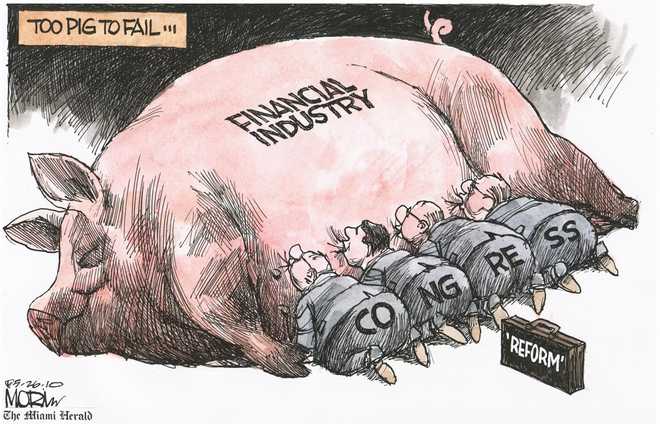
Financial Industry


clipped from www.ritholtz.com
http://www.ritholtz.com/blog/wp-content/uploads/2010/05/jm052610_COLOR_Congress_Financial_Reform.standalone.prod_affiliate.56.jpg
 blog it

Thursday, May 27, 2010

Corporate Profits: First Quarter 2010 (Preliminary Estimate)


Profits from current production (corporate profits with inventory valuation and capital
consumption adjustments) increased $81.4 billion in the first quarter, compared with an increase of $108.7 billion in the fourth quarter. Current-production cash flow (net cash flow with inventory valuation adjustment) -- the internal funds available to corporations for investment -- increased $30.8 billion in the first quarter, compared with an increase of $69.1 billion in the fourth.

Subscribe to All American Investor
Enter Your Email Address

Sunday, May 23, 2010

M2 Money Stock (Graph)


Subscribe to All American Investor Enter Your Email Address

Saturday, May 22, 2010

Reserve Bank Credit (Graph)


 blog it

Thursday, May 20, 2010

St. Louis Adjusted Monetary Base (Graph)


Subscribe to All American Investor
Enter Your Email Address

Google Funds Ultra Efficient Jet Engine-Inspired Geothermal Drill


clipped from inhabitat.com

Google Funds Ultra Efficient Jet Engine-Inspired Geothermal Drill

sustainable design, green design, alternative energy, renewable energy, potter drilling, geothermal energy, geothermal power, egs, green power

Geothermal energy is one of the most promising alternative energy technologies — it’s a clean, virtually unlimited resource, and unlike wind and solar it doesn’t require specific weather conditions. But it can be expensive. That’s where a Google-backed company called Potter Drilling comes in. The company has developed an jet engine-inspired drill for enhanced geothermal systems (EGS) drilling that uses super-heated water instead of mechanical stress to inexpensively break rocks open.

Mechanical abrasion drills don’t work on certain types of rock like quartz and feldspar, but Potter Drilling’s new EGS drill works everywhere. In other words, EGS can make use of geothermal resources that might not otherwise get to be tapped with traditional drilling methods.

Potter is currently working on a trial funded by the US Department of Energy and Google.org
 blog it

IS THE RISK OF DEFLATION RISING AGAIN?


Follow the link for full article.

IS THE RISK OF DEFLATION RISING AGAIN?

Last week, I advised that the unusual rallies in the dollar and gold this year may be a warning sign that deflationary winds are starting to blow harder. Historically, one falls as the other rises. The fact that both are climbing suggests the markets are worried about deflation...again. Today's report on April consumer prices only strengthens the case for thinking that the "D" risk is climbing once more. It may be a false warning, but it's getting harder to ignore.

051019b.GIF
051910a.GIF
 blog it

Real Retail and Food Services Sales (Chart)


Deflated Using the Consumer Price Index for All Urban Consumers (1982-84=100)

Subscribe to All American Investor Enter Your Email Address

Follow the Money (Video)


Subscribe to All American Investor Enter Your Email Address

Wednesday, May 19, 2010

CONSUMER PRICE INDEX –APRIL 2010


On a seasonally adjusted basis, the Consumer Price Index for All Urban Consumers (CPI-U) declined 0.1 percent in April, the U.S. Bureau of Labor Statistics reported today. Over the last 12 months, the index increased 2.2 percent before seasonal adjustment.

Tuesday, May 18, 2010

Producer Price Index: All Commodities (Chart)


Subscribe to All American Investor
Enter Your Email Address

Trade Weighted Exchange Index (Chart)


A weighted average of the foreign exchange value of the U.S. dollar against the currencies of a broad group of major U.S. trading partners.

Broad currency index includes the Euro Area, Canada, Japan, Mexico, China, United Kingdom, Taiwan, Korea, Singapore, Hong Kong, Malaysia, Brazil, Switzerland, Thailand, Philippines, Australia, Indonesia, India, Israel, Saudi Arabia, Russia, Sweden, Argentina, Venezuela, Chile and Colombia.

Subscribe to All American Investor
Enter Your Email Address


Original content Bob DeMarco, All American Investor

Housing Starts: Total: New Privately Owned Housing Units Started (Graph)


Current reading 672,000 versus 576,000 in December, and 477,000 in April, 2009.

Subscribe to All American Investor Enter Your Email Address


Original content Bob DeMarco, All American Investor

PRODUCER PRICE INDEXES – APRIL 2010


The Producer Price Index for Finished Goods declined 0.1 percent in April, seasonally adjusted, the U.S. Bureau of Labor Statistics reported today. This decrease followed a 0.7 percent advance in March and a 0.6 percent decrease in February. At the earlier stages of processing, prices received by producers of intermediate goods moved up 0.8 percent and the crude goods index fell 1.2 percent. On an unadjusted basis, prices for finished goods advanced 5.5 percent for the 12 months ended April 2010, their sixth consecutive 12-month increase.

Subscribe to All American Investor
Enter Your Email Address

Monday, May 17, 2010

Total Loans and Investments at All Commercial Banks


April, 2010. Current value $9264.2 Billion.

10-Year Treasury Constant Maturity Rate


Current: 3.55 percent.