Showing posts with label bonds. Show all posts

Thursday, June 27, 2013

Quarterly Survey of Public Pensions for 2013, Stocks, Bonds, Gov and More


TOTAL HOLDINGS AND INVESTMENTS OF MAJOR PUBLIC PENSION SYSTEMS REACH 
HIGHEST LEVEL EVER, PASSING THE 2007 PEAK2013 QUARTER 1

For the 100 largest public-employee retirement systems in the country, cash and security holdings totaled $2,930.3 billion in the first quarter of 2013, passing the 2007 fourth quarter peak of $2,928.9 billion, and reaching the highest level since this survey began collecting data in 1968.


Thursday, August 09, 2012

Now, It Is Man vs. Machine


In a move to repair its flagging bond-trading business, Morgan Stanley (MS)  is scrambling to replace some of its well-paid bond traders with computers.

The New York company is hiring programmers and technology specialists to help it trade bonds electronically and handle client orders in the hope of exploiting an expected shift in the way bonds and other fixed income products are traded.

While the effort represents only a part of what the firm is doing to boost low returns in the business, the shift already has reduced the ranks of interest-rate and foreign-exchange traders on some desks by 10% to 20%.

Morgan Stanley's head of interest-rate trading, Glenn Hadden, has told colleagues in recent months and that the trading floor of the future will surround a few traders with the hum of powerful machines. The unit, which has at least 200 staff according to industry estimates, has cut about 10% of staff on some trading desks. Morgan Stanley declines to discuss employment levels, but there according to these estimates the company employs more than 1,000 traders.

Continue Reading Now, It Is Man vs. Machine

Sunday, August 22, 2010

Small Investors Flee Stock Market


From -- In Striking Shift, Small Investors Flee Stock Market.

Renewed economic uncertainty is testing Americans’ generation-long love affair with the stock market.

Investors withdrew a staggering $33.12 billion from domestic stock market mutual funds in the first seven months of this year, according to the Investment Company Institute, the mutual fund industry trade group. Now many are choosing investments they deem safer, like bonds.

Thursday, June 18, 2009

Economist Samuelson Warns about China Pessimism and a Run on the Dollar


These are sobering words from renowned economist Paul Samuelson.
Some day -- maybe even soon -- China will turn pessimistic on the U.S. dollar.

That means lethal troubles for the future U.S. economy.

When a disorderly run against the dollar occurs, I believe a truly global financial panic is to be feared. China, Japan and Korea now hold dollars not because they think dollars will stay safe.

Why then?.....
The threat that China and others countries might divest the dollar is starting to cause jitters in the Treasury market. If the countries Samuelson mentioned held on to their dollar assets --but cut back on their purchases of U.S. Treasuries-- interest rates higher immediately.

The given in this equation is that the amounts of Treasuries coming on to the market in the years ahead is enormous.

Growing supply, and the likelihood that U. S. Treasury debt will get downgraded, means that the risk premium for owning longer dated treasuries is likely to rise and rise sharply.

During the early 1990s this risk premium rose to more than five percent.

Lets say we find ourselves with a three percent inflation rate in the next 12-18 months. What is the rate we could see in the ten years treasury?

8-11 percent. Inflation, inflation expectation, dollar risk, supply, plus a fair rate of interest all add to the interest rate that investors will demand in order to buy. It is not hard to envision five or more points of risk premium.

Does it make good sense in this environment to be fully invested in stocks?

My guess is that we are going to see a sharp uptick in inflation in the next 12-18 months. Given the enormous expansion in the money supply it is not hard to envision three percent inflation. Add in the necessary risk premium for owning longer dated securities, and it is not hard to envision sharply higher rates.

Right now most analysts continue to mention how inflation is not a problem. In 1980, when inflation was hitting 1.5 percent per month, analysts were forecasting higher inflation and higher interest rates in the future. Inflation peaked right then and right there.

Our we at the trough in inflation now?

Anybody old enough to remember when the ten year treasury yield was above 15 percent? Three month treasury bill at 14 percent?

It is time to be risk adverse. Not the time to be betting the ranch in the stock market.

To read the entire Samuelson article go here.
Subscribe to All American Investor via Email

Bob DeMarco is a citizen journalist and twenty year Wall Street veteran. Bob has written more than 700 articles with more than 18,000 links to his work on the Internet. Content from All American Investor has been syndicated on Reuters, the Wall Street Journal, Fox News, Pluck, Blog Critics, and a growing list of newspaper websites. Bob is actively seeking syndication and writing assignments.


More from All American Investor


Follow All American Investor on Twitter

Tuesday, June 02, 2009

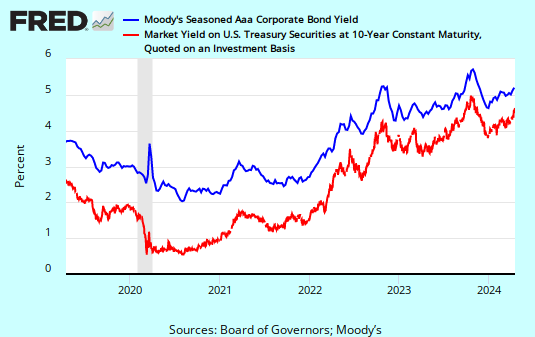
Corporate Aaa | Ten Year Treasury (Chart)


Moody's Seasoned Aaa Corporate Bond Yield, Weekly, Ending Friday, Percent (Blue)
10-Year Treasury Constant Maturity Rate, Daily, Percent (Red)


Spread narrows slightly, but still a historically wide risk premium.

Rates moving up across all quality preferences.
Subscribe to All American Investor via Email


Kindle: Amazon's Wireless Reading Device (Latest Generation)

Thursday, April 30, 2009

Fed Monetizing Debt -- How long before the Inflation Comes?


No matter how you cut or slice it, the FED is going to monetize debt. This means you want to be owning stocks and ETFs that benefit from an increase in inflation.

Over the next week, we will be putting up some of our ideas on how to take advantage of this scenario.

If you have been following the charts on All American Investor -- you noticed that I have been talking about rising rates in the ten and thirty year treasuries for a few weeks. If you are not paying close attention to this as in investor you are making a big mistake.

The bond vigilantes are coming back, and soon with a vengeance. Longer dated treasury interest rates are drifting up. This, in spite, of massive buying of treasuries by the FED -- we showed the balance sheet on Saturday.

Here is a snippet from the latest FOMC release:

As previously announced, to provide support to mortgage lending and housing markets and to improve overall conditions in private credit markets, the Federal Reserve will purchase a total of up to $1.25 trillion of agency mortgage-backed securities and up to $200 billion of agency debt by the end of the year. In addition, the Federal Reserve will buy up to $300 billion of Treasury securities by autumn. The Committee will continue to evaluate the timing and overall amounts of its purchases of securities in light of the evolving economic outlook and conditions in financial markets. The Federal Reserve is facilitating the extension of credit to households and businesses and supporting the functioning of financial markets through a range of liquidity programs. The Committee will continue to carefully monitor the size and composition of the Federal Reserve's balance sheet in light of financial and economic developments.

Buy $300 billion of treasuries by Autumn?

The best way to think of the current scenario is like boiling water in a tea pot. Sooner or later, the whistle will blow.

Don't like the above? Remember, I am the same guy that predicted this really in stocks when I wrote:
  • They call me crazy -- S and P 900-1000
  • and, Stocks Don't Fight the Tape.
There is a lot of chicken on the hill. My guess here right now is: material stocks, commodity stocks, related ETFs and short the long bond.
Subscribe to All American Investor via Email

Monday, April 27, 2009

Interest Rates at minus 5 Percent? (Charts)


There is an interesting article on the Financial Times pages that alludes to an internal FED analysis that the optimum interest rate right now would be -5%.
The ideal interest rate for the US economy in current conditions would be minus 5 per cent, according to internal analysis prepared for the Federal Reserve’s last policy meeting.

The analysis was based on a so-called Taylor-rule approach that estimates an appropriate interest rate based on unemployment and inflation.
Later in the article there is a short discussion of the FEDs massive expansion of bank reserves that is designed to keep rates near zero (see Reserve Bank Credit Soaring Again (Graph))

The FED has once again started buying Treasuries to keep rates down. Is it working? Just this weekend I published two charts that showed that ten year government and thirty year government bond interest rates are creeping up. See: 10 Year Treasury Closes above 3 Percent (Graph) and 30 Year Goverment Bond Signaling Problems Ahead (Chart).

All of this is worrisome and it should have holders of stocks paying attention.

Fed study puts ideal US interest rate at -5%
Subscribe to All American Investor via Email

Bob DeMarco is a citizen journalist and twenty year Wall Street veteran. Bob has written more than 500 articles with more than 11,000 links to his work on the Internet. Content from All American Investor has been syndicated on Reuters, the Wall Street Journal, Fox News, Pluck, Blog Critics, and a growing list of newspaper websites. Bob is actively seeking syndication and writing assignments.


More from All American Investor


Follow All American Investor on Twitter

Tuesday, April 21, 2009

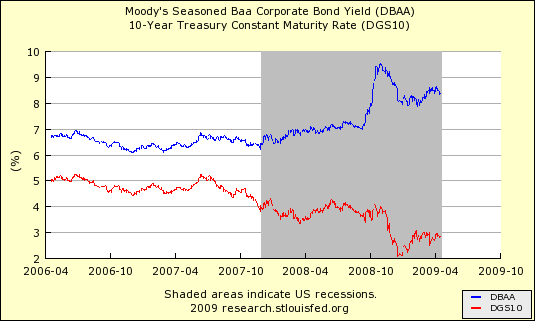
Bonds -- Corporate Baa Versus 10 Year Treasury Yield and Spread (Graph)


The spread between Corporate Baa and Treasury bonds remains wide. The risk premium evidences the considerable nervousness in the market place. Action by the Treasury and Federal Reserve are keeping treasury yields artificially low. I am expecting yields across all quality preferences to continue to rise.

In 2007, the spread was running around 175 basis point. It is now in the 550 basis points area.

Corporate Baa Versus 10 Year Treasury
Corporate Baa--blue line. 10 Year Treasury--red line.
Subscribe to All American Investor via Email


Bob DeMarco is a citizen journalist and twenty year Wall Street veteran. Bob has written more than 500 articles with more than 11,000 links to his work on the Internet. Content from All American Investor has been syndicated on Reuters, the Wall Street Journal, Fox News, Pluck, Blog Critics, and a growing list of newspaper websites. Bob is actively seeking syndication and writing assignments.


More from All American Investor


Follow All American Investor on Twitter

Saturday, March 14, 2009

Bad Omen for U. S. Government Debt


The cost of buying a credit default sway (CDS) on U. S. government debt is soaring. The spread has widened from 14 basis points a year ago to 97 basis points now. To put this in perspective, the cost to buy insurance against the possible default of U.S. government bonds (sovereign debt) has risen to $97,000 per $1,000,000 of debt. Yikes. This makes the cost of buying insurance roughly equivalent to that of France.

The potential for a downgrade of U. S. sovereign debt is listed as considerable by Moody's. Moody's describes the current situation for the debt as:
Resilient Aaa, whose ratings are being tested but, in our view, display sufficient capacity to grow out of their debt and repair the damage.

Subscribe to All American Investor via Email
Bob DeMarco is a citizen journalist and twenty year Wall Street veteran. Bob has written more than 500 articles with more than 11,000 links to his work on the Internet. Content from All American Investor has been syndicated on Reuters, the Wall Street Journal, Fox News, Pluck, Blog Critics, and a growing list of newspaper websites. Bob is actively seeking syndication and writing assignments.


Monday, February 23, 2009

Avalanche of Treasuries to Hit Market this week


An avalanche of treasuries are set to hit the market this week. The Treasury Department plans to auction $40 billion of two- year notes tomorrow, $32 billion of five-year securities and $22 billion of seven-year this week. This will be an important test of the market and its ability to absorb government debt, but it is only the beginning of a long series of massive auctions of treasury securities.
The U.S. will probably borrow $2.5 trillion during the fiscal year ending Sept. 30, according to Goldman Sachs Group Inc., one of the 16 primary dealers required to bid at U.S. debt sales. The figure is almost triple the $892 billion in notes and bonds it sold in the previous 12 months.
In a separate news item Hillary Clinton was calling on China to keep buying Treasuries this weekend.
“It would not be in China’s interest” if the U.S. were unable to finance deficit spending to stimulate its economy, Clinton said yesterday in an interview in Beijing with Shanghai- based Dragon Television.
This weeks Treasury auctions will be watched closely in the markets. A bigger issue moving forward is whether or not this avalanche of treasury sales is going to crowd corporation, states and municipalities out of the market. I think that is likely and we will be following that closely in the weeks and months ahead.
Subscribe to All American Investor via Email

Treasuries Fall on Speculation U.S. to Increase Citigroup Stake

Treasuries fell, paring two weeks of gains, as stocks rose on speculation the U.S. is planning to boost its stake in Citigroup Inc., increasing the likelihood of additional debt sales as borrowing soars.

Ten- and 30-year securities led the declines as the MSCI World Index snapped nine days of losses after the Wall Street Journal reported Citigroup is in talks with federal officials. The U.S. is planning to sell a record $94 billion of notes this week, raising speculation investors will demand higher yields to purchase the securities.

“We’ve got supply coming back into the market all this week,” said Padhraic Garvey, head of investment-grade debt strategy in Amsterdam at ING Groep NV. “We’re also seeing a reversal of the large risk aversion trade this week.”

Ten-year yields increased five basis points to 2.84 percent as of 11:15 a.m. in London, according to BGCantor Market Data. The price of the 2.75 percent security due in February 2019 fell 13/32, or $4.06 per $1,000 face amount, to 99 8/32. A basis point is 0.01 percentage point.

The yield, which touched a record low of 2.04 percent on Dec. 18, has averaged 4.65 percent during the past decade. Yields slid 10 basis points last week as falling stocks drove investors to bonds.

The U.S. government may end up with as much as 40 percent of Citigroup’s common stock, the Wall Street Journal said citing people familiar with the matter.

‘Wall of Supply’

“Treasuries face a wall of supply and the fact that Citigroup may need more government intervention means there may be more sovereign bond issuance to come,” said Nick Stamenkovic, a fixed-income strategist in Edinburgh at RIA Capital Markets, a securities broker for banks and institutional investors. “That’s unnerving investors.”

Banks may have to be nationalized for “a short time” to help lenders such as Citigroup and Bank of America Corp. survive the U.S. economic slump, Senate Banking Committee Chairman Christopher Dodd said Feb. 20.

U.S. yields indicate bets on inflation have been rising over the past three months.

The difference between rates on 10-year notes and Treasury Inflation Protected Securities, or TIPS, which reflects the outlook among traders for consumer prices, was 115 basis points. The spread climbed from minus eight basis points in November, and the six-month average is 95 basis points.

Stocks Advance

Consumer prices were unchanged over the last 12 months, a Labor Department report showed Feb. 20, meaning bond investors aren’t losing anything to inflation. The so-called real yield of 2.81 percent is close to the most since 2006.

Stocks in Europe and Asia climbed, pushing the MSCI World Index higher for the first time in 10 days, with a gain of 0.7 percent.

“It’s an unwinding of the flight to quality,” said Kazuaki Oh’e, a Tokyo-based debt salesman at Canadian Imperial Bank of Commerce, Canada’s fifth-biggest bank.

Government efforts to support the banking system will help corporate bonds outperform Treasuries, David Kotok, chief investment officer at Cumberland Advisors Inc. in Jersey City, wrote in a report today.

“The story circulating about Citigroup is a way for the idea of nationalization to get vetted,” wrote Kotok, who oversees $1 billion.

Treasuries have handed investors a 2.7 percent loss so far in 2009, while U.S. company bonds returned 1 percent, according to indexes complied by Merrill Lynch & Co.

The Treasury Department plans to auction $40 billion of two- year notes tomorrow, $32 billion of five-year securities on Feb. 25 and $22 billion of seven-year debt on Feb. 26.

Higher Yields

“That’s a lot of bonds that need to be sold,” said Peter Jolly, head of market research at National Australia Bank Ltd.’s investment-banking unit in Sydney. “The bias this week will be for yields to rise.”

The U.S. will probably borrow $2.5 trillion during the fiscal year ending Sept. 30, according to Goldman Sachs Group Inc., one of the 16 primary dealers required to bid at U.S. debt sales. The figure is almost triple the $892 billion in notes and bonds it sold in the previous 12 months.

Treasuries rose initially after U.S. Secretary of State Hillary Clinton said China, the largest foreign holder of Treasuries, should keep buying to help fund President Barack Obama’s economic-stimulus plans.

“It would not be in China’s interest” if the U.S. were unable to finance deficit spending to stimulate its economy, Clinton said yesterday in an interview in Beijing with Shanghai- based Dragon Television.

‘Good for Treasuries’

“Clinton’s statement is good for Treasuries,” said Takashi Yamamoto, chief trader in Singapore at Mitsubishi UFJ Trust & Banking Corp., part of Japan’s largest bank. “It will make yields decline.”

Fund managers became less bearish on Treasuries last week, a survey by Ried, Thunberg & Co. showed.

The company’s index measuring the investor outlook through the end of March rose to 44 in the seven days ended Feb. 20 from 43 the week before. The economic analysis firm in Jersey City, New Jersey, surveyed 25 fund managers controlling $1.39 trillion. A reading below 50 means investors expect prices to fall.

For all the $9.7 trillion pledged by the U.S. to combat the financial crisis, money markets show the world’s biggest banks see no recovery before 2010.

‘Barometer of Fears’

The premium banks charge each other for short-term loans, the so-called Libor-OIS spread, rose above 1 percentage point last week for the first time since Jan. 9. Contracts traded in the forward market indicate the gauge, which measures banks’ reluctance to lend, will remain higher for the rest of the year than before Sept. 15, when the bankruptcy of Lehman Brothers Holdings Inc. froze credit markets.

“Libor-OIS remains a barometer of fears of bank insolvency,” former Federal Reserve Chairman Alan Greenspan said in an interview. “That fear has been substantially reduced since mid-October, but the decline has stalled well short of any semblance of normal markets.”

The difference between what banks and the Treasury pay to borrow money for three months, the so-called TED spread, rose to 98 basis points from 91 basis points on Feb. 10.

Thirty-year fixed mortgage rates rose to 5.04 percent in the seven days ended Feb. 19 from 4.96 percent in the middle of January, according to loan finance company Freddie Mac. Rates are about 2.25 percentage points higher than 10-year Treasury yields, widening from 1.48 percentage points five years ago.

To contact the reporter on this story: Kim-Mai Cutler in London at kcutler@bloomberg.net; Wes Goodman in Singapore at wgoodman@bloomberg.net.


More from All American Investor


Tuesday, February 17, 2009

Good Morning--It's a Bad Day--Stocks down, Gold up


Not a surprise, the major U.S. stock indexes are down two or more percent this morning (futures). Gold continues to mystify many and is up at a new high for 2009 above $960 a troy ounce. Is Gold becoming the world's second reserve currency?

The markets are awakening to a the new reality--massive amounts of debt securities are coming to the market this year. Is this a surprise? No. But, it does leave one with a bit of uneasiness--the Italians call it 'agita'.

This morning the world markets are facing a new reality--widening credit spreads and the real possibility of defaults by major Japanese companies.

One part of the new reality could be the buying of gold by Central Banks. It appears that the central bank in Russia is purchasing gold. World central banks have been selling gold for than a decade--are they about to turn buyers?

I have been telling people for years that I expect the Chinese to become massive buyers of gold. I am old enough to remember when massive new orders for gold by Chinese came pouring out of Hong Kong each morning--that was in 1978-1980. Gold soared from $135 and ounce to over $800. Asian demand helps gold break $960

Also see:
S&P heads to first quarter ever of negative earnings
Global Stocks Retreat, Led by Banks; Gold, Treasuries Advance
Bailed-Out Banks Charge Taxpayers Highest Fees in FDIC Sales

Subscribe to All American Investor via Email


Tuesday, February 03, 2009

Citigroup Leads Hybrid Bond Drop on Bailout Concern


Citigroup Leads Hybrid Bond Drop on Bailout Concern
(Bloomberg) -- Bond investors’ bets on bank nationalizations are hindering already reduced lending by the world’s biggest financial institutions.

The market for securities with characteristics of both debt and equity that Citigroup Inc., Bank of America Corp. and other financial companies used to bolster their capital is in freefall on concern governments will stop banks that took public cash from paying interest. The hybrids, which typically count as regulatory capital to cushion against losses, fell 11 percent last month in the U.S., more than they did in all of 2008, according to Merrill Lynch & Co. index data. Citigroup and Bank of America bonds lost as much as 34 percent of their value.

Subscribe to All American Investor via Email

Sunday, January 11, 2009

PIMCOs Gross likes Muni Bonds and Treasury Inflation Protected Securities


Municipal bonds are among the best buying opportunities now as states line up for billions in federal aid from the incoming Barack Obama administration, said Bill Gross, chief investment officer of the giant bond firm PIMCO.

Other strategies offered by Gross in his January investment newsletter were buying Treasury Inflation Protected Securities (TIPS) and certain investment-grade corporate bonds.

By contrast, in the Treasury market, "low yields offer little reward and increasing risk," given ballooning federal budget deficits, he said.


PIMCO's Gross says muni bonds and TIPS "attractive"


By Ros Krasny

CHICAGO (Reuters) - Municipal bonds are among the best buying opportunities now as states line up for billions in federal aid from the incoming Barack Obama administration, said Bill Gross, chief investment officer of the giant bond firm PIMCO.

Other strategies offered by Gross in his January investment newsletter were buying Treasury Inflation Protected Securities (TIPS) and certain investment-grade corporate bonds.

By contrast, in the Treasury market, "low yields offer little reward and increasing risk," given ballooning federal budget deficits, he said.

Gross noted that requests for aid from municipalities and states total nearly $1 trillion "and to think California or New York City would be allowed to fail is, well -- unthinkable."

"Municipal bonds ... selling at historically high ratios relative to U.S. Treasuries, offer attractive price appreciation potential, or at the very least a defensiveness with high carry that a 2 1/2 percent 10-year Treasury cannot," Gross said.

According to Municipal Market Data, top-rated 30-year munis now yield 161 percent and 10-year munis yield 133 percent of comparable Treasuries.

Triple A rated munis started 2008 yielding a more normal 85 percent of 30-year Treasuries and 79 percent of 10-year government bonds.

Meanwhile, Gross said he doubted the U.S. economy was in for the type of deflation that markets are forecasting, making TIPS a good buy.

Current ultra-low Treasury yields "cannot possibly be maintained unless deflation, as opposed to inflation, becomes the odds-on favorite," he said.

Market-based break-even inflation rates now point to a consumer price index averaging negative 1 percent for the next 10 years, which Gross termed "possible, but not likely."

On the corporate bond side, yields of 6 percent or more for intermediate maturities are still common, Gross said.

"Investors should recognize the value of high-quality, investment-grade corporate bonds in many markets."

Otherwise, PIMCO continues to maintain a strategy of buying assets that are under the federal bailout "umbrella."

"Shake hands with the government ... their checkbook represents the largest and most potent source of buying power in 2009 and beyond," Gross said.

Gross said investors needed to be vigilant about higher inflation over the long term, given the "near certainty of future budget deficits approaching 6 percent to 7 percent of GDP."

(Additional reporting by Karen Pierog; Editing by Kenneth Barry)

Saturday, April 21, 2007

Treasury Inflation Protected Securities (TIPS)


Treasury Inflation-Protected Securities, often called TIPS, are government issued securities whose value is linked to the inflation rate

Treasury Inflation Protected Securities (TIPS)

Treasury Inflation-Protected Securities, often called TIPS, are government issued securities whose value is linked to the inflation rate.
Treasury Inflation-Protected Securities, often called TIPS, are government issued securities whose value is linked to the inflation rate. Like Treasury bills, bonds and notes, TIPS are backed by the full faith and credit of the United States government. This make TIPS an ideal investment for those concerned about safety when investing. Treasuries are considered to be the safest investment in the world. TIPS are liquid securities that can be bought and then resold at any time on the open market or directly to the Treasury Department.

TIPS are very different than standard bonds. TIPS pay a stated interest rate like a typical bond (fixed interest rate); however, the principal is adjusted every six months based on the changes in the Consumer Price Index (CPI). If inflation rises the principal of the bond increases, if deflation occurs your principal decreases. Just like all government securities you can never receive less than par (100) if you hold the TIPS to maturity. One of the best features of TIPS is you receive the inflation adjusted principal or the original principal, whichever is greater when the bonds mature.

TIPS pay a fixed rate of interest. However, the interest is applied to the inflation-adjusted principal of the security. If inflation as measured by the CPI increase over the course of ownership of the TIPS every interest payment would rise. If deflation occurs then the interest payment would decline. The amount of interest paid is calculated by multiplying the inflation-adjusted principal (regardless of whether it is greater or less than the original face value) by one-half the fixed annual interest rate (TIPS pay interest every six months).

Unlike typical bonds where you pay a broker a fee, you can buy TIPS direct from the US Treasury. This means 100 percent of your investment goes to work from day one. It is not unusual to suffer a 25-50 basis point drop in yield when purchasing a bond from a broker (the commission you pay reduces the yield, something investors often fail to take into account). And, if you are purchasing a small amount of bonds, the “real” yield on your investment can be reduced by one or more percentage points. The ability to buy TIPS direct from the Treasury is certainly a feature that makes the bonds more attractive.

You can purchase TIPS with 5, 10 or 20 year maturities. This is accomplished by setting up an account with the Treasury online or through the mail; and then, by submitting your non-competitive bid amount at the time of the next auction (the amount you intend to invest). Since most Treasuries are purchased with non-competitive bids you can feel assured that you will receive a fair price at the time of the auction. If you are too busy to set up your own account your broker or bank will do it for you, but they will charge you a fee.