Showing posts with label chart. Show all posts

Tuesday, September 03, 2013

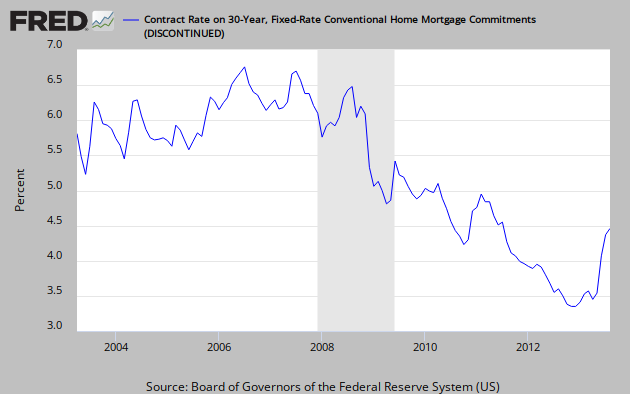
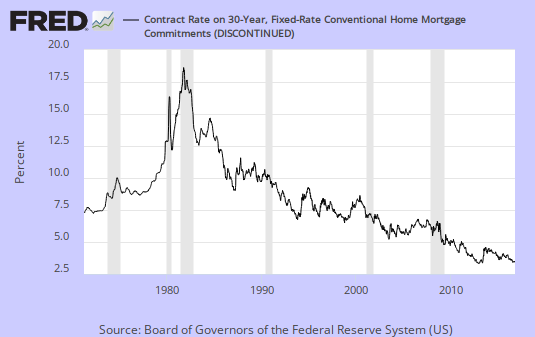
30 Year Conventional Mortgage Rate Chart 932013


4.46 Percent


All American Investor

Sunday, June 30, 2013

Money Supply, M2, 10,594.2 Billions of Dollars


Current M2 10,594.2 Billions of Dollars, versus 9912.1 Billions of Dollars one year ago, and 5962.3 Billions of Dollars ten years ago.


Updated: 2013-06-28

Saturday, June 08, 2013

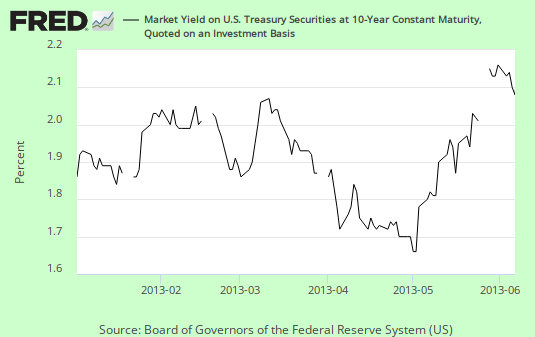
Ten Year Treasury January to Now Chart


10-Year Treasury Constant Maturity Rate (DGS10)

2.08 Percent

FRED Graph

Last Five Observations

2013-06-06: 2.08 Percent
2013-06-05: 2.10
2013-06-04: 2.14
2013-06-03: 2.13
2013-05-31: 2.16

Original content +Bob DeMarco , All American Investor

Monday, June 03, 2013

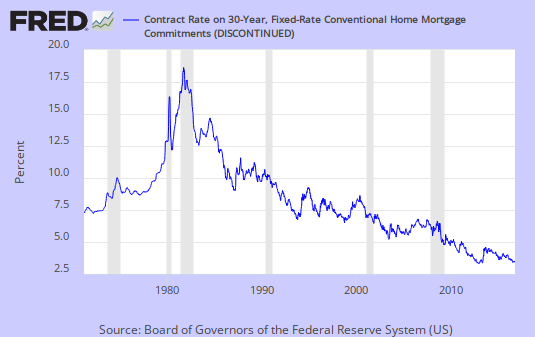
30-Year Conventional Mortgage Rate 5 30 2012


3.81 Percent

FRED Graph

Contract interest rates on commitments for fixed-rate first mortgages. Source: Primary Mortgage Market Survey data provided by Freddie Mac.

Original content +Bob DeMarco, All American Investor

Sunday, June 02, 2013

M2 Money Stock (M2) 5 20 2013


M2 includes a broader set of financial assets held principally by households.

M2 consists of M1 plus: 

(1) savings deposits (which include money market deposit accounts, or MMDAs); 
(2) small-denomination time deposits (time deposits in amounts of less than $100,000); and 
(3) balances in retail money market mutual funds (MMMFs). 

Seasonally adjusted M2 is computed by summing savings deposits, small-denomination time deposits, and retail MMMFs, each seasonally adjusted separately, and adding this result to seasonally adjusted M1.

10,541.5 Billions of Dollars

FRED Graph

Original content +Bob DeMarco , All American Investor


Tuesday, May 28, 2013

30-Year Conventional Mortgage Rate 2013-05-23


3.59 Percent

Graph of 30-Year Conventional Mortgage Rate

Source: Primary Mortgage Market Survey data provided by Freddie Mac.

Original content +Bob DeMarco , All American Investor

Saturday, May 25, 2013

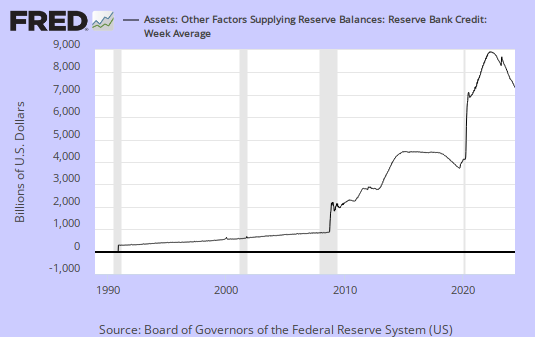
Reserve Bank Credit 2013-05-22


3,336.659 Billions of Dollars

Graph of Reserve Bank Credit

Wednesday, January 16, 2013

Industrial Production Index Jan 2013


All American Investor

2012-12: 98.0930 Index 2007=100

Industrial Production Index Jan 2013

Sunday, January 06, 2013

Reserve Bank Credit 12013


All American Investor

2,896.291 Billions of Dollars
Updated: 2013-01-04 12:01 PM CST

FRED Graph

If you don't see the chart - go here.

Saturday, January 05, 2013

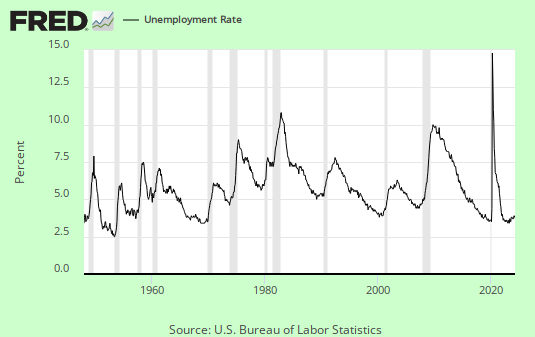
Civilian Unemployment Rate 104


The unemployment rate represents the number of unemployed as a percentage of the labor force.


2012-12: 7.8 Percent 

Monthly, Seasonally Adjusted, Updated: 2013-01-04

FRED Graph

If you don't see the chart go here

Tuesday, January 01, 2013

30-Year Conventional Mortgage Rate 1231


FRED Graph

Contract interest rates on commitments for fixed-rate first mortgages. Source: Primary Mortgage Market Survey data provided by Freddie Mac. Please refer to the series WMORTG for historical data. 
pdated: 2012-12-31 3:01 PM CST

Saturday, September 15, 2012

SEI Investments (SEIC) 2012 Review


SEI Investments, SEIC, has grown its profits and dividends at a 10-18% pace over the past 10 years earning an 18-30% return on equity.

SEI Investment< SEIC,  offers comprehensive software products and computer processing services for trusts and investment programs and administrative and distribution services to high net worth markets, mutual funds and other pooled funds.

SEI has grown its profits and dividends at a 10-18% pace over the past 10 years earning an 18-30% return on equity. The 2008/2009 turmoil in the securities markets caused SEIC earnings problems; however, the company has resumed its above average growth as a result of:

(1) rising assets under management,

(2) continuation of its aggressive stock buy back program,

(3) improving cost controls,

(4) new product offerings.

Thursday, September 13, 2012

Total System Services (TSS) 2012 Review


Total System Services, TSS, is a major processor of credit, debit and private label card transactions for institutions in North America.

TSS has grown dividends and profits at a 10-20% annual pace for the past 10 years earning a 15-20% return on equity. Despite a drop in revenue resulting from a tightening of consumer purse strings in the recent recession, management has structured a return to above average growth by:

(1) an improving economy leads to an increase in cardholder transactions,

(2) acquisitions [the company has a strong cash position],

(3) ongoing share buyback program,

(4) streamlining its operations and aggressive cost cutting.

Negatives:

(1) TSS is in a highly competitive industry,

(2) falling interest rates have a negative impact on income,

(3) new regulations may slower growth in cardholder accounts and higher operating costs.

Total is rated B++ by Value Line, carries a 4% debt to equity ratio and its stock yields 1.7%.

Statistical Summary

Stock Yield Dividend Growth Rate Payout Ratio # Increases Since 2002
TSS 1.7% 6% 28% 6
IND 2.0 9 26 NA


Debt/Equity ROE EPS Down Since 2002 Net Margin Value Line Rating
TSS 4% 18% 3 13% B++
IND 31 21 NA 17 NA


Chart

Note: TSS stock has made steady progress off its November 2008 low, surpassing the down trend off its May 2007 high (straight red line) and the November trading high (green line). TSS is in a long term trading range; the blue line is the lower boundary. However, it is an intermediate term up trend (purple lines). The wiggly red line is the 50 day moving average. The Dividend Growth Portfolio owns a 50% position in TSS. Shares would be Added at $12. The lower boundary of its Sell Half Range is $28.


http://finance.yahoo.com/q?s=TSS


Steve Cook received his education in investments from Harvard, where he earned an MBA, New York University, where he did post graduate work in economics and financial analysis and the CFA Institute, where he earned the Chartered Financial Analysts designation in 1973. His 40 years of investment experience includes institutional portfolio management at Scudder, Stevens and Clark and Bear Stearns. Steve's goal at Strategic Stock Investments is to help other investors build wealth and benefit from the investing lessons he learned the hard way.

Wednesday, September 12, 2012

VF Corp (VFC) 2012 Review


VF Corporation, VFC,  is an apparel maker and distributor and a leader in jeans wear, sportswear, image wear and work wear. It has raised its dividend every year for the last 20 years.

Its brands include Lee, Wrangler, Jansport, Nautica, The North Face, Vans, Napaplin, Timberland, John Varvatos and Reef. The company has grown its profits and dividend at a 9-11% rate over the last 10 years earning a 15-18% return on equity.

It has raised its dividend every year for the last 20 years. Despite tough conditions in many of its product categories in 2009, management negotiated this period with barely a hiccup and set the company on a course to continue to grow earnings by:

(1) the strength of VFC’s brand management strategy provides a competitive advantage with regard to distribution as well as benefiting it tough economic periods,

(2) its long history of manufacturing and engineering expertise produces cost and service benefits,

(3) a successful acquisition program focusing on companies with global growth opportunities. The recent acquisitions of [a] Timberland will spur growth in its outdoor and sportswear businesses and [b] Rock and Republic Enterprises will increase its competitive position in premium jeans.

Tuesday, September 11, 2012

Reliance Steel (RS) 2012 Review


Reliance Steel, RS,  provides value-added metals processing services and distributes more than 100,000 metal products. 

The company has grown profits and dividends at a 13-15% rate and earned a 7-19% return on equity over the last ten years. RS operations were under significant pressure from declining volume and increasing price competition in 2009. However, profits begun growing again as a result of:

(1) despite slow economic growth, it is witnessing improvement in its core customer base (aerospace and energy) resulting in both rising demand and prices,

(2) acquisitions (latest: McKey and National Specialty Alloys),

(3) an excellent cost control discipline.


Marathon Oil (MRO) 2012 Review


Marathon Oil , MRO,  is an oil and natural gas production company, having recently spun off its refining operations. 

As a newly separated entity, it has no available historical data. However, future profit and dividend increases are expected in the 8-13% range and ROE is estimated in the 12-15% area. Looking ahead both earnings and dividends will be driven by:

(1) expanding activity in Texas’ Eagle Ford shale,

(2) acquisitions,

(3) strong inventory of development projects [Indonesia, Iraq, Poland].

Monday, September 10, 2012

General Mills (GIS) 2012 Review


General Mills Inc., GIS, processes and markets such well known products as Cheerios, Wheaties, Total, Chex, Betty Crocker, Bisquick, Hamburger Helper, Yoplait and Progresso. 

The company has grown profits and dividends at a 7-10% pace over the last ten years earning a 20%+ return on equity. This performance should continue as a result of:

(1) an outstanding portfolio of fast growing brands

(2) a steady pipeline of new products which enhance sales and take market share,

(3) an aggressive cost cutting program,

(4) expansion into emerging markets which should account for 70% of food growth though 2012,

(5) acquisitions (latest: Yoplait Int’l, Parampara Foods [India], Yoki [Brazil])

(6) management is committed to enhancing shareholder value via increasing dividends and share buy backs.


Sunday, August 19, 2012

Mastercard (MA) 2012 Review


Mastercard (MA) is a global leader in electronic payments serving as a processor, franchisor and advisor to approximately 25,000 financial institutions for their credit, debit and other payment programs. 

Mastercard (MA) 2012 Review
In addition, it manages a family of payment card brands (Mastercard, Mastercard Electronic, Maestro, Cirrus). Importantly, MA does not extend credit; it simply acts as a toll collector and is paid on both transaction volume and dollar volume.

The company earns in excess of a 25% return on equity and has grown profits from $1.76 in 2004 to $18.70 in 2011 and its dividend from $.09 in 2006 to $.60 in 2011.

While the 2008-2009 pullback in global consumer spending impacted the gross dollar volume of transactions, the company continued to grow; further improvement should come as a result of:

Monday, August 06, 2012

Kimberly Clark (KMB) 2012 Review


Kimberly Clark develops, manufactures and markets personal care products (Huggies, Pull Ups, Little Swimmers, Goodnights, Kotex, Depends, Kleenex, Scott, Cottonelle tissue and Viva paper towels).

KMB has grown its profits and dividends at a 4-9% annual rate over the past 10 years earning an amazing 30%+ rate of return on equity. As with many of our companies, Kimberly has had a rough go of it in the last five years as customers ‘traded down’ to generic brands. However, the company is seeing improvement in its bottom line which should continue as a result of:

(1) significant cost cutting as well as better supply chain management,

(2) expansion into emerging markets,

(3) new product innovation,

(4) a significant stock buy back program,

Negatives:

(1) volatile commodity prices,

(2) currency fluctuations.

KMB is rated A++ by Value Line, carries a 51% debt to equity ratio and its stock yields 4.0%

Statistical Summary

Stock Yield Dividend Growth Rate Payout Ratio # Increases Since 2002
KMB 4.0% 4% 64% 10
IND 2.5 11 40 NA

Debt/Equity ROE EPS Down Since 2002 Net Margin Value Line Rating
KMB 51% 33% 3 8% A++
IND 36 20 NA 13 NA


Chart

Note: KMB stock made great progress off its March 2009 low, surpassing the downtrend off its June 2007 high (red line) and the November 2008 trading high (green line). Long term, the stock is in an uptrend (straight blue lines). Intermediate term, it is in an uptrend (purple lines). Short term it is in an uptrend (brown line). The High Yield Portfolio owns a 75% position in KMB. The upper boundary of its Buy Value Range is $51. The lower boundary of its Sell Half Range is $87.


http://finance.yahoo.com/q?s=KMB


Steve Cook received his education in investments from Harvard, where he earned an MBA, New York University, where he did post graduate work in economics and financial analysis and the CFA Institute, where he earned the Chartered Financial Analysts designation in 1973. His 40 years of investment experience includes institutional portfolio management at Scudder, Stevens and Clark and Bear Stearns. Steve's goal at Strategic Stock Investments is to help other investors build wealth and benefit from the investing lessons he learned the hard way.

Thursday, July 19, 2012

Tiffany (TIF) 2012 Review


Tiffany & Co (TIF) is an internationally known retailer, designer and manufacturer of fine jewelry, silverware, china, crystal and gift items.

The company has grown profits and dividends at a 10-20% rate over the last 10 years earning a 14-19% return on equity. 2009 was a difficult year for TIF, made especially so by management’s hesitancy to discount and the decline in spending by foreign tourists. However, 2010 rebounded strongly and profits have continued to grow as a result of:

(1) rising sales made possible by rising capital expenditures in its distribution, manufacturing and diamond sourcing process,

(2) increased penetration in international markets,

(3) expansion in new store openings,

(4) a growing customer base resulting from opening a line of new smaller stores with lower priced, higher margin products,

(5) stock buyback program.