Showing posts with label credit. Show all posts

Sunday, November 08, 2009

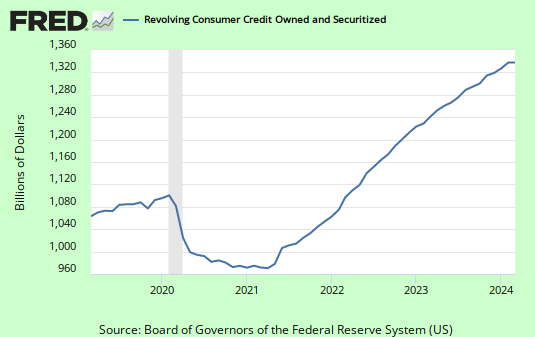
Consumer Credit -- Total Revolving Credit Outstanding (Graph)


Covers most short- and intermediate-term credit extended to individuals, excluding loans secured by real estate....


Subscribe to All American Investor via Email
Kindle: Amazon's 6" Wireless Reading Device

Friday, November 06, 2009

Reserve Bank Credit (Graph) - Securities Held Outright - Federal Agency Debt Securities


Up, Up, and Away.


Note: The current face value of federal agency obligations held by Federal Reserve Banks. These securities are direct obligations of Fannie Mae, Freddie Mac, and the Federal Home Loan Banks.
Subscribe to All American Investor via Email
Kindle: Amazon's 6" Wireless Reading Device

Saturday, October 17, 2009

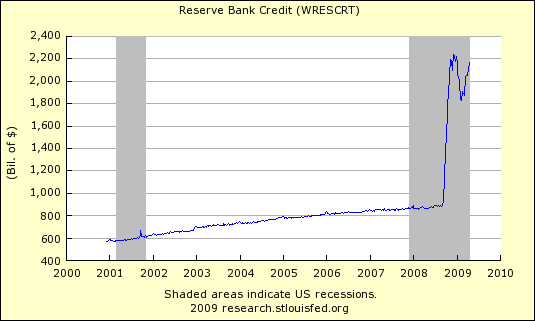
Reserve Bank Credit Remains Stubbornly High (Graph)


This is the truest measure of Fed liquidity. While Reserve Bank credit has peaked it still remains high and well above trend. This series needs to be watched closely. It is likely that the market will experience a sharp correction when the Fed starts to take out this over abundance of liquidity.

Is the market strong, or is what we are seeing being caused by this aggressive liquidity injection on the part of the Fed. In other words, are we seeing a real case of excessive exuberance?


Reserve Bank credit is the sum of securities held outright, repurchase agreements, term auction credit, other loans, net portfolio holdings of Commercial Paper Funding Facility LLC, net portfolio holdings of LLCs funded through the Money Market Investor Funding Facility, net portfolio holdings of Maiden Lane LLC, net portfolio holdings of Maiden Lane II LLC, net portfolio holdings of Maiden Lane III LLC, float, central bank liquidity swaps, and other Federal Reserve assets.
Subscribe to All American Investor via Email
Bob DeMarco is a citizen journalist and twenty year Wall Street veteran. Bob has written more than 700 articles with more than 18,000 links to his work on the Internet. Content from All American Investor has been syndicated on Reuters, the Wall Street Journal, Fox News, Pluck, Blog Critics, and a growing list of newspaper websites. Bob is actively seeking syndication and writing assignments.

Kindle: Amazon's 6" Wireless Reading Device

Saturday, August 01, 2009

Reserve Bank Credit Dropping are Higher Interest Rates Ahead (Graph)


Reserve Bank Credit is peaking. Reserve credit is down from the peak of $2,236 billions during December, 2008, the secondary top at $2,165 billions during May, 2009. The current reading is $2,010 billions.

This series should be watched closely. The current drop in the dollar could force the Federal Reserve to continue draining reserves from the system to protect the dollar from an all out free fall.

This will likely lead to an increase in long term interest rates. However, it is time to start watching the two year treasury security closely.


Note: Reserve Bank credit is the sum of securities held outright, repurchase agreements, term auction credit, other loans, net portfolio holdings of Commercial Paper Funding Facility LLC, net portfolio holdings of LLCs funded through the Money Market Investor Funding Facility, net portfolio holdings of Maiden Lane LLC, net portfolio holdings of Maiden Lane II LLC, net portfolio holdings of Maiden Lane III LLC, float, central bank liquidity swaps, and other Federal Reserve assets.
Subscribe to All American Investor via Email
Kindle: Amazon's 6" Wireless Reading Device

Wednesday, July 08, 2009

Roubini Still Concerned About the Economy


In conclusion, the outlook for the U.S. economy remains very weak. The recent rally in global equities, commodities and credit may soon fizzle out as worse-than-expected earnings and financial news take their toll on this rally, which has gotten ahead of improvements in actual macroeconomic data.

Source: RGE Monitor Newsletter
Subscribe to All American Investor via Email


Lingering Concerns:

Labor market conditions are still quite dire, more than 3.4 million jobs have been lost in 2009 and about 6.5 million have been lost since the beginning of the recession. Compare this with the 2.5 million jobs lost in the recession of 2001; 1.5 million lost in the recession of the early 1990s; 3 million in the one of the early 1980s; 2.2 million in the one of the 1970s.

The pace of job losses has fallen from the 600K plus per month registered between December and March 2009 to about 350K in May and 467K in June; the average monthly job losses in this recession is now at about 360K. While the recent slowing of losses is a positive development, we have to put this in perspective: in previous post-war recessions, average monthly job losses have ranged between 150 thousand and 260 thousand. Moreover, average weekly hours in private nonfarm payrolls are at the lowest since 1964, as employers have cut employees’ hours. Job openings and turnover openings continue to fall and are at the lowest levels since 2000, indicating continued weakness in the economy.

The U.S. consumer is still the engine of U.S. growth, and contributes to over 70% of aggregate demand. While saving rates are headed for the high single digits and high oil prices together with long-term rates keep putting a dent in personal consumption, the over-leveraged consumer is finding some support in the tax breaks of the fiscal stimulus package. Yet the over-indebted U.S. consumer – whose deleveraging process yet has to start – will likely continue to put the brakes on consumption, while the savings rate continues to creep up. While this will encourage a rebalancing in the U.S. and global economy, in the medium-term it isn’t likely to support strong U.S. and global growth.

Housing starts appear to have stabilized and will likely move sideways for quite some time. However, housing demand is not yet improving at a pace that can guarantee that the lingering inventory overhang will dissipate. This implies that home prices will continue to fall. RGE Monitor expects home prices to continue to fall through mid-2010.

U.S. industrial production has been contracting for 17 months in a row – with a short break in October 2008. Industrial production usually finds a bottom shortly after the ISM manufacturing index does. While the index probably found its bottom back in December 2008--at depression levels of 32.9--industrial production remains in a mode of contraction that started in January 2008.

Financial conditions are showing some improvement. Banks are borrowing at zero interest rates and higher net interest margin can definitely help rebuild capital. Regulatory forbearance, changes in FASB (Financial Accounting Standards Board) rules and under-provisioning might enable banks to post better than expected results for a few quarters. However, relaxation of mark-to-market rules reduces the banks’ incentives to participate in the Public-Private Investment Program (PPIP) and therefore reduces the likelihood that the program will succeed in clearing toxic assets from banks’ balance sheets. The muddle-through approach might be successful in a scenario in which the U.S. and global economy recover soon and go back to potential growth during 2010, but according to RGE’s forecasts, this is highly unlikely. While we might have positive surprises coming from the banking system in the next couple of quarters, the situation could turn around again after that, jarring confidence in financial markets in a way that would spill into the real economy. Increases in the unemployment rate, well beyond the rates envisioned by the adverse scenario of the recent bank stress tests, imply that recapitalization needs are larger than what the too-lenient stress test prescribed. The U.S financial system – in spite of the massive policy backstop – thus remains severely damaged, and the credit crunch remains unlikely to ease very fast.

A sharp rise in public debt burden – the U.S. Congressional Budget Office estimates that the public-debt-to-GDP ratio will rise from 40% to 80% (in the next decade), or about $9 trillion – will also put a dent on growth. If long-term rates were to increase to 5%, the resulting increase in the interest rate bill alone would be about $450 billion, or 3% of GDP. The implication is that the fiscal primary surplus will have to be permanently increased by 3% of GDP, which could constitute further pressure on the disposable income of the U.S. consumer.

Not only does the U.S. economy face downward risks to growth in the medium-term, but potential growth might fall as well. The U.S. population is aging. With employment still falling – and another jobless recovery on the horizon – the rate of human capital accumulation will fall. Moreover, workers who remain unemployed for a long period of time lose skills, while young workers that enter the workforce, but don’t find a job, don’t acquire on-the-job skills. Reduced investments in worker training and education, coupled with lower capital expenditure, are a recipe for lower productivity ahead.

Deflationary pressures are still present in the U.S. economy. Demand is falling relative to supply and excess capacity is still promoting slack in the goods markets. Moreover, the rising slack in labor markets, which is pushing down wages and labor costs, implies that deflationary pressures are going to be dominant this year and next year. This implies that the Fed will keep monetary policy loose for a while longer. However, discussion of an exit strategy has to start now as investors’ concerns about the Fed’s ballooning balance sheet and expectations of inflation both mount.

There are also signs that a double-dip recession could materialize toward the second half of next year, or in 2011. If oil prices rise too much, too fast, too soon, that’s going to have a negative effect in terms of trade and real disposable income in oil-importing countries. Also, concerns about unsustainable budget deficits are high and are pushing long-term interest rates higher. If these budget deficits are going to continue to be monetized, eventually, toward the end of next year, there is a risk of a sharp increase in expected inflation that could push interest rates even higher. Together with higher oil prices, driven up in part by this wall of liquidity rather than fundamentals alone, this could be a double whammy that would push the economy into a double-dip or W-shaped recession by late 2010 or 2011.

In conclusion, the outlook for the U.S. economy remains very weak. The recent rally in global equities, commodities and credit may soon fizzle out as worse-than-expected earnings and financial news take their toll on this rally, which has gotten ahead of improvements in actual macroeconomic data.


Bob DeMarco is a citizen journalist and twenty year Wall Street veteran. Bob has written more than 700 articles with more than 18,000 links to his work on the Internet. Content from All American Investor has been syndicated on Reuters, the Wall Street Journal, Fox News, Pluck, Blog Critics, and a growing list of newspaper websites. Bob is actively seeking syndication and writing assignments.


Original content All American Investor

More from All American Investor

Kindle: Amazon's 6" Wireless Reading Device

Saturday, June 13, 2009

FED Loans to AIG for Credit Default Swaps (Maiden Lane III, Graph)


On November 25, 2008, the Federal Reserve Bank of New York began extending credit to Maiden Lane III LLC.

This limited liability company was formed to purchase multi-sector collateralized debt obligations (CDOs) on which the Financial Products group of American International Group, Inc (AIG) had written credit default swap (CDS) contracts.

Net portfolio holding of Maiden Lane III at peak $28.085 billion (December 24, 2008). Current holding $19.876 billion.

FED continuing to assume risks of these credit default swap transactions.

Subscribe to All American Investor via Email


Bob DeMarco is a citizen journalist and twenty year Wall Street veteran. Bob has written more than 500 articles with more than 11,000 links to his work on the Internet. Content from All American Investor has been syndicated on Reuters, the Wall Street Journal, Fox News, Pluck, Blog Critics, and a growing list of newspaper websites. Bob is actively seeking syndication and writing assignments.


More from All American Investor

Kindle: Amazon's 6" Wireless Reading Device


Follow All American Investor on Twitter

FED Bank Reserve Credit (Graph)


Reserve Bank credit is the sum of securities held outright, repurchase agreements, term auction credit, other loans, net portfolio holdings of Commercial Paper Funding Facility LLC, net portfolio holdings of LLCs funded through the Money Market Investor Funding Facility, net portfolio holdings of Maiden Lane LLC, net portfolio holdings of Maiden Lane II LLC, net portfolio holdings of Maiden Lane III LLC, float, central bank liquidity swaps, and other Federal Reserve assets.
Subscribe to All American Investor via Email


More from All American Investor

Kindle: Amazon's 6" Wireless Reading Device


Follow All American Investor on Twitter

Tuesday, June 09, 2009

The Housing and Credit Crisis Explained


This presentation on the Housing and Credit crisis is the best I have seen. It explains everything from soup to nuts.

Each slide contains a graph that is well explained.

They say a picture is worth a thousand words.

Once you get through this, you will understanding the current credit crisis in housing, and what to expect in the years ahead.

If you take the time to view and read this you will be fully informed.

Hit the full screen button in the upper right hand corner of the panel below.

T2 Partners Presentation on the Mortgage Crisis

Subscribe to All American Investor via Email


Bob DeMarco is a citizen journalist and twenty year Wall Street veteran. Bob has written more than 500 articles with more than 11,000 links to his work on the Internet. Content from All American Investor has been syndicated on Reuters, the Wall Street Journal, Fox News, Pluck, Blog Critics, and a growing list of newspaper websites. Bob is actively seeking syndication and writing assignments.


More from All American Investor

Kindle: Amazon's 6" Wireless Reading Device


Follow All American Investor on Twitter

Sunday, June 07, 2009

Total Consumer Credit Outstanding Continues to Drop (Graph)


As you can see from the graph, Total Consumer Credit Outstanding Continues to Drop. This is an unusual pattern. After nine months down, we are now back to a level last seen during December, 2007.

If the trend continues at this pace, it will have a negative impact on GDP in the months ahead. This will certainly have an impact on future economic forecasts, consumption, and consumer spending.

Subscribe to All American Investor via Email

Bob DeMarco is a citizen journalist and twenty year Wall Street veteran. Bob has written more than 500 articles with more than 11,000 links to his work on the Internet. Content from All American Investor has been syndicated on Reuters, the Wall Street Journal, Fox News, Pluck, Blog Critics, and a growing list of newspaper websites. Bob is actively seeking syndication and writing assignments.


More from All American Investor

Kindle: Amazon's 6" Wireless Reading Device


Follow All American Investor on Twitter

Saturday, April 25, 2009

Reserve Bank Credit Soaring Again (Graph)


Reserve Bank Credit, Factors Affecting Reserve Balances

The Federal Reserve is starting to expand their balance sheet again. Week over Week.
  • The biggest increase this week is in the purchase of Mortgage Backed Securities (MBS) -- up $75 Billion. 
  • An additional $18 Billion increase in Maiden Lane LLC (Bear Stearns bailout).
  • An additional $ 34 Billion increase in Maiden Lane II LLC and Maiden Lane III LLC (AIG bailout).
  • U.S. Treasury securities held outright rose $94 Billion, and $405 Billion versus a year ago.
  • Reserve Bank Credit rose $70 Billion week, and $1.3 Trillion versus a year ago.
  • Reserve Bank Credit now stands at $2.169 Trillion and is once again approaching the peak of $2.31 Trillion (December, 2008).

Reserve Bank Credit 424

Notes: H.4.1 Reserve Bank credit is the sum of securities held outright, repurchase agreements, term auction credit, other loans, net portfolio holdings of Commercial Paper Funding Facility LLC, net portfolio holdings of LLCs funded through the Money Market Investor Funding Facility, net portfolio holdings of Maiden Lane LLC, net portfolio holdings of Maiden Lane II LLC, net portfolio holdings of Maiden Lane III LLC, float, central bank liquidity swaps, and other Federal Reserve assets
Subscribe to All American Investor via Email
Bob DeMarco is a citizen journalist and twenty year Wall Street veteran. Bob has written more than 500 articles with more than 11,000 links to his work on the Internet. Content from All American Investor has been syndicated on Reuters, the Wall Street Journal, Fox News, Pluck, Blog Critics, and a growing list of newspaper websites. Bob is actively seeking syndication and writing assignments.


Follow All American Investor on Twitter

Tuesday, March 17, 2009

Credit Card Defaults at 20 Year High


The level of defaults are reaching a dangerous level. The big question right now--has the market already discounted this information? If not, a new leg down is coming after this consolidation.
U.S. credit card defaults rose in February to their highest level in at least 20 years, with losses particularly severe at American Express Co (AXP) and Citigroup (C) amid a deepening recession.

AmEx, the largest U.S. charge card operator by sales volume, said its net charge-off rate -- debts companies believe they will never be able to collect -- rose to 8.70 percent in February from 8.30 percent in January.

Subscribe to All American Investor via Email

U.S. credit card defaults rise to 20 year-high


By Juan Lagorio

NEW YORK (Reuters) - U.S. credit card defaults rose in February to their highest level in at least 20 years, with losses particularly severe at American Express Co (AXP) amid a deepening recession.

AmEx, the largest U.S. charge card operator by sales volume, said its net charge-off rate -- debts companies believe they will never be able to collect -- rose to 8.70 percent in February from 8.30 percent in January.

The credit card company's shares wiped out early gains and ended down 3.3 percent as loan losses exceeded expectations. Moshe Orenbuch, an analyst at Credit Suisse, said American Express credit card losses were 10 basis points larger than forecast.

In addition, Citigroup Inc (C) -- one of the largest issuers of MasterCard cards -- disappointed analysts as its default rate soared to 9.33 percent in February, from 6.95 percent a month earlier, according to a report based on trusts representing a portion of securitized credit card debt.

"There is a continued deterioration. Trends in credit cards will get worse before they start getting better," said Walter Todd, a portfolio manager at Greenwood Capital Associates.

U.S. unemployment -- currently at 8.1 percent -- is seen approach 10 percent as the country endures its worst recession since World War Two, leaving more than 13 million Americans jobless, according to a Reuters poll of economists.

However, not all were bad surprises. JPMorgan Chase & Co (JPM) and Capital One reported higher credit card losses, but they were below analysts expectations.

Chase -- a big issuer of Visa cards -- reported its charge-off rate rose to 6.35 percent in February from 5.94 percent in January. The loss rate for the first two months of the quarter is 126 bps from the previous quarterly average compared to an estimate of a 145 bp increase, Orenbuch said.

Capital One Financial Corp's (COF)default rate increased to 8.06 percent in February from 7.82 percent in January.

MORE PAIN AHEAD

Analysts estimate credit card chargeoffs could climb to between 9 and 10 percent this year from 6 to 7 percent at the end of 2008. In that scenario, such losses could total $70 billion to $75 billion in 2009.

"People underestimated the severity of the downturn we are experiencing and I wouldn't be surprised to see them north of 10 percent," said Todd, who added American Express was most exposed to higher credit card losses, given its sole reliance on the industry.

Credit card lenders are trying to protect themselves by tightening credit limits, rising standards, and closing accounts. They have also been slashing rewards, raising interest rates and increasing fees to cushion further losses.

Meredith Whitney, one of Wall Street's best known and most bearish bank analysts, estimates that Americans' credit card lines will be cut by $2.7 trillion, or 50 percent, by the end of 2010 -- and fewer Americans will be offered new cards.

"We believe that the US credit card industry will feel additional credit pain over the next 12-18 months. Until lenders like Capital One show stabilization, followed by trend-bucking improvement over a several-month period, we will continue to remain bearish on credit card lenders," said John Williams, an analyst at Macquarie Research.

Todd said credit card issuers shares -- which are down up to 60 percent in 2009 -- will remain under pressure until the end of 2009, or early next year, when bad loans could start to redeem.

(Reporting by Juan Lagorio, editing by Bernard Orr)

Bob DeMarco is a citizen journalist and twenty year Wall Street veteran. Bob has written more than 500 articles with more than 11,000 links to his work on the Internet. Content from All American Investor has been syndicated on Reuters, the Wall Street Journal, Fox News, Pluck, Blog Critics, and a growing list of newspaper websites. Bob is actively seeking syndication and writing assignments.

Follow All American Investor on Twitter
More from All American Investor


Saturday, March 14, 2009

Bad Omen for U. S. Government Debt


The cost of buying a credit default sway (CDS) on U. S. government debt is soaring. The spread has widened from 14 basis points a year ago to 97 basis points now. To put this in perspective, the cost to buy insurance against the possible default of U.S. government bonds (sovereign debt) has risen to $97,000 per $1,000,000 of debt. Yikes. This makes the cost of buying insurance roughly equivalent to that of France.

The potential for a downgrade of U. S. sovereign debt is listed as considerable by Moody's. Moody's describes the current situation for the debt as:
Resilient Aaa, whose ratings are being tested but, in our view, display sufficient capacity to grow out of their debt and repair the damage.

Subscribe to All American Investor via Email
Bob DeMarco is a citizen journalist and twenty year Wall Street veteran. Bob has written more than 500 articles with more than 11,000 links to his work on the Internet. Content from All American Investor has been syndicated on Reuters, the Wall Street Journal, Fox News, Pluck, Blog Critics, and a growing list of newspaper websites. Bob is actively seeking syndication and writing assignments.


Wednesday, March 11, 2009

The Bottom Rung of Companies


I ran across an interesting list and report about bad companies on Moodys.com--The Bottom Rung. This list could be important to you if you own any of the companies. You might also get some good shorting ideas. You can get the list of the 286 companies by going through a simple registration process (free). You can also download the list into an Excel spreadsheet which makes it easy to search and easy to use.
Moody's Investors Service has launched the "Bottom Rung," a list of the lowest-rated U.S. non-financial speculative-grade companies, as a tool to help investors discern which companies are under the most stress at a time of tight credit markets and global economic weakness.
In addition to the list they also have a quarterly report that is interesting reading and explains the rating system.

You never know where your next great trading idea is going to come from--I hope this helps.
Subscribe to All American Investor via Email

Moody's: "Bottom Rung" Lists Companies Most At Risk Amid Tight Credit Markets, Weak Economy

Moody's Investors Service has launched the "Bottom Rung," a list of the lowest-rated U.S. non-financial speculative-grade companies, as a tool to help investors discern which companies are under the most stress at a time of tight credit markets and global economic weakness.

The inaugural Bottom Rung list includes the 283 companies that carry either a Probability of Default Rating of Caa1 or lower, a B3 with a negative rating outlook or a B3 with a rating under review for downgrade. These companies have not defaulted, but their current ratings indicate elevated risk of default relative to other rated corporate issuers.

"The number of companies in this low-rated tier has increased substantially, which coincides with Moody's forecasts of a sharply higher speculative-grade default rate this year," said David Keisman, senior vice president at Moody's Investors Service. "There are now nearly twice as many companies on the Bottom Rung list as there would have been a year ago."

An increasing percentage of U.S. speculative-grade companies are appearing on the Bottom Rung. More than 23% of that universe currently meets the Bottom Rung rating criteria. In contrast, 12% met the criteria in the first quarter of 2008 and just over 9% did so in the first quarter of 2007.

"Even as the overall number of speculative-grade companies increases, the percentage in the Bottom Rung continues to rise sharply as well," Keisman said. "The expansion of this low-rated tier reflects wide-ranging stress in corporate credit markets and the pronounced effects of the global economic slowdown."

Moody's currently forecasts that the trailing 12-month default rate for all U.S. speculative-grade issuers will reach 14.5% in November 2009, compared with an actual default rate of 4.4% at the end of 2008. For the already low rated Bottom Rung population as a whole, the estimated default rate over the next 12 months is just over 45%.

The probability of default varies significantly from issuer to issuer, with the companies in the lowest rating categories (C,Ca,Caa3) at a substantially higher risk of default than the companies on the list with relatively higher ratings. Moody's defines default as a bankruptcy, a missed payment of principal or interest, or a distressed exchange.

The Bottom Rung list, which will be updated monthly, is available at www.moodys.com/BottomRung, along with an accompanying quarterly research report to help investors identify trends and changes in the composition of the list.

The Bottom Rung is one of many tools and research products that Moody's provides to help investors identify companies most at risk as the default cycle begins to accelerate. These include Probability of Default Ratings, Loss Given Default assessments, Speculative Grade Liquidity ratings, and, later this year, SGL component scores. These data points, which are increasingly used in leveraged finance practice, aim to improve ratings transparency; the Bottom Rung publication will now aggregate them for each company on the list.

The Bottom Rung list does not reflect any change in Moody's analytical approach, but aggregates for investors companies with already-low ratings to help highlight the scope of stress in speculative-grade credit.

Bob DeMarco is a citizen journalist, blogger, and Caregiver. Bob has written more than 500 articles with more than 11,000 links to his work on the Internet. Content from All American Investor has been syndicated on Reuters, the Wall Street Journal, Fox News, Pluck, Blog Critics, and a growing list of newspaper websites. Bob is actively seeking syndication and writing assignments.

Follow All American Investor on Twitter
More from All American Investor


Tuesday, March 10, 2009

Credit Crunch Are Credit Cards the Next Shoe to Drop-


Without doubt, credit was extended too freely over the past 15 years, and a rationalization of lending is unavoidable. What is avoidable, however, is taking credit away from people who have the ability to pay their bills. If credit is taken away from what otherwise is an able borrower, that borrower's financial position weakens considerably. With two-thirds of the U.S. economy dependent upon consumer spending, we should tread carefully and act collectively.
I am reading stories about consumers complaining that their credit card limits are being reduced. In addition, I wrote recently about consumer complaints about sharp increases in the annual percentage rates they are paying on their credit card. It seems that credit lines are getting cut, and APRs are going up, regardless of the quality of the consumers' credit. It appears credit card companies are using zip codes to determine your credit worthiness. In other words, if the zip code you live in is experience high housing default rates or price deterioration--you are going to pay higher rates regardless of your credit history.

Today, Meredith Whitney is writing about the behavior of credit card companies. She says,
...available (credit) lines were reduced by nearly $500 billion in the fourth quarter of 2008 alone, and she estimates over $2 trillion of credit-card lines will be cut within 2009, and $2.7 trillion by the end of 2010.
When you couple this with the rising savings rate, you could easily conclude that the economy is going to grow slowly for the foreseeable future.

You should read the article below carefully and to the end.

There are going to be investment opportunities based on this trend. For example, is it a good idea to be short the major credit card companies? Are travel companies going to get "killed"? While it is not well known, a large fraction of senior citizens use credit cards to purchase their medication, is this trend going to effect the health of older people and retiring baby boomers? Or, the earnings of pharmaceutical companies?

Are you listening? Your thoughts?
Subscribe to All American Investor via Email

Credit Cards Are the Next Credit Crunch


Washington shouldn't exacerbate the looming problem in consumer credit lines.
By MEREDITH WHITNEY

Few doubt the importance of consumer spending to the U.S. economy and its multiplier effect on the global economy, but what is underappreciated is the role of credit-card availability in that spending. Currently, there is roughly $5 trillion in credit-card lines outstanding in the U.S., and a little more than $800 billion is currently drawn upon. While those numbers look small relative to total mortgage debt of over $10.5 trillion, credit-card debt is revolving and accordingly being paid off and drawn down over and over, creating a critical role in commerce in America.

Just six months ago, I estimated that at least $2 trillion of available credit-card lines would be expunged from the system by the end of 2010. However, today, that estimate now looks optimistic, as available lines were reduced by nearly $500 billion in the fourth quarter of 2008 alone. My revised estimates are that over $2 trillion of credit-card lines will be cut inside of 2009, and $2.7 trillion by the end of 2010.

Inevitably, credit lines will continue to be reduced across the system, but the velocity at which it is already occurring and will continue to occur will result in unintended consequences for consumer confidence, spending and the overall economy. Lenders, regulators and politicians need to show thoughtful leadership now on this issue in order to derail what I believe will be at least a 57% contraction in credit-card lines.

There are several factors that are playing into this swift contraction in credit well beyond the scope of the current credit market disruption. First, the very foundation of credit-card lending over the past 15 years has been misguided. In order to facilitate national expansion and vast pools of consumer loans, lenders became overly reliant on FICO scores that have borne out to be simply unreliable. Further, the bulk of credit lines were extended during a time when unemployment averaged well below 6%. Overly optimistic underwriting standards made more borrowers appear creditworthy. As we return to more realistic underwriting standards, certain borrowers will no longer appear worth the risk, and therefore lines will continue to be pulled from those borrowers.

Second, home price depreciation has been a more reliable determinant of consumer behavior than FICO scores. Hence, lenders have reduced credit lines based upon "zip codes," or where home price depreciation has been most acute. Such a strategy carries the obvious hazard of putting good customers in more vulnerable liquidity positions simply because they live in a higher risk zip code. With this, frequency of default is increased. In other words, as lines are pulled and borrowing capacity is reduced, paying borrowers are pushed into vulnerable financial positions along with nonpaying borrowers, and therefore a greater number of defaults in fact occur.

Third, credit-card lenders are currently playing a game of "hot potato," in which no one wants to be the last one holding an open credit-card line to an individual or business. While a mortgage loan is largely a "monogamous" relationship between borrower and lender, an individual has multiple relationships with credit-card providers. Thus, as lines are cut, risk exposure increases to the remaining lender with the biggest line outstanding.

Here, such a negative spiral strategy necessitates immediate action. Currently five lenders dominate two thirds of the market. These lenders need to work together to protect one another and preserve credit lines to able paying borrowers by setting consortium guidelines on credit. We, as Americans, are all in the same soup here, and desperate times are requiring of radical and cooperative measures.

And fourth, along with many important and necessary mandates regarding fairness to consumers, impending changes to Unfair and Deceptive Acts or Practices (UDAP) regulations risk the very real unintended consequence of cutting off vast amounts of credit to consumers. Specifically, the new UDAP provisions would restrict repricing of risk, which could in turn restrict the availability of credit. If a lender cannot reprice for changing risk on an unsecured loan, the lender simply will not make the loan. This proposal is set to be effective by mid-2010, but talk now is of accelerating its adoption date. Politicians and regulators need to seriously consider what unintended consequences could occur from the implementation of this proposal in current form. Short of the U.S. government becoming a direct credit-card lender, invariably credit will come out of the system.

Over the past 20 years, Americans have also grown to use their credit card as a cash-flow management tool. For example, 90% of credit-card users revolve a balance (i.e., don't pay it off in full) at least once a year, and over 45% of credit-card users revolve every month. Undeniably, consumers look at their unused credit balances as a "what if" reserve. "What if" my kid needs braces? "What if" my dog gets sick? "What if" I lose one of my jobs? This unused credit portion has grown to be relied on as a source of liquidity and a liquidity management tool for many U.S. consumers. In fact, a relatively small portion of U.S. consumers have actually maxed out their credit cards, and most currently have ample room to spare on their unused credit lines. For example, the industry credit line utilization rate (or percentage of total credit lines outstanding drawn upon) was just 17% at the end of 2008. However, this is in the process of changing dramatically.

Without doubt, credit was extended too freely over the past 15 years, and a rationalization of lending is unavoidable. What is avoidable, however, is taking credit away from people who have the ability to pay their bills. If credit is taken away from what otherwise is an able borrower, that borrower's financial position weakens considerably. With two-thirds of the U.S. economy dependent upon consumer spending, we should tread carefully and act collectively.

Ms. Whitney is CEO of Meredith Whitney Advisory Group, LLC.

Bob DeMarco is a citizen journalist, blogger, and Caregiver. Bob has written more than 500 articles with more than 11,000 links to his work on the Internet. His content has been syndicated on Reuters, the Wall Street Journal, Fox News, Pluck, Blog Critics, and a growing list of newspaper websites (15). Bob is actively seeking syndication and writing assignments.


Roubini on Global Recession, Credit Crunch, and Deflation (Part Two)


Part two of Nouriel Rubini's speech at the 2009 CBOE Risk Management Conference. He discusses several topics including: the credit crunch,  global recession, and deflation.


Subscribe to All American Investor via Email

Monday, March 02, 2009

Systemic risk defined--Too Big to Fail


Systemic risk is the risk of collapse of an entire system or entire market and not to any one individual entity or component of that system. It can be defined as "financial system instability, potentially catastrophic, caused or exacerbated by idiosyncratic events or conditions in financial intermediaries". It refers to the risks imposed by inter-linkages and inter-dependencies in a system or market, which could potentially bankrupt or bring down the entire system or market if one player is eliminated, or a cluster of failures occurs at once.[3] It is also sometimes erroneously referred to as "systematic risk".

Subscribe to All American Investor via Email
Explanation

The easiest way to understand systemic risk is to consider a bank run which has a cascading effect on other banks which are owed money by the first bank in trouble. As depositors sense the ripple effects of default, and liquidity concerns cascade through money markets, a panic can spread through a market, creating many sellers but few buyers. These inter-linkages and the potential "clustering" of bank runs are the issues which policy makers consider when addressing the issue of protecting a system against systemic risk. Governments and market monitoring institutions (such as the SEC, and central banks) often try to put policies and rules in place to safeguard the interests of the market as a whole, as all the trading participants in financial markets are entangled in a web of dependencies arising from their inter-linkages and often policy makers are concerned to protect the resiliency of the system, rather than any one individual in that system. Sometimes "picking winners" and protecting favored individual participants in a system can engender moral hazard in a system and weaken the resilience of the system as a whole.

Systemic risk should not be confused with market or price risk as the latter is specific to the item being bought or sold and the effects of market risk are isolated to the entities dealing in that specific item. This kind of risk can be mitigated by hedging an investment by entering into a mirror trade.

Consider a portfolio of perfectly hedged investments, we can say that the market risk of this portfolio is nullified. Yet, if there is a downturn in the economy and the market as a whole sinks, the hedges would not be of use. This is the systemic risk to the portfolio.

Insurance is often difficult to obtain against "systemic risks" because of the inability of any counterparty to accept the risk or mitigate against it, because, by definition, there is likely to be no (or very few) solvent counterparties in the event of a systemic crisis. For example it is difficult to obtain insurance for life or property in the event of nuclear war. The essence of systemic risk is therefore the correlation of losses. Because of the inter-dependencies between market participants, an event triggering systemic risk is much more difficult to evaluate than "specific risk". For example, while econometric estimates and expectation proxies in business cycle research led to a considerable improvement in forecasting recessions, good analysis on "systemic risk" protection is often hard to obtain, since inter-dependencies and counterparty risk in financial markets play a crucial role in times of systemic stress, and the interaction between interdependent market players is extremely difficult (or impossible) to model accurately. If one bank goes bankrupt and sells all its assets, the drop in asset prices may induce liquidity problems of other banks, leading to a general banking panic.

One concern is the potential fragility of liquidity in some highly leveraged financial markets. If the participants are trading at levels far above their capital bases, then the failure of one participant to settle trades may deprive others of liquidity, and through a domino effect expose the whole market to systemic risk.

Systemic risk can also be defined as the likelihood and degree of negative consequences to the larger body. With respect to federal financial regulation, the systemic risk of a financial institution is the likelihood and the degree that the institution's activities will negatively affect the larger economy such that unusual and extreme federal intervention would be required to ameliorate the effects.

Measurement of Systemic Risk

Too Big To Fail: The traditional analysis for assessing the risk of required government intervention is the "Too Big to Fail" Test (TBTF). TBTF can be measured in terms of an institution's size relative to the national and international marketplace, market share concentration (using the Herfindahl-Hirschman Index for example), and competitive barriers to entry or how easily a product can be substituted. While there are large companies in most financial marketplace segments, the national insurance marketplace is spread among thousands of companies, and the barriers to entry in a business where capital is the primary input are relatively minor. The policies of one homeowners insurer can be realtively easily substituted for another or picked up by a state residual market provider, with limits on the underwriting fluidity primarily stemming from state-by-state regulatory impediments, such as limits on pricing and capital mobility. There are arguably either no or extremely few insurers that are TBTF in the U.S. marketplace.

Too Interconnected to Fail: A more useful systemic risk measure than a traditional TBTF test is a "Too Interconnected to Fail" (TICTF) assessment. An intuitive TICTF analysis has been at the heart of most recent federal financial emergency relief decisions. TICTF is a measure of the likelihood and amount of medium-term net negative impact to the larger economy of an institution's failure to be able to conduct its ongoing business. The impact is measured not just on the institution's products and activities, but also the economic multiplier of all other commercial activities dependent specifically on that institution. It is also dependent on how correlated an instituion's business is with other systemic risk.

Bob DeMarco is a citizen journalist, blogger, and Caregiver. In addition to being an experienced writer he taught at the University of Georgia , was an Asociate Director and Limited Partner at Bear Stearns, was CEO of IP Group, and is a mentor. Bob currently resides in Delray Beach, FL where he cares for his mother, Dorothy, who suffers from Alzheimer's disease. Bob has written more than 500 articles with more than 11,000 links to his work on the Internet. His content has been syndicated on Reuters, the Wall Street Journal, Fox News, Pluck, BlogCritics, and a growing list of newspaper websites (15). Bob is actively seeking syndication and writing assignments.


More from All American Investor


Monday, February 23, 2009

Should Rick Santelli Care that Credit Card Companies are Raising Rates?


Where is Rick Santelli when you really need him? Ready to call people current on their mortgage--losers, Rick Santelli is no where to be found as credit card companies raise interest rates on customers--good or bad. Here is an issue you could sink your teeth into Rick, and I am going to help you understand it. No ignorance is bliss on this one.

Lets start with the reason credit card companies are raising rates. They will tell you, Rick, more customers are defaulting on their credit cards so they have to raise rates on good customers to make up the difference. So the losers--those unable to pay their credit card bills-- are causing the winners--those that are paying their credit card bills--to pay more (higher interest rates).

Credit card rates can go as high as 25-30 percent depending on state. This might get your Republican (or is it Liberatarian?) blood boiling Rick. Hillary Clinton while running for President told Ohioans,
“I’ve advocated that we rein in the credit card interest rates, cap them at 30 percent and get them below,” she said.
Ohioans owe around $30 billion on their credit cards. Gee, thanks Hillary.

Regardless of credit rating, credit card companies can charge you any rate they see fit as long as they keep it below 30 percent or the highest allowable rate in a given state. Politicians clearly in the pocket of the credit card companies are allowing these high rates of interest. Some might think of 25 percent as usury. Not as bad as loan sharking--but close.

Any of those guys that live in Barrington, Illinois that were cheering for you the other day getting screwed Rick? Would you call someone who has been paying their credit card bill month after month, year after year, a loser Rick? And, if they have been paying faithfully is it fair to raise their interest rate because "losers" aren't paying?

Rick, Help for Homeowners got you in a tizzy the other day--the rant. All of housing accounts for about 16 percent of GDP. The biggest category in GDP is retail sales. Retail sales account for about 66-70 percent of GDP. So when a credit card company raises interest rates they take money away from retail sales the lifeblood of GDP. I think it is safe to assume that most people paying interest on a credit cards are living pay check to pay check. So, their disposal income goes down if they have to send more bucks to the credit card company. As an aside, credit card companies are also raising minimum payments. Isn't this anti-American Rick?

Rick, someone needs to wake up the Obama administration about this. You seem to have their attention, and I bet if you attack on this issue not only will your blackberry freeze it will likely explode--this is the stuff that makes hero's. Somebody has to do it Rick--and you are the best man for the job.

By the way Rick, the banks that received TARP money are raising credit cards interest rates on existing credit card customers. This means they are taking your hard earned bucks and robbing the winners. I think its time for you to get your constituency riled up.
Subscribe to All American Investor via Email

Source of these quotes: Credit Card Companies Raising Rates on Consumers
  • “I received notice that the interest on my Chase card will go up from 4.24% APR to 9.24%,” Chase customer John Biek said in an email to FOX Business.

  • Gary Barrett told FOX Business that his Capital One card rate was going to increase from 14.3% to 17.9%. “This is a card that normally I carry a balance of less than $800, and frequently it has no balance due, and I have never been late on a payment,” Barrett wrote in an email.

  • And Patricia of York, Pa., said in an email that her Capital One Visa will see a hike as well: “My current rate of interest is 5.37%. The notice states that [the] rate increase will go to 13.9% on purchases [and] 24.9% on cash advance.”

  • “Bank of America is doing the most dramatic changes I’ve seen,” said Emily Peters, a personal-finance expert for Credit.com. She said she has heard of cases where BofA card rates have been going up 10 to 20 percentage points.


Feel free to email this to Rick Santelli.

Rick's CNBC Bio

More from All American Investor


Friday, January 23, 2009

Are the Democrats peddling voodoo economics?


Voodoo economics: a slanderous term used by President George H. W. Bush in reference to President Reagan's economic policies known as Reaganomics. Now known as "trickle down economics" by democrats. Bush used the term voodoo economics to categorize Reagan's strategy of extreme supply side economics. One of the early tenants of supply side economics was that that across-the-board cuts in income-tax rates might raise overall tax revenues.
It now appears that the new theory being espoused by the Obama administration is the use of extreme demand side economics. The theory being that each dollar of government spending can increase the nation’s gross domestic product by more than a dollar. In some arguments the multiplier is as high as 1.5 times.

This has me thinking two things. First, if this is true why don't we spend two trillion dollars instead of one trillion? Second, why are savings in such ill repute that no one is saying a single word about savings. The argument being used right now is that savings do not add to demand--in other words if people save then they don't spend. As I look at past bull markets, they are always preceded by savings. Prior to the latest bull market in the U. S. the savings rate soared to 8 percent. More recently, saving rates have dwindled to zero percent and sometimes less than zero.

I don't think it is a crazy to assume that over consumption and creating artificial demand for things like houses and cars is part of our problem. Our current problems are being caused by the use of credit gone wild. Nevertheless, the government is proposing spending over savings, and by the way, they will borrow the money to do it. On the other hand, when people save they have to invest it somewhere--usually in stocks, bonds, or bank CDs. This helps the economy grow and creates jobs because these savings get invested directly into companies or in the form of loans by banks to companies.

The articles by economist for and against the stimulus package are coming out rapid fire. Here are a few that are very thought provoking.

Is Government Spending Too Easy an Answer?
Government Spending Is No Free Lunch
Let's Stimulate Private Risk Taking
Subscribe to All American Investor via Email

Sunday, January 18, 2009

The End of the Wall Street Boom


Michael Lewis is best known for his books Liar's Poker, The New New Thing, and Moneyball: The Art of Winning an Unfair Game. Lewis started his career in finance as a bond trader at Solomon Brothers. In Liar's Poker he gave a first-person account of how bond traders and salesmen truly work, their personalities, and their culture. The account was less than flattering to most and lead Lewis to conclude that anyone could make millions on Wall Street if they were in the "right place at the right time".

In this new article, The End of the Wall Street Boom, Lewis gives the best account of of the subprime mortgage business and the "phoney baloney" use of credit default swaps currently available. He delves into the craziness of it all and names many of the key players. It is a very good description of greed gone wrong.
I had been waiting for the end of Wall Street. The outrageous bonuses, the slender returns to shareholders, the never-ending scandals, the bursting of the internet bubble, the crisis following the collapse of Long-Term Capital Management: Over and over again, the big Wall Street investment banks would be, in some narrow way, discredited. Yet they just kept on growing, along with the sums of money that they doled out to 26-year-olds to perform tasks of no obvious social utility.
He couldn’t figure out exactly how the rating agencies justified turning BBB loans into AAA-rated bonds. “I didn’t understand how they were turning all this garbage into gold".
The reason they did this was that the rating agencies, presented with the pile of bonds backed by dubious loans, would pronounce most of them AAA. These bonds could then be sold to investors—pension funds, insurance companies—who were allowed to invest only in highly rated securities. “I cannot fucking believe this is allowed—I must have said that a thousand times in the past two years,” Eisman says.
“We have a simple thesis,” Eisman explained. “There is going to be a calamity, and whenever there is a calamity, Merrill is there.”
This was what they had been waiting for: total collapse. “The investment-banking industry is fucked,” Eisman had told me a few weeks earlier. “These guys are only beginning to understand how fucked they are. It’s like being a Scholastic, prior to Newton. Newton comes along, and one morning you wake up: ‘Holy shit, I’m wrong!’ ” Now Lehman Brothers had vanished, Merrill had surrendered, and Goldman Sachs and Morgan Stanley were just a week away from ceasing to be investment banks. The investment banks were not just fucked; they were extinct.

The End of the Wall Street Boom


Subscribe to EF Hutton via Email

Follow EF Hutton on Twitter