Showing posts with label economy. Show all posts

Friday, August 16, 2013

PRODUCTIVITY AND COSTS, Second Quarter 2013


PRODUCTIVITY AND COSTS, Second Quarter 2013, Preliminary

Nonfarm business sector labor productivity increased at a 0.9 percent annual rate during the second quarter of 2013, the U.S. Bureau of Labor Statistics reported today.

The increase in productivity reflects increases of 2.6 percent in output and 1.7 percent in hours worked. (All quarterly percent changes in this release are seasonally adjusted annual rates.)

From the second quarter of 2012 to the second quarter of 2013, productivity was unchanged as output and hours worked both increased 1.8 percent. (See table A.)

Labor productivity, or output per hour, is calculated by dividing an index of real output by an index of hours worked of all persons, including employees, proprietors, and unpaid family workers.


Original content +Bob DeMarco , All American Investor

Friday, August 02, 2013

U.S. ECONOMIC STATISTICS - MONTHLY DATA


Monitoring the Economy.
The Office of Economic Policy monitors key economic indicators to produce the following summary tables of monthly and quarterly U.S. economic statistics.


Original content +Bob DeMarco , All American Investor

Saturday, June 08, 2013

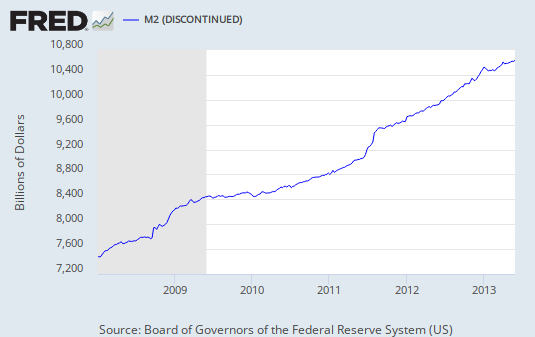
M2, Money Supply, 2008 to the Present Chart


M2 Money Stock (M2)

10,557.6 Billions of Dollars

FRED Graph


M2 includes a broader set of financial assets held principally by households. M2 consists of M1 plus: (1) savings deposits (which include money market deposit accounts, or MMDAs); (2) small-denomination time deposits (time deposits in amounts of less than $100,000); and (3) balances in retail money market mutual funds (MMMFs). Seasonally adjusted M2 is computed by summing savings deposits, small-denomination time deposits, and retail MMMFs, each seasonally adjusted separately, and adding this result to seasonally adjusted M1.

Original content Bob DeMarco, All American Investor

Wednesday, May 29, 2013

METROPOLITAN AREA EMPLOYMENT AND UNEMPLOYMENT —APRIL 2013


Jobless rates were lower in April than a year earlier in 276 of the 372 metropolitan areas, higher in 78, and unchanged in 18.

Nonfarm payroll employment was up in 274 metropolitan areas over the year, down in 88, and unchanged in 10.

Read the full blown report

Original content +Bob DeMarco , All American Investor

Monday, March 05, 2012

Stocks and Economy News 119


China Slices 2012 Growth Target to Eight-Year Low

Chinese Premier Wen Jiabao cut his nation's 2012 growth target to an eight-year low of 7.5 percent and made boosting consumer demand the year's first priority as Beijing looks to wean the economy off its reliance on external demand and foreign capital.
He lowered the target from a longstanding annual goal of 8 percent, a move investors anticipated so that Beijing has some economic leeway to rebalance the economy and defuse price pressures in the run up to a leadership change later this year.
Read more

All American Investor

Thursday, August 19, 2010

Economist on Jobless Claims and the Market


Economists and others weigh in on the jump in jobless claims.

– Initial claims climbed to its highest level in the past 9 months. Although new claims are often very volatile during the summer due to seasonal adjustment difficulties, these data still suggest a softer labor market. Although new claims are still much lower than they were a year ago, they are still relatively high and are no longer trending lower. –Steven A. Wood, Insight Economics

Wednesday, August 18, 2010

PIMCO Boss Bill Gross Calls For Massive Taxpayer-Backed Mortgage Refinance Initiative


Gross said the refi scheme would spur some $50-60 billion a year in new consumer spending and raise home prices between 5-10 percent.


Wednesday, July 21, 2010

The United States of...China?


clipped from money.cnn.com
The United States of...China?
China's great outward march of investing into the United States is turning into a mad dash. Chinese investments into the U.S. rose 360% in the first half of this year compared to last year, according to Chinese government figures released Tuesday.
china_factory_main.top.jpg

The Ministry of Commerce in Beijing has not yet released actual figures except to say that the total of its global overseas investments had reached $55.2 billion by the end of June, compared to $43.3 billion for the entirety of 2009. Last year, Chinese companies announced new direct investments in the U.S. of close to $5 billion -- up from an average of $500 million a year previously, according to economic consultancy the Rhodium Group.

 blog it

Wednesday, July 07, 2010

Roubini Gloomy News on U.S. Employment


We still believe that the second half of the year will display weaker growth as personal consumption growth aligns with income growth, inventory growth aligns with final sales (still a weak spot) and fiscal stimulus turns neutral or becomes a drag on growth. In normal times, the labor market needs to create around 130,000-150,000 jobs per month to absorb increases in the work force. Clearly, given the slack in the market, job creation must go substantially beyond that range to reduce the unemployment rate during this recovery.

Friday, July 02, 2010

Percentage of S and P 500 Stocks Above 50-Days Down to 4%


via Steve Cook

The percentage of stocks in the S&P 500 now trading above their 50-day moving averages is down to 4%.  At the March 2009 lows, the reading only got down to 5%, so that gives investors a good idea of just how extreme this decline has gotten.

 blog it

Wednesday, June 30, 2010

M2, Money Supply a Sobering View (Graph) -- A Look Beyond the Obvious


Sometimes you have to look beyond the obvious.

Robert Shiller Says the Depression Scare is Back


Subscribe to All American Investor
Enter Your Email Address

Wednesday, June 23, 2010

Roubini: What a Flexible Yuan Means for the Economy


Back in April, when we were piecing together our last quarterly outlook on China, we projected that China would begin to allow renminbi appreciation against the U.S. dollar around mid-year. Last weekend’s announcement, then, came about two weeks ahead of schedule... We won’t complain!

Subscribe to All American Investor
Enter Your Email Address

Thursday, November 26, 2009

How Little We Know: The Challenges of Financial Reform


Good read.

To read this article --go here.

Subscribe to All American Investor via Email
Kindle: Amazon's 6" Wireless Reading Device


Original content Bob DeMarco, All American Investor

Friday, October 02, 2009

Jobless 27 Weeks or Longer Soars to 5.4 Million


15.1 million Americans are now out of work. Or if you look at real unemployment-- 17 million.

One of the scariest statistics is the number of people unemployed 27 weeks or longer -- now 5.4 million. This number soared by 450,000 in the last month.

At 27 weeks, people start losing their unemployment benefits. Then what?

This number is likely to rise by another million plus by the end of the year?

This does not bode well for the economy or the the Christmas retail sales season.

Sources of Information

Real Unemployment Jumps to 17.0 Percent (Explanation)

Bureau of Labor Statistics -- Employment Situation news release

Table 12 in the Bureau of Labor Statistics

Commissioner's Statement on the Employment Situation

Follow All Anerican Investor on Twitter


Kindle: Amazon's 6" Wireless Reading Device

Tuesday, September 15, 2009


The Producer Price Index for Finished Goods advanced 1.7 percent in August, seasonally
adjusted. This increase followed a 0.9-percent decline in July and a 1.8-percent advance in June.

Prices for finished goods less foods and energy rose 0.2 percent in August after edging down 0.1 percent a month earlier.


Subscribe to All American Investor via Email

The Producer Price Index for Finished Goods advanced 1.7 percent in August, seasonally adjusted, the Bureau of Labor Statistics of the U.S. Department of Labor reported today. This increase followed a 0.9-percent decline in July and a 1.8-percent advance in June. In August, at the earlier stages of processing, prices received by manufacturers of intermediate goods rose 1.8 percent and the crude goods index moved up 3.8 percent. On an unadjusted basis, prices for finished goods fell 4.3 percent from August 2008 to August 2009, following a record 6.8 percent 12-month decline in July.

Finished goods

In August, over ninety percent of the finished goods increase was the result of higher energy prices, which moved up 8.0 percent. The indexes for finished goods less foods and energy and for finished consumer foods also contributed to the advance in finished goods prices, rising 0.2 percent and 0.4 percent, respectively.

Finished energy: The index for finished energy goods climbed 8.0 percent in August, the largest monthly increase since a 10.2-percent rise in November 2007. About eighty-five percent of the August advance can be attributed to higher gasoline prices, which surged 23.0 percent. Rising prices for home heating oil and liquefied petroleum gas also contributed to the increase in the finished energy goods index. (See table 2.)

Finished core: Prices for finished goods less foods and energy rose 0.2 percent in August after edging down 0.1 percent a month earlier. Accounting for over half of this increase, the light motor trucks index moved up 0.8 percent. Higher prices for passenger cars also were a major factor in the advance in the finished core index.

Finished foods: Prices for finished consumer foods moved up 0.4 percent in August following a 1.5-percent decline in July. Almost half of this increase can be attributed to higher prices for fresh fruits and melons, which rose 5.9 percent.

Intermediate goods

The Producer Price Index for Intermediate Materials, Supplies, and Components advanced 1.8 percent after falling 0.2 percent in July. Accounting for about eighty percent of the August increase, prices for intermediate energy goods rose 7.1 percent. Prices for intermediate materials less foods and energy gained 0.6 percent and the index for intermediate foods and feeds moved up 0.3 percent. For the 12 months ending in August, the decline in intermediate goods prices slowed to 12.3 percent from a record decrease of 15.1 percent from July 2008 to July 2009. (See table B.)

Intermediate energy: The index for intermediate energy goods increased 7.1 percent after decreasing 1.4 percent in July. A major contributor to the August increase was diesel fuel prices, which rose 15.9 percent. Higher prices for gasoline and lubricating oil base stocks also had a significant impact on the intermediate energy goods index. (See table 2.)

Intermediate core: Prices for intermediate materials less foods and energy climbed 0.6 percent, the third consecutive monthly increase. Accounting for over half of the gain in August, the steel mill products index increased 6.8 percent. Rising prices for primary basic organic chemicals also had a considerable effect on the intermediate core index.

Intermediate foods: The index for intermediate foods and feeds advanced 0.3 percent after declining 2.0 percent in July. A 6.1-percent increase in the index for corn, cottonseed, and soybean cake and meal accounted for nearly all of the increase in intermediate foods and feeds prices.

Source Bureau of Labor Statistics of the U.S. Department of Labor


Bob DeMarco is a citizen journalist and twenty year Wall Street veteran. Bob has written more than 500 articles with more than 11,000 links to his work on the Internet. Content from All American Investor has been syndicated on Reuters, the Wall Street Journal, Fox News, Pluck, Blog Critics, and a growing list of newspaper websites. Bob is actively seeking syndication and writing assignments.


Kindle: Amazon's 6" Wireless Reading Device

Wednesday, September 02, 2009

New Orders Durable Goods (Chart)


New orders for Durable goods orders to rise from the March lows, however you can see they are still well below trend. This series will be important to watch in the last quarter of this year.

Subscribe to All American Investor via Email
Kindle: Amazon's 6" Wireless Reading Device

Manufacturing ISM Report On Business (NAPM, Graph)


The Institute for Supply Management factory index (ISM)index rose to 52.9% in August, the first time the index has been above 50% since the early days of the recession in January 2008.


"The year-and-a-half decline in manufacturing output has come to an end, as 11 of 18 manufacturing industries are reporting growth when comparing August to July. While this is certainly a positive occurrence, we have to keep in mind that it is the beginning of a new cycle and that all industries are not yet participating in the growth. The August index of 52.9 percent is the highest since June 2007. The 4 percentage point increase was driven by significant strength in the New Orders Index, which is up 9.6 points to 64.9 percent, the highest since December 2004. The growth appears sustainable in the short term, as inventories have been reduced for 40 consecutive months and supply chains will have to re-stock to meet this new demand."
Subscribe to All American Investor via Email
WHAT RESPONDENTS ARE SAYING ...

  • "Production is picking up as demand [for] orders is being accelerated." (Nonmetallic Mineral Products)
  • "Demand from automotive manufacturers increasing thanks to 'Cash for Clunkers.'" (Fabricated Metal Products)
  • "In addition to improved business come the complications of a supply chain drained of inventory." (Paper Products)
  • "The sudden increase in customer demand, plus the low inventories held at services centers, is causing a shortage in the supply of raw steel." (Transportation Equipment)
  • "[It] appears customers' inventories are getting low, and they are cautiously placing orders." (Apparel, Leather & Allied Products)
PMI

Manufacturing's 18 consecutive months of decline ended in August as the PMI registered 52.9 percent, which is 4 percentage points higher than the 48.9 percent reported in July. This is the highest reading since June 2007, when the index also registered 52.9 percent. A reading above 50 percent indicates that the manufacturing economy is generally expanding; below 50 percent indicates that it is generally contracting.

A PMI in excess of 41.2 percent, over a period of time, generally indicates an expansion of the overall economy. Therefore, the PMI indicates growth for the fourth consecutive month in the overall economy, as well as expansion in the manufacturing sector for the first time since January 2008. Ore stated, "The past relationship between the PMI and the overall economy indicates that the average PMI for January through August (42.2 percent) corresponds to a 0.3 percent increase in real gross domestic product (GDP). However, if the PMI for August (52.9 percent) is annualized, it corresponds to a 3.7 percent increase in real GDP annually."


Bob DeMarco is a citizen journalist and twenty year Wall Street veteran. Bob has written more than 700 articles with more than 18,000 links to his work on the Internet. Content from All American Investor has been syndicated on Reuters, the Wall Street Journal, Fox News, Pluck, Blog Critics, and a growing list of newspaper websites. Bob is actively seeking syndication and writing assignments.


Kindle: Amazon's 6" Wireless Reading Device

Friday, August 07, 2009

People Unemployed 27 Weeks or Longer Rises Sharply (Chart)


News on unemployment was pretty good this morning, right?

The number of people unemployed 27 weeks or longer rose to 4,965,000 versus 4,381,000 a month ago.

Subscribe to All American Investor via Email

Kindle: Amazon's 6" Wireless Reading Device

Tuesday, August 04, 2009

Manufacturing ISM Report On Business (NAPM, Graph)


Economic activity in the manufacturing sector failed to grow in July for the 18th consecutive month, while the overall economy grew for the third consecutive month, say the nation's supply executives in the latest Manufacturing ISM Report On Business®.


The current index is 48.9 versus 44.8 in June. An increase of 4.1 percent.

A PMI reading above 50 percent indicates that the manufacturing economy is generally expanding; below 50 percent that it is generally declining. Institute for Supply Management.
Subscribe to All American Investor via Email

Kindle: Amazon's 6" Wireless Reading Device