Showing posts with label price. Show all posts

Friday, November 09, 2012

U.S. IMPORT AND EXPORT PRICE INDEXES - OCTOBER 2012


The price index for U.S. imports rose 0.5 percent in October, the U.S. Bureau of Labor Statistics reported today, following increases for each of the previous two months. 

Higher fuel and nonfuel prices each contributed to the October advance. U.S. export prices were unchanged in October after increasing 0.8 percent in September.

All American Investor

Wednesday, May 19, 2010

CONSUMER PRICE INDEX –APRIL 2010


On a seasonally adjusted basis, the Consumer Price Index for All Urban Consumers (CPI-U) declined 0.1 percent in April, the U.S. Bureau of Labor Statistics reported today. Over the last 12 months, the index increased 2.2 percent before seasonal adjustment.

Wednesday, November 18, 2009

CONSUMER PRICE INDEX (Chart and Text) OCTOBER 2009


On a seasonally adjusted basis, the Consumer Price Index for All Urban Consumers (CPI-U) rose 0.3 percent in October, the U.S. Bureau of Labor Statistics reported today.

The index has decreased 0.2 percent over the last 12 months on a not seasonally adjusted basis.


Subscribe to All American Investor via Email


The seasonally adjusted all items increase largely reflected advances in the indexes for energy and for new and used motor vehicles. The energy index rose for the fifth time in the last six months, advancing 1.5 percent as the indexes for gasoline, fuel oil, natural gas, and electricity all increased.

The index for all items less food and energy rose 0.2 percent in October, the same increase as in September.

The indexes for used cars and trucks and for new vehicles both rose sharply and together they accounted for over 90 percent of the increase in the index for all items less food and energy.

The indexes for airline fares and medical care also increased, while the shelter index was unchanged and the indexes for apparel and recreation declined.

The food index also increased in October, rising 0.1 percent after declining in two of the previous three months. The index for food away from home increased slightly, while the food at home index was unchanged. Within the food at home group, the index for dairy and related products rose significantly, while the fruits and vegetables index declined for the fourth straight month.

Consumer Price Index Data for October 2009

Food

The food index rose 0.1 percent in October after declining 0.1 percent in September. The index for food away from home increased 0.1 percent while the food at home index was unchanged. Within the food at home group, the index for dairy and related products rose 1.0 percent in October after a 0.5 percent increase in September, and the index for other food at home advanced 0.3 percent. These increases were offset by a 0.7 percent decline in the fruits and vegetables index and 0.2 percent decreases in the indexes for meats, poultry, fish, and eggs and for nonalcoholic beverages. The index for cereals and bakery products was unchanged in October. Over the past 12 months, the food index has declined 0.6 percent with the food at home index down 2.8 percent.

Energy

The energy index rose 1.5 percent in October after increasing 0.6 percent in September. The index for energy commodities rose 1.9 percent, with the gasoline index increasing 1.6 percent. (Before seasonal adjustment, gasoline prices fell 0.8 percent in October.) The index for fuel oil rose 6.3 percent. The index for energy services, which increased 0.1 percent in September, rose 0.9 percent in October. The electricity index increased 0.6 percent while the index for natural gas rose 1.9 percent in October after declining 1.7 percent in September. Over the past 12 months, the energy index has fallen 14.0 percent with the gasoline index declining 17.9 percent.

All items less food and energy

The index for all items less food and energy rose 0.2 percent in October, the same increase as in September. Most of the advance was due to increases in transportation indexes. The new vehicles index rose 1.6 percent and the index for used cars and trucks rose 3.4 percent, its third consecutive substantial increase.

The index for airline fares rose for the fourth straight month, increasing 1.7 percent in October.

Outside of the transportation group, the changes within all items less food and energy were largely modest.

The medical care index rose 0.2 percent in October after increasing 0.4 percent in September.

The shelter index was unchanged in October, as it was in September. The rent index decreased 0.1
percent, the index for owners’ equivalent rent was unchanged, and the index for lodging away from home rose 0.4 percent.

Posting declines in October were the indexes for recreation and apparel, which both fell 0.4 percent. For the past 12 months, the index for all items less food and energy has risen 1.7
percent.

Kindle: Amazon's 6" Wireless Reading Device


Original content Bob DeMarco, All American Investor

Tuesday, November 17, 2009

Producer Price Index Graph 1117


The Producer Price Index for Finished Goods advanced 0.3 percent in October, seasonally adjusted, the U.S. Bureau of Labor Statistics reported today.

This increase followed a 0.6-percent decline in September and a 1.7-percent rise in August.

In October, at the earlier stages of processing, prices received by manufacturers of intermediate goods moved up 0.3 percent and the crude goods index increased 5.4 percent.

On an unadjusted basis, from October 2008 to October 2009, prices for finished goods fell 1.9 percent, the eleventh consecutive month of year-over-year declines.


Subscribe to All American Investor via Email

Kindle: Amazon's 6" Wireless Reading Device


Original content Bob DeMarco, All American Investor

Tuesday, October 20, 2009

Poducer Price Index (PPI) Details 1020


On an unadjusted basis, from September 2008 to September 2009, prices for finished goods fell 4.8 percent, the tenth consecutive month of year-over-year declines.

The Producer Price Index for Finished Goods declined 0.6 percent in September, seasonally adjusted, the Bureau of Labor Statistics of the U.S. Department of Labor reported today.

This decrease followed a 1.7-percent rise in August and a 0.9-percent decline in July.

In September, at the earlier stages of processing, prices received by manufacturers of intermediate goods moved up 0.2 percent, and the crude goods index fell 2.1 percent.
Subscribe to EF Hutton via Email

Finished goods

In September, over ninety percent of the finished goods decrease was the result of lower energy prices, which moved down 2.4 percent. The indexes for finished goods less foods and energy and for finished consumer foods also contributed to the decline in finished goods prices, both edging down 0.1 percent.

Finished energy: The index for finished energy goods fell 2.4 percent in September compared with an 8.0-percent surge a month earlier. Almost eighty percent of the decrease can be attributed to gasoline prices, which moved down 5.4 percent. Falling prices for home heating oil and residential natural gas also contributed to the decline in the finished energy goods index.

Finished core: Prices for finished goods less foods and energy edged down 0.1 percent in September following a 0.2-percent increase in August. Leading the decline, the index for light motor trucks moved down 1.4 percent. Lower prices for pet food also impacted the finished core index.

Finished foods:

Prices for finished consumer foods inched down 0.1 percent in September after rising
0.4 percent in August. The index for eggs for fresh use, which declined 9.8 percent, led the decrease in finished consumer food prices.

Intermediate goods

The Producer Price Index for Intermediate Materials, Supplies, and Components moved up 0.2 percent in September, its second consecutive monthly increase. This advance can be attributed to prices for intermediate materials less foods and energy, which rose 0.9 percent. By contrast, the index for intermediate energy goods fell 2.1 percent, and prices for intermediate foods and feeds declined 0.5 percent. On a 12-month basis, the intermediate goods index fell 11.7 percent in September. This was the second consecutive month of slowing year-over-year declines after a record 15.1-percent drop for the 12-months ended July 2009.

Intermediate core: Prices for intermediate materials less foods and energy climbed 0.9 percent in September, their fourth consecutive monthly increase. Accounting for about a quarter of the September advance, the index for primary basic organic chemicals rose 8.1 percent. Higher prices for hot rolled steel sheet and strip and for primary nonferrous metals also were factors in the intermediate core increase.

Follow E F Hutton on Twitter

Kindle: Amazon's 6" Wireless Reading Device

Tuesday, September 15, 2009


The Producer Price Index for Finished Goods advanced 1.7 percent in August, seasonally
adjusted. This increase followed a 0.9-percent decline in July and a 1.8-percent advance in June.

Prices for finished goods less foods and energy rose 0.2 percent in August after edging down 0.1 percent a month earlier.


Subscribe to All American Investor via Email

The Producer Price Index for Finished Goods advanced 1.7 percent in August, seasonally adjusted, the Bureau of Labor Statistics of the U.S. Department of Labor reported today. This increase followed a 0.9-percent decline in July and a 1.8-percent advance in June. In August, at the earlier stages of processing, prices received by manufacturers of intermediate goods rose 1.8 percent and the crude goods index moved up 3.8 percent. On an unadjusted basis, prices for finished goods fell 4.3 percent from August 2008 to August 2009, following a record 6.8 percent 12-month decline in July.

Finished goods

In August, over ninety percent of the finished goods increase was the result of higher energy prices, which moved up 8.0 percent. The indexes for finished goods less foods and energy and for finished consumer foods also contributed to the advance in finished goods prices, rising 0.2 percent and 0.4 percent, respectively.

Finished energy: The index for finished energy goods climbed 8.0 percent in August, the largest monthly increase since a 10.2-percent rise in November 2007. About eighty-five percent of the August advance can be attributed to higher gasoline prices, which surged 23.0 percent. Rising prices for home heating oil and liquefied petroleum gas also contributed to the increase in the finished energy goods index. (See table 2.)

Finished core: Prices for finished goods less foods and energy rose 0.2 percent in August after edging down 0.1 percent a month earlier. Accounting for over half of this increase, the light motor trucks index moved up 0.8 percent. Higher prices for passenger cars also were a major factor in the advance in the finished core index.

Finished foods: Prices for finished consumer foods moved up 0.4 percent in August following a 1.5-percent decline in July. Almost half of this increase can be attributed to higher prices for fresh fruits and melons, which rose 5.9 percent.

Intermediate goods

The Producer Price Index for Intermediate Materials, Supplies, and Components advanced 1.8 percent after falling 0.2 percent in July. Accounting for about eighty percent of the August increase, prices for intermediate energy goods rose 7.1 percent. Prices for intermediate materials less foods and energy gained 0.6 percent and the index for intermediate foods and feeds moved up 0.3 percent. For the 12 months ending in August, the decline in intermediate goods prices slowed to 12.3 percent from a record decrease of 15.1 percent from July 2008 to July 2009. (See table B.)

Intermediate energy: The index for intermediate energy goods increased 7.1 percent after decreasing 1.4 percent in July. A major contributor to the August increase was diesel fuel prices, which rose 15.9 percent. Higher prices for gasoline and lubricating oil base stocks also had a significant impact on the intermediate energy goods index. (See table 2.)

Intermediate core: Prices for intermediate materials less foods and energy climbed 0.6 percent, the third consecutive monthly increase. Accounting for over half of the gain in August, the steel mill products index increased 6.8 percent. Rising prices for primary basic organic chemicals also had a considerable effect on the intermediate core index.

Intermediate foods: The index for intermediate foods and feeds advanced 0.3 percent after declining 2.0 percent in July. A 6.1-percent increase in the index for corn, cottonseed, and soybean cake and meal accounted for nearly all of the increase in intermediate foods and feeds prices.

Source Bureau of Labor Statistics of the U.S. Department of Labor


Bob DeMarco is a citizen journalist and twenty year Wall Street veteran. Bob has written more than 500 articles with more than 11,000 links to his work on the Internet. Content from All American Investor has been syndicated on Reuters, the Wall Street Journal, Fox News, Pluck, Blog Critics, and a growing list of newspaper websites. Bob is actively seeking syndication and writing assignments.


Kindle: Amazon's 6" Wireless Reading Device

Wednesday, April 15, 2009

Consumer Price Index (CPI) - All Urban Consumers (Chart)


The Consumer Price Index for All Urban Consumers (CPI-U) increased
0.2 percent in March, before seasonal adjustment, the Bureau of Labor
Statistics of the U.S. Department of Labor reported today. The index has
decreased 0.4 percent over the last year, the first 12 month decline since
August 1955.


Consumer Price Index - All Urban Consumers 415
Subscribe to All American Investor via Email

Report and Tables

On a seasonally adjusted basis, the CPI-U decreased 0.1 percent in
March after rising 0.4 percent in February. The decrease was due to a
downturn in the energy index, which declined 3.0 percent in March after
rising 3.3 percent the previous month. All the energy indexes decreased,
particularly the indexes for fuel oil, natural gas, and motor fuel. The
food index declined 0.1 percent for the second straight month to virtually
the same level as October 2008. The food at home index declined 0.4
percent, the second straight such decrease, as the index for dairy and
related products continued to decline.

The index for all items less food and energy increased 0.2 percent
for the third month in a row. An 11.0 percent increase in the index for
tobacco and smoking products accounted for over sixty percent of the March
rise, with a 0.6 percent increase in the new vehicles index also
contributing. In contrast, the indexes for lodging away from home, used
cars and trucks, and airline fares continued to decline. The index for
all items less food and energy has risen 1.8 percent over the past year.

Bob DeMarco is a citizen journalist and twenty year Wall Street veteran. Bob has written more than 500 articles with more than 11,000 links to his work on the Internet. Content from All American Investor has been syndicated on Reuters, the Wall Street Journal, Fox News, Pluck, Blog Critics, and a growing list of newspaper websites. Bob is actively seeking syndication and writing assignments.


More from All American Investor


Follow All American Investor on Twitter

Tuesday, March 31, 2009

S & P Case Shiller Home Price Indices Chart


Data through January 2009, released today by Standard & Poor’s for its S&P/Case-Shiller1 Home Price Indices, the leading measure of U.S. home prices, shows continued broad based declines in the prices of existing single family homes across the United States, with 13 of the 20 metro areas showing record rates of annual decline, and 14 reporting declines in excess of 10% versus January 2008.


SP Case Shiller Home Price Indices Chart


Follow All American Investor on Twitter
Subscribe to All American Investor via Email

Source: S&P/Case-Shiller Home Price Indices

Sunday, March 29, 2009

Is the Barrons Cover the Kiss of Death for Jeff Bezos and Amazon (AMZN)?


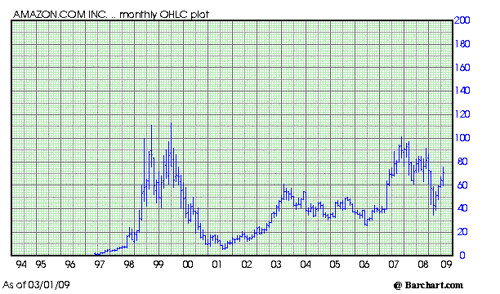
Wow. Last night, just after midnight I wrote about Amazon (AMZN)--Amazon . Toast up 5000 percent since IPO (Chart).

Next thing I know, an article from Barron's pops into my reader--The World's Best Retailer. Ironic? Well, yeah.

Here is a note of caution. Jeff Bezos is on the cover of Barron's this week. Why is this important?

If you read my article, Amazon . Toast, all the way to the end you would have noticed that Jeff Bezos was named Time's person of the year in 1999. What happened next? The stock dropped from a split adjusted $113 a share, all the way down to $5.67. Yikes.

Is the Barron's cover the kiss of death for Jeff Bezos and Amazon?
Subscribe to All American Investor via Email

Jeff Bezos' Amazon.com is winning customers with competitive prices, wide selection, reliability -- and Kindle. It's winning shareholders, too.


The World's Best Retailer --Barron's

THIS MAY BE AN OPPORTUNE time to add shares of Amazon.com to your shopping cart and proceed to checkout.
Now, Amazon is taking that a step further by providing Web services, better known these days as "cloud computing." What is cloud computing? It is the outsourcing of information-technology and data-center operations to third parties, mostly by small- and medium-sized companies that choose not to spend their resources to deal with these tasks themselves. (The name cloud derives from the remote ether-like computer space where the outsourced operations take place.) Amazon, which has spent more than $2 billion on its systems in the last decade, has divided these services into several parts, including: Amazon Simple DB (databases), Amazon Elastic Compute Cloud (computing capacity) and Amazon Simple Storage (data storage).

Price believes these services could eventually generate hundreds of millions of dollars annually -- and investors are getting them for almost nothing.
The second kicker is Kindle, a digital-reading device. Its original version was generally well received, but its recently released 2.0 edition has become a hit with consumers. Wall Street analysts estimate the company has sold 350,000 of the devices, which got a plug from Oprah Winfrey last fall.
Bob DeMarco is a citizen journalist and twenty year Wall Street veteran. Bob has written more than 500 articles with more than 11,000 links to his work on the Internet. Content from All American Investor has been syndicated on Reuters, the Wall Street Journal, Fox News, Pluck, Blog Critics, and a growing list of newspaper websites. Bob is actively seeking syndication and writing assignments.

Follow All American Investor on Twitter

Go See Kindle

Amazon . Toast up 5000 percent since IPO (Chart)


Amazon (AMZN), Ten Year Chart, Monthly.

In May, 1997 Amazon (AMZN) was labeled Amazon.toast and Amazon.bomb by Forrester Research and Barron's. Since then it has risen more than 5,000 percent.

Amazon Chart Ten Year 328Align Center

Highlights:
  • Amazon was founded in 1994, and went public in 1997.
  • In 1997, Amazon was labeled Amazon.toast and Amazon.bomb by Forrester Research and Barron's.
  • By 1999, cumulative losses at Amazon exceeded $550 million.
  • In December, 1999, Jeff Bezos was chosen as Time magazine's person of the year (see Cover).
  • In December 1999, Amazon reached its highest raw price in history at $113 a share.
  • In the summer of 2000, an analyst at Lehman Brothers warned investors that the company might run out of cash and advised them to avoid its stock.
  • In September 2001, Amazon dropped to its lowest raw price in history--$5.67 a share.
  • In October, 2007 Amazon traded over $100 a share for the third time, and the first time since 1999.
  • The split adjusted price of Amazon dating back to 1997 is $1.31 a share.
  • On March 23, 2009 Amazon closed at $75.61 a share, its highest price since falling to $34.68 a share in November, 2008.
  • Amazon is currently up more than 50 times its adjusted initial public offering price, or 5,700 percent.

A month after Jeff Bezos' was named Time's person of the year, the company fired 150 workers as part of an internal reorganization. Just five days later, Amazon reported a loss of $323 million for the holiday fourth quarter and promised that future losses would be lower. (The company, however, would later exceed that amount by more than $200 million).

Follow All American Investor on Twitter
Subscribe to All American Investor via Email

Wednesday, March 18, 2009

Southern California Home Prices Stabilize


For the first time in 10 months, the median home price in Southern California in February didn’t decline from the prior month, the La Jolla, Calif., firm said. The median price for a home sold in the counties of Los Angeles, Riverside, San Diego, Ventura, San Bernardino and Orange last month was $250,000. While that was down 39% from February 2008, it was unchanged from January.

Foreclosures continue to dominate the market. Sales of bank-owned properties accounted for 56% of total home resales in February, MDA DataQuick said.

Source: MDA DataQuick

Subscribe to All American Investor via Email

Tuesday, March 03, 2009

House in San Diego sells below 1989 price Deal


Sold August 1989: $165,000

Sold August 2005: $520,000

Sold December 2008: $100,000

Deal: 81 percent
Source of information: DEAL OF THE WEEK: Turning back the clock in Vista
Subscribe to All American Investor via Email


Sunday, March 01, 2009

Why gold is going up (Part one)


This is the first article in a series of articles on gold. This article will give you some perspective on the historical price of gold and the reason why gold is going up now. In future articles, I will discuss the current supply/demand statistics for gold, the best ways to purchase gold, why the Chinese and Indians are buying gold, and my forecast for gold well above $2000 an ounce (Hint: think oil).

London Gold Fix (PM), Quoted in Dollars

blog it

Subscribe to All American Investor via Email
Follow us on Twitter

Larry Kudlow acts like gold near $1000 is a new thing. If Larry had been paying attention he would have noticed that gold traded at $1000 per troy ounce back in March, 2008. After that peak in gold, the price of gold proceeded to crash down to the $700 level in November, 2008. Gold is now moving up sharply again and it seems that this is disconcerting to Larry. Perhaps he should look at the current supply/demand statistics and the growing number of institutional investors that see gold as a good alternative investment in their portfolios.

Here is some background and history on gold since 1980.
  • Gold rallied from $135 an ounce in 1978 to $860 an ounce in 1980.
  • The late 70s-80s gold rush was caused by consumer fears about inflation. The monthly CPI reading reached 1.5 percent in 1980. Gold peaked along with the inflation rate.
  • From 1980 until late 1999 gold prices trended down.
  • Gold bottomed near $250 an ounce in 1999.
  • When gold was making its lows in 1999, most of the major Central Banks around the world announced they intended to sell-off a large fraction of their gold reserves (400 tonnes a year, 2000 tonnes total).
  • Central banks are still selling their gold reserves in 2009 under the most recent agreement made in 2004 (500 tonnes a year, 2500 tonnes total).
  • Central banks continue to sell gold and the price continues to rise.
  • Since the late 1980s the purchases of gold by institutional investors has been rising. This trend continues and seems to be picking up momentum.
  • Demand for gold rose sharply in the fourth quarter of 2008, up 27 percent to $26.7 billion (year over year, Q4-2007 versus Q4- 2008.
The current sharp increase in the price of gold can be explained by the sharp increase in demand. Much of this demand is coming from retail investors (GLD), institutional investors, and large purchases from China and India. Central banks continue to sell gold and are in the process of formulating a new plan for selling gold into the market. The fact that the market continues to take these central bank sales indicates there is good ongoing demand for physical gold (since 2000).

Next time I'll write more about,
  • Why gold is going up and should continue to go up.
  • The strong seasonal tendency in gold. Gold usually goes down from March to October and usually soars from October to March. I'll explain why.
  • Why the Chinese are fascinated with gold and are likely to purchase enormous amounts of gold.
  • Why I believe gold is going to perform much like the bull market we saw in oil during 2007-2008.
  • And, the best ways to invest in gold.

Bob DeMarco is a citizen journalist, blogger, and Caregiver. In addition to being an experienced writer he taught at the University of Georgia , was an Associate Diretor and Limited Parther at Bear Stearns, CEO of IP Group, and is a mentor. He currently resides in Delray Beach, FL where he cares for his mother, Dorothy, who suffers from Alzheimer's disease. Bob has written more than 500 articles with more than 11,000 links to his work on the Internet. The content ha been syndicated by Reuters, the Wall Street Journal, Fox News, Pluck, BlogCritics, and a growing list of newspaper websites. Bob is actively seeking syndication and writing assignments.


More from All American Investor


Wednesday, February 25, 2009

Dividend to Earnings Payout Ratio--Chart


This chart is a little disconcerting. On the other hand it is rapidly approaching the area we saw in 1982--the last major low in the market. File this one under food for thought. Feel free to comment or interpret.


Click on the chart for a better view.

Thanks to the Big Picture.

Stress Test Good, Could lead to a Bottom in the Stock Market


This is one of the better articles I have read on the stress test--Stress Test for Banks Exposes Rift on Wall St. It has me thinking about the long term direction of the stock market.

I think if you read this article carefully you might conclude that much of what is being written about banks is getting discounted in the stock market. I am not saying everything is beautiful. Quite the contrary, we are teetering on the brink of disaster. But, I find myself asking myself constantly--has the market discounted the news. It is always hard when things look bleak to see the light at the end of the tunnel. However, the market always discounts the future long before the future gets here. The market always bottoms when things look bleakest to the herd. The herd tends to focus on the recent past, rarely looking forward into the future.

I am reminding myself that back in 1990-91 Ross Perot was shorting Citibank stock. If you had bought the stock back then you could have made more than 30 times your money by 2006.

At the time of the 1991 recession there were many that felt the banks were going to go broke. Remember, we were just coming through the S and L Crisis and the failure of some major banks in the southwest. The stock market had crashed in 1987 and we were entering a recession. The time really looked bleak. Most investors had thrown in the towel and were focusing on the past.

If you are old enough, you might remember that from 1966 to 1982 the market traded in a broad trading range that was capped by Dow 1060. Up and down, up and down, The Dow did crash down to the 550 area in 1973, and the 750 area in 1980.

Most of you are too young to remember that the S an P 500 traded around 102 in 1973 and again in 1982 (you read that right 102). It turned out that August, 1982 was the bottom of a long term consolidation and the beginning of the bull market. The Dow crashed through the ceiling and the market soared.

I am starting to believe we are nearing a major low in the market. So put me down the way I have been for some time--long term bullish, short term bearish. Not quite ready to the jump all the way into the pool. It is a good time to stick your foot in the water and check the temperature.

These hot flash day rallies in this stock market downturn are not making me feel like I am missing out on anything. I do find it amusing that every time we have a nice up day the talking heads on television get all excited and start talking bull market.

The market rarely goes up or down in a straight line. The rallies right now are for suckers who think every tiny piece of news is what is going to make the market go up or down long term. Each piece of news is like a piece of the puzzle. It is not the puzzle.

These hot interpretations of every little blip on the news screen makes the market go up and down like a yo-yo. But, it is the long term trend of the market that is most important; and, the big picture fundamentals set the stage for the big big moves. You make the big bucks by spotting the long term trends and being patient once they get underway.

I'll leave with two things. First, read the article about stress testing banks--to me this is a good thing and might be an event that could put in the bottom for the stock market. I am thinking we could be in for a 20-30 percent rally soon. Second, the major trend of the stock market is still down--so it is very risky to have the boat loaded. Foot in the water--good, water up to your neck--not good. Chicken on hill, maybe.
Subscribe to All American Investor via Email


Stress Test for Banks Exposes Rift on Wall St

The New York Times
By ERIC DASH

Big banks keep insisting that they have all the capital they need — a claim that might strike many people as absurd at a time the government is spending billions of taxpayer dollars to prop up the financial industry.

So here is a surprise: By some common measures, the banks do have enough capital.

The problem is, it is not the kind of capital investors think the banks need.

For years, the question of what constitutes a bank’s capital, and how to measure it, was largely academic. But the issue is coming to the fore as federal regulators start administering a tough new “stress test” to 20 large banks on Wednesday to determine how the banks would withstand a severe economic downturn.

Investors in the stock market and the banks are increasingly at odds over how to assess the health of financial institutions. Where regulators side could determine the fate of many lenders, particularly big banks like Citigroup and Bank of America, whose share prices have plummeted this year on fears the government will increase its ownership of them.

Until the financial system deteriorated last fall, investors focused on what is known as Tier 1 capital, which consists of common stock, preferred stock and hybrid debt-equity instruments.

Now, however, they are focusing on what is called tangible equity capital, which includes only common stock, saying it is a better way to measure the risk in bank shares.

The difference might sound like something only an accountant would worry about, but it lies at the heart of two questions confounding both Washington and Wall Street: Are the nation’s banks sound? And are bank shares a good barometer for the health of the financial system?

Sheila C. Bair, the head of the Federal Insurance Deposit Corporation, said on Tuesday that the nation’s banking industry was safe. “All these large banks exceed regulatory standards for being well capitalized, so for right now, they’re fine,” Ms. Bair said on CBS television’s “The Early Show.”

“I think the big issue is how much of an additional buffer they have to withstand more adverse economic situations and that’s something we’re going to try to figure out with a stress test.”

But Citigroup, which maintains that it is well capitalized by its regulators’ standards, was nonetheless locked in negotiations with the government on Tuesday over a third rescue. Under the plan, the government is expected to raise its stake in Citigroup to 30 to 40 percent, from about 8 percent now. The deal, which was moving toward completion and could be announced as early as Wednesday, would bolster the level of common stock that investors are focused on.

At Bank of America, Kenneth D. Lewis, the chief executive, assured the bank’s employees on Monday that Bank of America has enough capital, including common stock. “I have said repeatedly that our company does not need further assistance today and I don’t believe we’ll need any more in the future,” Mr. Lewis wrote in a memorandum.

Like regulators, investors are struggling to determine how much additional capital banks might require if the recession deepens and unemployment rises, developments that would almost certainly lead to new, heavy losses at banks.

Institutions that fail the stress test will be required to raise new capital, probably through more money from the government.

Beaten-down financial shares rallied on Tuesday after Ben S. Bernanke, the chairman of the Federal Reserve, seemed to rebuff suggestions that banks might be nationalized outright. Even so, Mr. Bernanke offered a sober assessment of the economy to Congress on Tuesday.

Details of the bank stress test are scant, but federal regulators are expected to examine the ability of banks to cope with a situation in which unemployment rose to 10 to 12 percent and home prices declined by an additional 20 percent, according to Treasury Department and Federal Reserve officials. While officials say they don’t expect such a severe downturn, some economists aren’t ruling one out.

In recent weeks, federal regulators were planning to continue to demand that banks maintain Tier 1 capital equivalent of at least 6 percent of total assets adjusted for risk. Regulators also want at least half of it in common stock, but have given banks some leeway.

On Monday, the federal banking regulators issued a statement saying that if the stress test indicated an “additional capital buffer” was necessary for some institutions, it “did not imply a new capital standard and is not expected to be maintained.”

But stock investors are homing in on tangible common equity. Whereas Tier 1 capital gives regulators comfort because it captures a bank’s ability to weather a financial storm, stock investors, who suffer the first losses, are worried about their own exposure. Tangible common equity, or T.C.E., they argue, is the best measure for them.

Until last fall, there was little difference between the two measures. But when the government made big investments of preferred stock to shore up banks, common shareholders became more vulnerable.

John McDonald, an analyst at Sanford C. Bernstein & Company, compared the move to an army reinforcing its troops from the back. “Any reinforcements improve the chances of winning the battle,” he said. But if you are a stockholder, “you are still the guy taking the first hit on the front line.”

Regulators worry that banks’ depositors and trading partners might interpret more bad news for banks — including a continued decline in share prices — as a sign confidence is flagging. As a result, regulators, too, are focusing more on tangible equity.

“If our banking system looks frail and hobbled, we care since there could be a loss of confidence” Mr. McDonald said. “But the stock price may very well not be a reflection of the broader risk.”

Louise Story contributed reporting.


More from All American Investor


Sunday, February 22, 2009

Sinclair Says Gold Price Driven By Fear of Inflation


Subscribe to All American Investor via Email

Sunday, January 25, 2009

Are stocks cheap?


I often hear people say the stock market is cheap. Many times this is based on a simple assumption--if prices are a lot lower then they were a few months ago they must be cheap. There was a lot of talk about how cheap financial stocks were back in early September--right before they crashed. One method that can be used to determine if stocks are cheap is the price-earnings ratio (P/E). You can look at the chart below and decide for yourself, are stocks cheap?

If you take a close look you will notice that the market tends to get extremely overvalued at the peak of bull markets and extremely undervalued at the end of bear markets.
Chart Source
Subscribe to All American Investor via Email