How to make money in the market...look beyond the obvious...spot the trends...and do your homework.
Thursday, May 20, 2010
Tuesday, November 17, 2009
Real Retail and Food Services Sales Still Dropping (Graph)
Subscribe to All American Investor via Email
Wireless Reading Device Original content Bob DeMarco, All American Investor
Friday, November 06, 2009
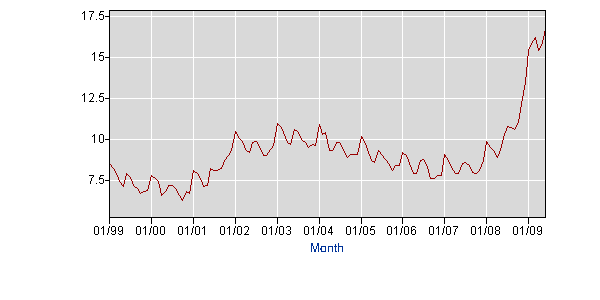
Real Unemployment Jumps to 17.5 Percent (Explanation)
Most news organizations report the more popular U.S. Department of Labor: Civilian Unemployment Rate. If you read the report today you learned that unemployment is 10.2 percent for September.
If you read Table 12 in the Bureau of Labor Statistics report you learned the real unemployment rate is 17.5 percent, not 10.2 percent.You would also have noticed the real rate of unemployment is 17.5 percent versus 11.1 percent in September 2008.
Real Unemployment U-6 -- 17.5%
There are other groups of unemployed that are not counted in the more popular employment report. The Bureau of Labor Statistics U-6 report includes the unemployed, and those that have thrown in the towel.
The U-6 report includes:
- Total unemployed
- plus all marginally attached workers
- plus total employed part time for economic reasons
- marginally attached workers are persons who currently are neither working nor looking for work, but indicate that they want and are available for a job, and have looked for work sometime in the recent past.
- Discouraged workers, a subset of the marginally attached, have given a job-market related reason for not looking currently for a job.
Here are some other statistics that you might find disconcerting.
- About 2.4 million persons were marginally attached to the labor force in October,
reflecting an increase of 736,000 from a year earlier. (The data are not sea-
sonally adjusted.) These individuals were not in the labor force, wanted and
were available for work, and had looked for a job sometime in the prior 12 months.
They were not counted as unemployed because they had not searched for work in
the 4 weeks preceding the survey. - Among the marginally attached, there were 808,000 discouraged workers in October,
up from 484,000 a year earlier. (The data are not seasonally adjusted.) Dis-
couraged workers are persons not currently looking for work because they believe
no jobs are available for them. The other 1.6 million persons marginally attached
to the labor force in October had not searched for work in the 4 weeks preceding
the survey for reasons such as school attendance or family responsibilities.
- The average workweek for production and nonsupervisory workers on private nonfarm
payrolls was unchanged at 33.0 hours in October. The manufacturing workweek rose
by 0.1 hour to 40.0 hours, and factory overtime increased by 0.2 hour over the
month. - The number of long-term unemployed (those jobless for 27 weeks and over) was
little changed over the month at 5.6 million. In October, 35.6 percent of
unemployed persons were jobless for 27 weeks or more. - The civilian labor force participation rate was little changed over the month
at 65.1 percent. The employment-population ratio continued to decline in
October, falling to 58.5 percent.
All of the statistics in this article were sourced from the Department of Labor--Bureau of Labor Statistics.
Subscribe to All American Investor via Email
Original content by Bob DeMarco, All American Investor
Friday, October 02, 2009
Real Unemployment Jumps to 17.5 Percent (Explanation)
Most news organizations report the more popular U.S. Department of Labor: Civilian Unemployment Rate. If you read the report today you learned that unemployment is 10.2 percent for September.
If you read Table 12 in the Bureau of Labor Statistics report you learned the real unemployment rate is 17.5 percent, not 10.2 percent.You would also have noticed the real rate of unemployment is 17.5 percent versus 11.1 percent in September 2008.
To view this report and the numbers go here.
Real Unemployment U-6 -- 17.5%
There are other groups of unemployed that are not counted in the more popular employment report. The Bureau of Labor Statistics U-6 report includes the unemployed, and those that have thrown in the towel.
The U-6 report includes:
- Total unemployed
- plus all marginally attached workers
- plus total employed part time for economic reasons
- marginally attached workers are persons who currently are neither working nor looking for work, but indicate that they want and are available for a job, and have looked for work sometime in the recent past.
- Discouraged workers, a subset of the marginally attached, have given a job-market related reason for not looking currently for a job.
Here are some other statistics that you might find disconcerting.
- About 2.4 million persons were marginally attached to the labor force in October,
reflecting an increase of 736,000 from a year earlier. (The data are not sea-
sonally adjusted.) These individuals were not in the labor force, wanted and
were available for work, and had looked for a job sometime in the prior 12 months.
They were not counted as unemployed because they had not searched for work in
the 4 weeks preceding the survey. - Among the marginally attached, there were 808,000 discouraged workers in October,
up from 484,000 a year earlier. (The data are not seasonally adjusted.) Dis-
couraged workers are persons not currently looking for work because they believe
no jobs are available for them. The other 1.6 million persons marginally attached
to the labor force in October had not searched for work in the 4 weeks preceding
the survey for reasons such as school attendance or family responsibilities.
- The average workweek for production and nonsupervisory workers on private nonfarm
payrolls was unchanged at 33.0 hours in October. The manufacturing workweek rose
by 0.1 hour to 40.0 hours, and factory overtime increased by 0.2 hour over the
month. - The number of long-term unemployed (those jobless for 27 weeks and over) was
little changed over the month at 5.6 million. In October, 35.6 percent of
unemployed persons were jobless for 27 weeks or more. - The civilian labor force participation rate was little changed over the month
at 65.1 percent. The employment-population ratio continued to decline in
October, falling to 58.5 percent.
All of the statistics in this article were sourced from the Department of Labor--Bureau of Labor Statistics.
Subscribe to All American Investor via Email
Original content by Bob DeMarco, All American Investor
Friday, August 07, 2009
Real Unemployment 16.8 Percent
Discouraged workers are persons not currently looking for work because they believe no jobs are available for them.
Not many people are aware of the U-6 report that is issued by the Bureau of Labor Statistics. Most news organizations report the more popular Bureau of Labor Statistics--Civilian Unemployment Rate. If you read this report today then you learned that unemployment was 9.4 percent.
Real Unemployment U-6 -- 16.8%
There is another category of unemployed that are not counted in that report. They are described in the U-6 report this way,
Marginally attached workers are persons who currently are neither working nor looking for work but indicate that they want and are available for a job and have looked for work sometime in the recent past. Discouraged workers, a subset of the marginally attached,have given a job-market related reason for not looking currently for a job.The U-6 report counts everyone that is unemployed. To view the report go here.
U-6
- Total unemployed
- plus all marginally attached workers
- plus total employed part time for economic reasons
- as a percent of the civilian labor force plus all marginally attached workers
Not a very pretty picture if you fall in these categories.
Kindle: Amazon's 6" Wireless Reading Device Saturday, August 01, 2009
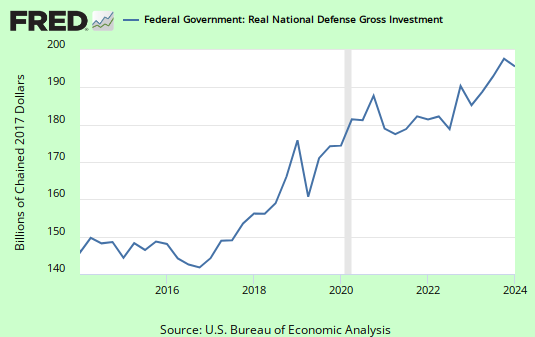
Real National Defense Gross Investment (Chart)
FYI.

Subscribe to All American Investor via Email
Wireless Reading Device Tuesday, July 07, 2009
U.S. office vacancy hits 15.9 percent
- U.S. office vacancy hits 15.9 percent in Q2U.S.
- office rent falls 2.7 percent in Q2.
Subscribe to All American Investor via Email
US office market continues to spiral down--report
By Ilaina Jonas
NEW YORK, July 7 (Reuters) - The U.S. office market vacancy rate reached 15.9 percent in the second quarter, its highest in four years and rent fell by the largest amount in more than seven as demand from companies and other office renters remained weak, real estate research firm Reis said Inc.
"It's bad," Reis director of research Victor Calanog said. "It's decaying and getting worse. Given the depth and magnitude of the recession, you can argue that we are facing a storm of epic proportions and we're only at the beginning.
The weak demand helped push up the average weighted U.S. office vacancy rate 0.70 percentage points during the quarter and 2.7 percentage points compared with a year ago, according to the report released on Tuesday.
Asking rent during the quarter fell 1.4 percent to $28.43 per square foot. Factoring in rent-free months and improvement costs to landlords, effective rent -- the net amount of cash landlords take in -- fell 2.7 percent in the quarter to $23.42 per square foot. The second-quarter drop was more severe than the first quarter's 2.3 percent, dampening hopes the office market is bottoming out, Reis said.
Year over year, rent was down 6.7 percent, the largest one- quarter decline since the first quarter 2002.
"This is really only the third quarter that we've experienced negative effective rent growth," Calanog said. "Last time, the office sector had four years of negative effective rent growth."
Although the sector has experienced downturns before, the current one may be lethal for lenders and investors who bought property during the boom years of 2005 from 2007. Many of them based the price and the loan on the belief that rents would continue to post strong growth and occupancy increases.
"It's like taking on a lot of debt as an individual and now suddenly earning 10 percent 20 percent 30 percent less," he said.
The dwindling cash flow resulting from higher vacancy and lower rent weakens the ability to repay financing and pushes a borrower closer to defaulting on a loan.
The weak second-quarter performance prompted Reis to maintain its February forecast calling for the U.S. office vacancy rate to top out at 18.2 percent in 2010 and for rent to continue to fall through 2011. It also sees the commercial real estate default rate to reach 4.2 percent by the end of the year and peak at 5.2 percent in 2011.
The U.S. vacancy rate was at 12.5 percent in the third quarter of 2007, but has since risen 3.4 percentage points, Reis said.
Of the 79 markets that Reis tracks, vacancy rose in 65 and effective rent fell in 72, indicating the weakness is widespread.
Vacancy in the New York area, which includes all the New York City boroughs except Staten Island, rose 1.2 percentage points to 10.8 percent, the highest since 1996, and effective rent slid 5.2 percent
"As far as we can tell for New York, the next two years will be murder," Calanog said.
Boston and Orange County and San Jose California saw rent fall more than 5 percent.
Those results do not bode well for office landlords Brookfield Properties Corp (BPO.TO: Quote, Profile, Research, Stock Buzz), Vornado Realty Trust (VNO.N: Quote, Profile, Research, Stock Buzz), Boston Properties Inc (BXP.N: Quote, Profile, Research, Stock Buzz), SL Green Realty Corp (SLG.N: Quote, Profile, Research, Stock Buzz) and Maguire Properties Inc (MPG.N: Quote, Profile, Research, Stock Buzz).
About 20 million square feet of office space came on the market than was rented during the quarter, slightly less than the 25.2 million square feet in the prior quarter.
Year-to-date, a net of 45.2 million more square feet of space put onto the market than was rented, on track with Reis' earlier project of about 67.6 million square feet 2009. If the forecast holds true, 2009 will be the worst year for net absorption of office space since Reis began tracking it in 1980. (Reporting by Ilaina Jonas; editing by Andre Grenon)
Bob DeMarco is a citizen journalist and twenty year Wall Street veteran. Bob has written more than 700 articles with more than 18,000 links to his work on the Internet. Content from All American Investor has been syndicated on Reuters, the Wall Street Journal, Fox News, Pluck, Blog Critics, and a growing list of newspaper websites. Bob is actively seeking syndication and writing assignments. |
More from All American Investor
- Bond Vigilantes Take over in the Long End (Graph)
- Ten Year Treasury Yield in Orbit (Graph)
- Ten Year Interest Rates Rising (Chart)
- Option ARM--The Toxic Mortgage
- Systemic Risk Defined--Too Big to Fail
- Ray Dalio on the current state of affairs in the market
- Roubini Predicts U.S. Losses May Reach $3.6 Trillion
- 60 Minutes -- Cold Fusion
Wireless Reading Device Thursday, July 02, 2009
Real Unemployment Jumps to 16.8 Percent (Statistics, Graph)
If you read Table 12 in the Bureau of Labor Statistics report you learned the real unemployment rate is 16.8 percent, not 9.5 percent.
Few people are familiar with the U-6 report that is issued by the United States Department of Labor-- Bureau of Labor Statistics. The U-6 (Table A-12: Alternative measures of labor under utilization) measures the real rate of unemployment in the United States.
Most news organizations report the more popular U.S. Department of Labor: Civilian Unemployment Rate. If you read the report today you learned that unemployment is 9.5 percent for June.
If you read the U-6 you learned the real rate of unemployment is 16.8 percent versus 10.3 percent in June 2008. To view this report and the numbers go here.
Real Unemployment U-6 -- 16.8%

The U-6 report includes:
- Total unemployed
- plus all marginally attached workers
- plus total employed part time for economic reasons
In other words,
- marginally attached workers are persons who currently are neither working nor looking for work, but indicate that they want and are available for a job, and have looked for work sometime in the recent past.
- Discouraged workers, a subset of the marginally attached, have given a job-market related reason for not looking currently for a job.
The U-6 report counts everyone that is unemployed--officially and unofficially.
Here are some other statistics that you might find disconcerting.- About 2.2 million persons (not seasonally adjusted) were marginally attached to the labor force in June. 618,000 more than a year earlier. These individuals wanted and were available for work, and had looked for a job sometime in the past 12 months. They were not counted as unemployed because they had not searched for work in the 4 weeks preceding the survey.
- Among the marginally attached, there were 793,000 discouraged workers in June, up by 373,000 from a year earlier.
- In June, the average workweek for production and nonsupervisory workers on private nonfarm payrolls fell by 0.1 hour to 33.0 hours--the lowest level on record for the series, which began in 1964.
- The number of long-term unemployed (those jobless for 27 weeks or more) increased by 433,000 over the month to 4.4 million.
- In June, 3 in 10 unemployed persons were jobless for 27 weeks or more.
This morning the stock market reacted negatively to the unemployment report. If you are wondering why--all you need to do is look beyond the obvious.
This is what this website is all about.
These numbers do not bode well for stocks and indicate at best, we are looking at slow growth in the months ahead.
All of the statistics in this article were sourced from the Department of Labor--Bureau of Labor Statistics.
Subscribe to All American Investor via Email
Bob DeMarco is a citizen journalist and twenty year Wall Street veteran. Bob has written more than 700 articles with more than 18,000 links to his work on the Internet. Content from All American Investor has been syndicated on Reuters, the Wall Street Journal, Fox News, Pluck, Blog Critics, and a growing list of newspaper websites. Bob is actively seeking syndication and writing assignments. |
More from All American Investor
- Bond Vigilantes Take over in the Long End (Graph)
- Ten Year Treasury Yield in Orbit (Graph)
- Ten Year Interest Rates Rising (Chart)
- Option ARM--The Toxic Mortgage
- Systemic Risk Defined--Too Big to Fail
- Ray Dalio on the current state of affairs in the market
- Roubini Predicts U.S. Losses May Reach $3.6 Trillion
- 60 Minutes -- Cold Fusion
Original content by Bob DeMarco. Also posted on Blog Critics.
Friday, June 12, 2009
Real Retail and Food Services (Graph)

Not a pretty picture. It will be interesting to watch this series in the next few months. No real surprise here. The trend remains down, but could be bottoming.
***Deflated Using the Consumer Price Index for All Urban Consumers (1982-84=100)
Subscribe to All American Investor via Email

Bob DeMarco is a citizen journalist and twenty year Wall Street veteran. Bob has written more than 500 articles with more than 11,000 links to his work on the Internet. Content from All American Investor has been syndicated on Reuters, the Wall Street Journal, Fox News, Pluck, Blog Critics, and a growing list of newspaper websites. Bob is actively seeking syndication and writing assignments. |
More from All American Investor
- Bond Vigilantes Take over in the Long End (Graph)
- Ten Year Treasury Yield in Orbit (Graph)
- Ten Year Interest Rates Rising (Chart)
- Option ARM--The Toxic Mortgage
- Systemic Risk Defined--Too Big to Fail
- Ray Dalio on the current state of affairs in the market
- Roubini Predicts U.S. Losses May Reach $3.6 Trillion
- 60 Minutes -- Cold Fusion
Kindle: Amazon's 6" Wireless Reading Device Follow All American Investor on Twitter
Friday, June 05, 2009
Real Unemployment Jumps to 16.4 Percent (Graph)
Real Unemployment U-6 -- 16.4%
Source Bureau of Labor StatisticsThere is another category of unemployed that are not counted in that report. They are described in the U-6 report this way,
Marginally attached workers are persons who currently are neither working nor looking for work but indicate that they want and are available for a job and have looked for work sometime in the recent past. Discouraged workers, a subset of the marginally attached,have given a job-market related reason for not looking currently for a job.The U-6 report counts everyone that is unemployed. To view the report go here.
Subscribe to All American Investor via Email
U-6
- Total unemployed
- plus all marginally attached workers
- plus total employed part time for economic reasons
- as a percent of the civilian labor force plus all marginally attached workers
This paints a very ugly picture for the future.
Bob DeMarco is a citizen journalist and twenty year Wall Street veteran. Bob has written more than 500 articles with more than 11,000 links to his work on the Internet. Content from All American Investor has been syndicated on Reuters, the Wall Street Journal, Fox News, Pluck, Blog Critics, and a growing list of newspaper websites. Bob is actively seeking syndication and writing assignments. |
Kindle: Amazon's 6" Wireless Reading Device Friday, May 08, 2009
Real Unemployment Now 15.8 Percent
There is another category of unemployed that are not counted in that report. They are described in the U-6 report this way,
Marginally attached workers are persons who currently are neither working nor looking for work but indicate that they want and are available for a job and have looked for work sometime in the recent past. Discouraged workers, a subset of the marginally attached,have given a job-market related reason for not looking currently for a job.The U-6 report counts everyone that is unemployed. To view the report go here.
U-6
- Total unemployed
- plus all marginally attached workers
- plus total employed part time for economic reasons
- as a percent of the civilian labor force plus all marginally attached workers
This paints a very ugly picture for the future.
Unemployment rose to 25 percent during the Great Depression.
Subscribe to All American Investor via Email
Bob DeMarco is a citizen journalist and twenty year Wall Street veteran. Bob has written more than 500 articles with more than 11,000 links to his work on the Internet. Content from All American Investor has been syndicated on Reuters, the Wall Street Journal, Fox News, Pluck, Blog Critics, and a growing list of newspaper websites. Bob is actively seeking syndication and writing assignments. |
More from All American Investor
- 30 Year Conventional Mortgage Rate (Chart)
- Top Hedge Fund Managers Make Billions in 2008
- Systemic Risk Defined--Too Big to Fail
- Ray Dalio on the current state of affairs in the market
- Roubini Predicts U.S. Losses May Reach $3.6 Trillion
- Option ARM--The Toxic Mortgage
- Warren Buffett's Annual Letter to Investors (Cliff Notes Version)
Follow All American Investor on Twitter
Wednesday, March 25, 2009
You could buy this House for $165,000 in South Florida
3 bedrooms, 2 baths, 2,178 square feet

Comes out to about $75 a square foot. Believe it or not, that might be a bit high in South Florida. On the other hand, if its your dream house that is a good price. It also has a nice pool.
I didn't look it up, but I believe homes like this one sold around $375,000 at the peak. Ouch.
Home Description:
Beautiful Carlson Park Estates. This Pool Home Sits On Two Lots Approx. 21,000Sf. On A Very Private Culdesac And Within Walking Distance To Shopping And Medical Facilities. Very Open And Spacious Living And Dining Room Combination. Tiled Kitchen And Baths, Nook And Family Room Overlooking Pool. Split Floor Plan With Vaulted Ceilings. Separate 8X10 Computer Room. This Home Is In Move-In Condition.
Source: Zillow
Subscribe to All American Investor via Email
Tuesday, March 17, 2009
Are the Housing Start Numbers Really a Surprise?

I wrote previously about how 80 percent of the housing crisis is contained in 35 counties. That is, 35 counties throughout the entire country. Much of the crisis is contained in a small number of geographic areas. Although, the unemployment situation is certainly becoming a factor nationally in he housing statistics. This would be especially true if you live in an area hit by major layoff.
The numbers reported today if looked at in the proper context are pitiful. The seasonally adjusted annual rate of 583,000 units is nothing to write home to "mama" about. This compares to the February 2008 rate of 1,107,000. Down 47 percent.
The more important building permits number rose 3 percent, to a seasonally adjusted annual rate of 547,000. This number does not indicate a surge in the housing market.
Subscribe to All American Investor via Email
Housing Starts Post Surprise Rebound, Up 22%
The number of new housing projects that builders broke ground on in February rose sharply, defying economists' forecasts for yet another drop in activity.The Commerce Department reported Tuesday that construction of new homes and apartments jumped 22.2 percent from January to a seasonally adjusted annual rate of 583,000 units. Economists were expecting construction to drop to a pace of around 450,000 units.
February's pickup was led by a big increase in apartment construction.
By region, all parts of the country reported an increase in overall housing construction, except for the West, which led the housing boom and has been hard hit by the bust.
Overall housing construction activity fell to a pace of 477,000 units in January, according to revised figures. That was a little higher than first reported but still marked a record low.
Applications for building permits, considered a reliable sign of future activity, also rose in February by 3 percent to an annual rate of 547,000. Economists were expecting permits to fall to a pace of 500,000 units.
Even with February's rare burst of activity, housing construction is down a whopping 47.3 percent from a year ago.
The collapse of the once high-flying housing market has been devastating to the United States' economic health.
Its spreading fallout has contributed to big pullbacks by consumers and businesses alike, plunging the economy into a recession now in its second year.
The Obama administration has announced a $75 billion program to stem skyrocketing home foreclosures, which have dumped even more properties on an already crippled market.
More than 2 million American homeowners faced foreclosure proceedings last year, and that number could soar as high as 10 million in the coming years depending on the severity of the recession, according to a report last month by Credit Suisse.
Home mortgages are harder to come by because of the credit crisis and unemployment is at a quarter-century peak of 8.1 percent, factors that will make it difficult for the depressed housing market to snap back to full health.
Builders aren't optimistic that will happen any time soon.
The National Association of Home Builders' housing market index was flat in March at a reading of nine. That was one point above the all-time low reached in January. Readings lower than 50 indicate negative sentiment about the market. The index has been below 10 since November, reflecting the toughest market conditions in a generation.
Tighter lending standards for home mortgages, rising defaults and fear about the housing market's future have sidelined buyers, an absence felt acutely by homebuilders such as D.R. Horton , Pulte Homes and Centex .
Copyright 2009 Reuters. Click for restrictions.
URL: http://www.cnbc.com/id/29734541/
Bob DeMarco is a citizen journalist and twenty year Wall Street veteran. Bob has written more than 500 articles with more than 11,000 links to his work on the Internet. Content from All American Investor has been syndicated on Reuters, the Wall Street Journal, Fox News, Pluck, Blog Critics, and a growing list of newspaper websites. Bob is actively seeking syndication and writing assignments. |
Follow All American Investor on Twitter
More from All American Investor
- Systemic Risk Defined--Too Big to Fail
- Ray Dalio on the current state of affairs in the market
- Roubini Predicts U.S. Losses May Reach $3.6 Trillion
- Six Errors on the Path to the Financial Crisis
- Who Caused the Financial Crisis?
- Option ARM--The Toxic Mortgage
- Debt Binge--The Perfect Financial Storm
- Warren Buffett's Annual Letter to Investors (Cliff Notes Version)
Wednesday, March 11, 2009
Don't Get Swindled by a Foreclosure Rescue Company

The new scam is being run by so called "foreclosure rescue companies". Many of these outfits charge consumers upfront fees and then walk away with the money. In Florida, you will see ads on television all day long offering to save you from the impending disaster of losing your home. More often than not, these "scam artists" have words like "federal" or "government" in their company name. The company names are intentionally misleading and often lead consumers to believe they are somehow connected to the so called federal government "housing bailout". In other words, official government agencies.
At a seminar for troubled borrowers near her home, one company offered a service that promised just what Ms. Martinez needed: for $1,000, the company said it would negotiate with her mortgage company to lower her interest rate.If you are in dire straights I would suggest two paths to getting help. First, talk to the company that services your mortgage loan. Many of these companies have set up relief programs to help stressed out consumers. Second, here are two websites you can go to find local housing counselors: Guide to Avoiding Foreclosure or Housing Crisis Resource Center.
“I was desperate,” said Ms. Martinez, 57, a clerk at the San Joaquin County Jail. She made an initial payment of $500 and paid another $500 a few weeks later.
Now the house is in foreclosure, and Ms. Martinez is waiting for the sheriff to evict her. She cannot reach the man she paid to modify her loan.
Swindlers Find Growing Market in Foreclosures
Subscribe to All American Investor via Email
Tuesday, March 10, 2009
TALF a Trillion for Commercial Real Estate
If you live in Florida one thing you notice is empty stores in malls. In Delray Beach we have one of those giant strip malls--lots of empty space. It is really startling to see. Restaurants in business for 20 years or more--gone. Circuit City, Linens and Things, you name it gone. And, associated businesses around these anchors--going, going, gone. The mall in Boynton Beach, Walgreens, now closing at 7 PM.The goal is to head off a “looming crisis” that could spread far beyond “For Rent” signs and shuttered mall shops--Federal Reserve Chairman Ben Bernanke
“Empty stores in a mall deters shoppers just like it deters them in downturn areas if there is vacant space at street level,” says Todd Sinai, an associate professor of real estate at the Wharton School at University of Pennsylvania in Philadelphia. “Then if your retailers stop selling you cannot get new tenants.”In carrying out the Financial Stability Plan, the Department of the Treasury and the Federal Reserve Board are announcing the launch of the Term Asset-Backed Securities Loan Facility (TALF), a component of the Consumer and Business Lending Initiative (CBLI). The TALF has the potential to generate up to $1 trillion of lending for businesses and households.
Here comes TALF to the rescue. One potato Wall Street, two potato banks, three potato homeowners, and a steak for commercial real estate.
The Treasury is readying a giant bailout for commercial real estate properties as rents fall and vacancies rise. Is this the next shoe ready to drop?
See
Subscribe to All American Investor via Email
Follow AAI on Twitter
Bob DeMarco is a citizen journalist, blogger, and Caregiver. Bob has written more than 500 articles with more than 11,000 links to his work on the Internet. The content has been syndicated on Reuters, the Wall Street Journal, Fox News, Pluck, Blog Critics, and a growing list of newspaper websites. Bob is actively seeking syndication and writing assignments. |
More from All American Investor
- Systemic Risk Defined--Too Big to Fail
- Ray Dalio on the current state of affairs in the market
- Roubini Predicts U.S. Losses May Reach $3.6 Trillion
- Six Errors on the Path to the Financial Crisis
- Who Caused the Financial Crisis?
- Option ARM--The Toxic Mortgage
- Debt Binge--The Perfect Financial Storm
- Warren Buffett's Annual Letter to Investors (Cliff Notes Version)
Wednesday, March 04, 2009
Mortgage Modification Plan--Making Homes Affordable
The Treasury Department released the guidelines of its mortgage modification today. The program will help up to 9 million homeowners avoid foreclosure. The guidelines will enable mortgage servicers to begin modifying mortgages right away. Please note: the Treasury program also includes incentives for removing second liens on loans.You can follow this link,
Making Home Affordable , and find the links to self assessment questionnaires and contact information.
Or hit these links:
- Do I qualify for a Making Home Affordable refinance?
- Do I qualify for a Home Affordable Modification?
Here is the link to the main website Financial Stability.gov. The links below lead to the detailed information (PDF format):
Ok, you are good to go. Good luck. If you found this information helpful let us know.
Subscribe to All American Investor via Email
Follow us on Twitter
More from All American Investor