Back in April, when we were piecing together our last quarterly outlook on China, we projected that China would begin to allow renminbi appreciation against the U.S. dollar around mid-year. Last weekend’s announcement, then, came about two weeks ahead of schedule... We won’t complain!
Showing posts with label currency. Show all posts
Showing posts with label currency. Show all posts
Wednesday, June 23, 2010


Saturday, May 29, 2010
St. Louis Source Base (Chart)

Sum of currency in circulation, reserve balances with Federal Reserve Banks, and service-related adjustments to compensate for float. Calculated by the Federal Reserve Bank of St. Louis.
Tuesday, May 18, 2010
Trade Weighted Exchange Index (Chart)

A weighted average of the foreign exchange value of the U.S. dollar against the currencies of a broad group of major U.S. trading partners.
Broad currency index includes the Euro Area, Canada, Japan, Mexico, China, United Kingdom, Taiwan, Korea, Singapore, Hong Kong, Malaysia, Brazil, Switzerland, Thailand, Philippines, Australia, Indonesia, India, Israel, Saudi Arabia, Russia, Sweden, Argentina, Venezuela, Chile and Colombia.
Original content Bob DeMarco, All American Investor
Friday, May 15, 2009
Roubini on the U.S. Dollar and the Chinese Yuan
The Almighty Renminbi?
More from All American Investor
Follow All American Investor on Twitter
Now, imagine a world in which China could borrow and lend internationally in its own currency. The renminbi, rather than the dollar, could eventually become a means of payment in trade and a unit of account in pricing imports and exports, as well as a store of value for wealth by international investors. Americans would pay the price. We would have to shell out more for imported goods, and interest rates on both private and public debt would rise. The higher private cost of borrowing could lead to weaker consumption and investment, and slower growth.Also see Roubini vs. Zhou on the U.S. Dollar and the Chinese Yuan
Subscribe to All American Investor via Email
 Bob DeMarco is a citizen journalist and twenty year Wall Street veteran. Bob has written more than 500 articles with more than 11,000 links to his work on the Internet. Content from All American Investor has been syndicated on Reuters, the Wall Street Journal, Fox News, Pluck, Blog Critics, and a growing list of newspaper websites. Bob is actively seeking syndication and writing assignments. Bob DeMarco is a citizen journalist and twenty year Wall Street veteran. Bob has written more than 500 articles with more than 11,000 links to his work on the Internet. Content from All American Investor has been syndicated on Reuters, the Wall Street Journal, Fox News, Pluck, Blog Critics, and a growing list of newspaper websites. Bob is actively seeking syndication and writing assignments. |
More from All American Investor
- 30 Year Conventional Mortgage Rate (Chart)
- Top Hedge Fund Managers Make Billions in 2008
- Systemic Risk Defined--Too Big to Fail
- Ray Dalio on the current state of affairs in the market
- Roubini Predicts U.S. Losses May Reach $3.6 Trillion
- Option ARM--The Toxic Mortgage
- Warren Buffett's Annual Letter to Investors (Cliff Notes Version)
Follow All American Investor on Twitter
Saturday, April 25, 2009
St Louis Monetary Base Soars to Record High (Graph)
St. Louis Weekly Reserves and Monetary Base
The biggest spike in the base started in October, 2008 in response to the growing financial crisis. From that perspective, we are only six months into this monster attempt at reinflation. A general rule of thumb says it takes 6 to 18 months to see the reaction from monetary inflation. We are entering the window now.
It is interesting that we are seeing all these deflationary numbers now. It reminded me of how inflation soared to over 1.5 percent a month in 1980. At that time, it appeared that the world was coming to an end. Paul Volcker stepped in and tightened, causing interest rates and inflation to came down fast. It also lead to the great bull market in stocks that started in 1982.
It is going to be interesting to see how high interest rates go when the Fed is forced to reverse field. A risky strategy for certain.
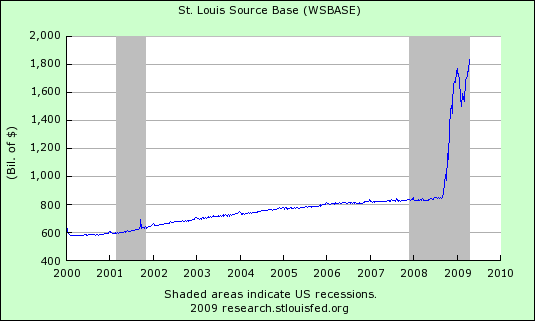
Note: Sum of currency in circulation, reserve balances with Federal Reserve Banks, and service-related adjustments to compensate for float. Calculated by the Federal Reserve Bank of St. Louis.
Follow All American Investor on Twitter
The biggest spike in the base started in October, 2008 in response to the growing financial crisis. From that perspective, we are only six months into this monster attempt at reinflation. A general rule of thumb says it takes 6 to 18 months to see the reaction from monetary inflation. We are entering the window now.
It is interesting that we are seeing all these deflationary numbers now. It reminded me of how inflation soared to over 1.5 percent a month in 1980. At that time, it appeared that the world was coming to an end. Paul Volcker stepped in and tightened, causing interest rates and inflation to came down fast. It also lead to the great bull market in stocks that started in 1982.
It is going to be interesting to see how high interest rates go when the Fed is forced to reverse field. A risky strategy for certain.
Note: Sum of currency in circulation, reserve balances with Federal Reserve Banks, and service-related adjustments to compensate for float. Calculated by the Federal Reserve Bank of St. Louis.
Subscribe to All American Investor via Email
| Bob DeMarco is a citizen journalist and twenty year Wall Street veteran. Bob has written more than 500 articles with more than 11,000 links to his work on the Internet. Content from All American Investor has been syndicated on Reuters, the Wall Street Journal, Fox News, Pluck, Blog Critics, and a growing list of newspaper websites. Bob is actively seeking syndication and writing assignments. |
Follow All American Investor on Twitter
Saturday, March 21, 2009
Dollar versus Euro Exchange Rate (Chart)

The chart has an interesting long term double bottom. The chart is evidencing a fear of inflation in the U. S. Along with the Chart on Money Supply, M2, these series should be watched closely.
Subscribe to All American Investor via Email
Saturday, March 14, 2009
Trade Weighted Dollar Index Chart
A weighted average of the foreign exchange value of the U.S. dollar against the currencies of a broad group of major U.S. trading partners.
Broad currency index includes the Euro Area, Canada, Japan, Mexico, China, United Kingdom, Taiwan, Korea, Singapore, Hong Kong, Malaysia, Brazil, Switzerland, Thailand, Philippines, Australia, Indonesia, India, Israel, Saudi Arabia, Russia, Sweden, Argentina, Venezuela, Chile and Colombia.
For more information about trade-weighted indexes see http://www.federalreserve.gov/pubs/bulletin/2005/winter05_index.pdf.
Subscribe to All American Investor via Email
Monday, January 26, 2009
China commentary says currency criticism unfair
U.S. Treasury Secretary-designate Timothy Geithner said last week that Beijing was manipulating its currency exchange policies to gain an unfair trade advantage.
The Chinese officials responded immediately, saying that criticism is "unfair, unjust and being used an excuse for trade protectionism".
The Chinese officials responded immediately, saying that criticism is "unfair, unjust and being used an excuse for trade protectionism".
"These comments do not only not accord with reality, they are also a misinterpretation of the main reasons for the financial crisis, and will encourage the rise of trade protectionism in some Western countries," the commentary said, without directly naming the United States.
"We should avoid any excuse that might lead to the revitalization of trade protectionism. Because it will do no good to the fight against the crisis, nor will it help the healthy and stable development of the global economy," said Su Ning, vice governor of the People's Bank of ChinaTouchy Touchy. This is sure to become a major issue this year. American backlash?
China Rejects Currency Manipulation Charge
Subscribe to All American Investor via Email
Subscribe to:
Posts (Atom)