
Showing posts with label monetary. Show all posts
Showing posts with label monetary. Show all posts
Thursday, May 20, 2010


Wednesday, November 11, 2009
Monetary Policy Outlook -- RGE Monitor
While RGE leans towards the U-shaped camp, we do not expect risky assets to invert their course as long as the Federal Reserve commits to maintaining “exceptionally low levels of the federal funds rate for an extended period.” So the policy dilemma is one of having to maintain “exceptionally low rates” given the still very difficult real economic conditions, but with the danger of an increasing disconnect between risky asset valuations and the economy–which could eventually snap back and compromise economic and financial stability in the medium term.
Subscribe to All American Investor via Email
From the RGE Monitor

Last week was a busy one for the Federal Reserve (Fed), the European Central Bank (ECB) and the Bank of England (BoE). Policymaking is tricky when different asset classes are sending very different signals about the economy. However, those different signals are themselves a byproduct of policy. In the U.S., bond markets are discounting a sluggish U-shaped recovery or even a double-dip recession, while risky markets are signaling a strong V-shaped recovery ahead. Which is right?
While RGE leans towards the U-shaped camp, we do not expect risky assets to invert their course as long as the Federal Reserve commits to maintaining “exceptionally low levels of the federal funds rate for an extended period.” So the policy dilemma is one of having to maintain “exceptionally low rates” given the still very difficult real economic conditions, but with the danger of an increasing disconnect between risky asset valuations and the economy–which could eventually snap back and compromise economic and financial stability in the medium term. While this environment reignites the debate on whether central banks should target asset prices or not, RGE maintains that Fed fund hikes are a story for end of 2010 or Q1 2011.
The Bank of England kept its rate on hold at 0.5% for the 8th consecutive month in November with another hold almost certain in December. As the UK economy failed to pull out of recession in Q3 2009, a rise in interest rates is unlikely to occur before Q2 2010; a view supported by evidence in the money markets. The Monetary Policy Committee did move to increase the program of quantitative easing, asking the Chancellor of the Exchequer, Alistair Darling, for an extra £25 billion to be pumped into the economy, bringing the total amount to £200 billion. With interest rates remaining at a historically low level and public finances precarious, quantitative easing has replaced traditional monetary and fiscal policy as the favoured tool of policy makers. The extra £25 billion is likely to act as the final push with the Bank of England attempting to revive an economy operating with spare capacity. It is unlikely that any further increase in quantitative easing will occur, barring a severe economic shock.
The ECB, meanwhile, stayed on hold at 1.0% in November. ECB president Jean-Claude Trichet expressed concern over the excess volatility and strength of the U.S. dollar. Nonetheless, further rate cuts seem unnecessary as signs of economic stabilization and a deceleration of deflation have emerged. Broad money supply growth continues to decelerate and credit to households and non-financial businesses is contracting. The ECB will continue conducting the QE operations it started July 6, but December may be the last tender for its 12-month refinancing operation. Trichet signaled as much, saying "not all our liquidity measures will be needed to the same extent as in the past."
While global monetary policy easing was synchronized, tightening does not need to be. Australia embarked on its rate tightening phase earlier than other developed world central banks. It raised rates twice, in October and November, by 25 basis points each. Australia avoided a recession in 2009 thanks to commodity restocking and prompt fiscal and monetary easing. Australia will likely remain on a gradual easing path, however, until the strength and sustainability of its recovery becomes clearer. Extra government subsidies for home purchases sparked a buying boom that raised Australia's mortgage debt level to a new high. The expiry of those subsidies at the end of 2009 and the increases in interest rates could restrain the recovery of domestic demand. On the other hand, recovering export demand and the expansion of a Treasury program to buy resident MBS may help offset the decline in direct support to home buyers.
Following in the footsteps of the Reserve Bank of Australia, which was the first among advanced economies to hike rates, Norges Bank (Norway's central bank) recently increased its key policy rate by 0.25 percentage points to 1.5%. The executive board's strategy sets the key policy rate interval at 1.25% - 2.25% until its meeting in March 2010. Given the Norwegian economy's mild downturn and strong recovery prospects, monetary tightening was expected. Norges Bank cautioned that a stronger krone could slow its expected pace of rate increases.
In October, the Bank of Japan (BoJ) adjusted its policy to reflect the modest improvements in credit markets and the economy. Due to thawing corporate credit markets and very weak demand at the BoJ's special facilities to purchase corporate bonds and commercial paper, the Bank of Japan decided to allow those programs to expire at the end of 2009 as planned. Further purchases would only distort corporate debt pricing as liquidity returns to the market. As a safety precaution against potential disruptions to corporate credit for businesses that cannot access market funding, the Bank of Japan extended until March 2010 its program to offer unlimited low interest rate loans to banks, collateralized with corporate debt. However, at the behest of the Ministry of Finance, the Bank of Japan will keep purchasing government debt. Like other central banks that engaged heavily in unconventional easing, the BoJ will roll back its targeted easing programs before resorting to the blunter tool of rate hikes. The BoJ reiterated its view that deflation will grip Japan until 2011, hence the policy rate will likely stay on hold throughout 2010. See Bank of Japan's Exit from Monetary Easing: Strategies and Timing.
After having to hike interest rates aggressively in the 2006– 2008 period, most central banks from emerging market economies had to undo them rapidly from the end of 2008 to Q3 2009, as output gaps widened significantly and inflation and inflation expectations collapsed as a result of the global crisis. Moreover, currencies experienced strong appreciating pressures from the end of Q1 2009 onwards, facilitating the dovish monetary policy reaction. Now that the worst of the global crisis seems to have past, macroeconomic policies are loose, and economic activities are healing, central banks are facing the difficult task of carefully implementing exit strategies, while avoiding exacerbating appreciative pressures on their currencies and trying to control asset inflation and bubbles.
Asian central banks will be the first among emerging markets to tighten monetary policy as capital inflows and loose policies since late 2008 are raising liquidity and asset inflation. But goods inflation will remain within the central banks’ target in most countries amid a slow recovery in domestic demand, weak credit growth in Asia ex-China, and an output gap. This will delay interest rate hikes into 2010, especially in the export-dependent economies, and constrain aggressive tightening until domestic and external demand improve further. Until then, Asian central banks will continue to fight credit and asset bubbles via liquidity absorption and regulatory and prudential measures, such as in real estate. Countries that are less export-dependent and have attractive asset markets—India, South Korea and Indonesia—will be the first ones to hike rates and allow currency appreciation. In November 2009, Taiwan banned foreign inflows in time deposits and might resort to further capital controls. If hot inflows maintain their momentum, other Asian countries might use enforcement or regulatory measures to manage capital flows.
In Latin America, there is a marked differentiation on the speed of the economic recovery; however, most countries will experience slow closing of the output gaps over the next year. Moreover, stable if not strong currencies (BRL, CLP, COP, MXN, and PEN) and limited upward wage pressures should help in containing probable external supply-side shocks emerging from commodity prices and limit inflationary pressures sparked by recovering domestic demand. Although inflation and inflation expectations will bounce back, central banks will most likely achieve their inflation targets in 2010. Nevertheless, monetary authorities will start moving away from a very loose monetary policy stance toward a neutral one in 2010 in order to safeguard medium-term inflation expectations once the recovery has gained momentum. In this light, central banks mainly will target the monetary policy rate. However, upward adjustment in other monetary policy instruments (reserve requirements and margin reserve requirements) will likely be implemented. Those central banks that have acted the most aggressively and face potential surprises to the upside in growth and inflation will initiate the mapping out of excessive accommodation sooner than the rest.
Rate hikes in Central and Eastern European (CEE) countries are expected to lag those in other emerging market regions given the particularly sharp downturn in the CEE and prospects for a weak recovery. Many central banks are still in easing mode, amid economic contractions and easing inflation. Uneven growth prospects across the region mean monetary policy paths will vary.
Aside from Israel, which in August became the first country globally to begin raising interest rates, Middle East and Africa will remain effectively on hold until late in 2010. Most of the GCC countries peg to the U.S. dollar and thus import U.S. monetary policy. Meanwhile despite the inflationary impact of a weak dollar, tight domestic credit conditions will restrain a liquidity surge.
* As of Sept. 30, only 100 billion yen of commercial paper (CP) was offered for the BoJ to purchase - just 3% of the 3 trillion yen allocated by the BoJ for the CP purchasing program. Only 300 billion yen of corporate bonds was offered for the BoJ to purchase - just 30% of 1 trillion yen allocated for the corporate bond purchasing program.
 Wireless Reading Device
 Original content Bob DeMarco, All American Investor
Saturday, October 17, 2009
St. Louis Source Monetary Base (Graph)
Wonder why gold is trading up? Here is one good reason.

Kindle: Amazon's 6" Wireless Reading Device
- Sum of currency in circulation,
- Reserve balances with Federal Reserve Banks,
- and service-related adjustments to compensate for float.
Subscribe to All American Investor via Email
Wireless Reading Device Friday, July 31, 2009

Friday, June 12, 2009
Monetary Base Continues to Soar (Graph)

Subscribe to All American Investor via Email
This chart helps explain why investors are increasingly worried about future inflation. The adjusted monetary base has nearly doubled since April, 2008. In comparison, the moneatry base doubled once from January, 1994 to October, 2005.
 Bob DeMarco is a citizen journalist and twenty year Wall Street veteran. Bob has written more than 500 articles with more than 11,000 links to his work on the Internet. Content from All American Investor has been syndicated on Reuters, the Wall Street Journal, Fox News, Pluck, Blog Critics, and a growing list of newspaper websites. Bob is actively seeking syndication and writing assignments. Bob DeMarco is a citizen journalist and twenty year Wall Street veteran. Bob has written more than 500 articles with more than 11,000 links to his work on the Internet. Content from All American Investor has been syndicated on Reuters, the Wall Street Journal, Fox News, Pluck, Blog Critics, and a growing list of newspaper websites. Bob is actively seeking syndication and writing assignments. |
More from All American Investor
- Bond Vigilantes Take over in the Long End (Graph)
- Ten Year Treasury Yield in Orbit (Graph)
- Ten Year Interest Rates Rising (Chart)
- Option ARM--The Toxic Mortgage
- Systemic Risk Defined--Too Big to Fail
- Ray Dalio on the current state of affairs in the market
- Roubini Predicts U.S. Losses May Reach $3.6 Trillion
- 60 Minutes -- Cold Fusion
Kindle: Amazon's 6" Wireless Reading Device Follow All American Investor on Twitter
Sunday, May 24, 2009
Fed UP UP and Away (Chart)
Net Free and Borrowed Reserves Soaring. M2, Money Supply Soaring. Monetary Base Soaring. Fed Balance sheet Soaring. Nonperforming loans Soaring.
Long term interest rates rising. Mortgage interest rates rising. Stocks topping and weakening. Gold surging.
Bull market in stocks? Not likely in the short term. It is getting more risky by the week.

More from All American Investor
Long term interest rates rising. Mortgage interest rates rising. Stocks topping and weakening. Gold surging.
Bull market in stocks? Not likely in the short term. It is getting more risky by the week.
Subscribe to All American Investor via Email
| Bob DeMarco is a citizen journalist and twenty year Wall Street veteran. Bob has written more than 500 articles with more than 11,000 links to his work on the Internet. Content from All American Investor has been syndicated on Reuters, the Wall Street Journal, Fox News, Pluck, Blog Critics, and a growing list of newspaper websites. Bob is actively seeking syndication and writing assignments. |
More from All American Investor
Follow All American Investor on Twitter
Friday, May 22, 2009
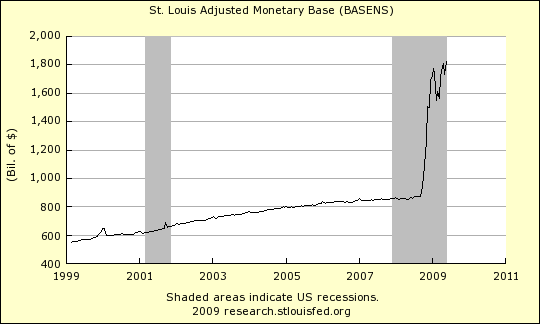
Monetary Base Gushes to New Record High (Graph)
Monetary Base, Chart
The monetary base soared up the last two weeks and is now at an all time high.
We have been discussing the potential for this series to create angst in the market for several months. It is now happening.
Increases in the base, Fed balance sheet, and the coming explosion in Treasury offerings has the market worried about inflation, higher interest rates, and the potential for the downgrade of U. S. debt rating. Uncertainty and angst is now creeping into the stock market and this is a negative development.
The monetary base soared up the last two weeks and is now at an all time high.
We have been discussing the potential for this series to create angst in the market for several months. It is now happening.
Increases in the base, Fed balance sheet, and the coming explosion in Treasury offerings has the market worried about inflation, higher interest rates, and the potential for the downgrade of U. S. debt rating. Uncertainty and angst is now creeping into the stock market and this is a negative development.
Friday, May 08, 2009
Monetary Base Continues to Soar (Graph)

St Louis Adjusted Monetary Base, May 6, 2009
Still soaring, slight down tick this time around.
Subscribe to All American Investor via Email
| Bob DeMarco is a citizen journalist and twenty year Wall Street veteran. Bob has written more than 500 articles with more than 11,000 links to his work on the Internet. Content from All American Investor has been syndicated on Reuters, the Wall Street Journal, Fox News, Pluck, Blog Critics, and a growing list of newspaper websites. Bob is actively seeking syndication and writing assignments. |
Follow All American Investor on Twitter
Wednesday, March 11, 2009
Alan Greenspan Defends Himself on the Housing Bubble
In the article--The Fed Didn't Cause the Housing Bubble--Alan Greenspan defends himself. No doubt this makes for interesting reading. And, equally interesting conclusions.

By ALAN GREENSPAN
We are in the midst of a global crisis that will unquestionably rank as the most virulent since the 1930s. It will eventually subside and pass into history. But how the interacting and reinforcing causes and effects of this severe contraction are interpreted will shape the reconfiguration of our currently disabled global financial system.
There are at least two broad and competing explanations of the origins of this crisis. The first is that the "easy money" policies of the Federal Reserve produced the U.S. housing bubble that is at the core of today's financial mess.
The second, and far more credible, explanation agrees that it was indeed lower interest rates that spawned the speculative euphoria. However, the interest rate that mattered was not the federal-funds rate, but the rate on long-term, fixed-rate mortgages. Between 2002 and 2005, home mortgage rates led U.S. home price change by 11 months. This correlation between home prices and mortgage rates was highly significant, and a far better indicator of rising home prices than the fed-funds rate.
This should not come as a surprise. After all, the prices of long-lived assets have always been determined by discounting the flow of income (or imputed services) by interest rates of the same maturities as the life of the asset. No one, to my knowledge, employs overnight interest rates -- such as the fed-funds rate -- to determine the capitalization rate of real estate, whether it be an office building or a single-family residence.
The Federal Reserve became acutely aware of the disconnect between monetary policy and mortgage rates when the latter failed to respond as expected to the Fed tightening in mid-2004. Moreover, the data show that home mortgage rates had become gradually decoupled from monetary policy even earlier -- in the wake of the emergence, beginning around the turn of this century, of a well arbitraged global market for long-term debt instruments.
U.S. mortgage rates' linkage to short-term U.S. rates had been close for decades. Between 1971 and 2002, the fed-funds rate and the mortgage rate moved in lockstep. The correlation between them was a tight 0.85. Between 2002 and 2005, however, the correlation diminished to insignificance.
As I noted on this page in December 2007, the presumptive cause of the world-wide decline in long-term rates was the tectonic shift in the early 1990s by much of the developing world from heavy emphasis on central planning to increasingly dynamic, export-led market competition. The result was a surge in growth in China and a large number of other emerging market economies that led to an excess of global intended savings relative to intended capital investment. That ex ante excess of savings propelled global long-term interest rates progressively lower between early 2000 and 2005.
That decline in long-term interest rates across a wide spectrum of countries statistically explains, and is the most likely major cause of, real-estate capitalization rates that declined and converged across the globe, resulting in the global housing price bubble. (The U.S. price bubble was at, or below, the median according to the International Monetary Fund.) By 2006, long-term interest rates and the home mortgage rates driven by them, for all developed and the main developing economies, had declined to single digits -- I believe for the first time ever. I would have thought that the weight of such evidence would lead to wide support for this as a global explanation of the current crisis.
However, starting in mid-2007, history began to be rewritten, in large part by my good friend and former colleague, Stanford University Professor John Taylor, with whom I have rarely disagreed. Yet writing in these pages last month, Mr. Taylor unequivocally claimed that had the Federal Reserve from 2003-2005 kept short-term interest rates at the levels implied by his "Taylor Rule," "it would have prevented this housing boom and bust. "This notion has been cited and repeated so often that it has taken on the aura of conventional wisdom.
Aside from the inappropriate use of short-term rates to explain the value of long-term assets, his statistical indictment of Federal Reserve policy in the period 2003-2005 fails to address the aforementioned extraordinary structural developments in the global economy. His statistical analysis carries empirical relationships of earlier decades into the most recent period where they no longer apply.
Moreover, while I believe the "Taylor Rule" is a useful first approximation to the path of monetary policy, its parameters and predictions derive from model structures that have been consistently unable to anticipate the onset of recessions or financial crises. Counterfactuals from such flawed structures cannot form the sole basis for successful policy analysis or advice, with or without the benefit of hindsight.
Given the decoupling of monetary policy from long-term mortgage rates, accelerating the path of monetary tightening that the Fed pursued in 2004-2005 could not have "prevented" the housing bubble. All things considered, I personally prefer Milton Friedman's performance appraisal of the Federal Reserve. In evaluating the period of 1987 to 2005, he wrote on this page in early 2006: "There is no other period of comparable length in which the Federal Reserve System has performed so well. It is more than a difference of degree; it approaches a difference of kind."
How much does it matter whether the bubble was caused by inappropriate monetary policy, over which policy makers have control, or broader global forces over which their control is limited? A great deal.
If it is monetary policy that is at fault, then that can be corrected in the future, at least in principle. If, however, we are dealing with global forces beyond the control of domestic monetary policy makers, as I strongly suspect is the case, then we are facing a broader issue.
Global market competition and integration in goods, services and finance have brought unprecedented gains in material well being. But the growth path of highly competitive markets is cyclical. And on rare occasions it can break down, with consequences such as those we are currently experiencing. It is now very clear that the levels of complexity to which market practitioners at the height of their euphoria tried to push risk-management techniques and products were too much for even the most sophisticated market players to handle properly and prudently.
However, the appropriate policy response is not to bridle financial intermediation with heavy regulation. That would stifle important advances in finance that enhance standards of living. Remember, prior to the crisis, the U.S. economy exhibited an impressive degree of productivity advance. To achieve that with a modest level of combined domestic and borrowed foreign savings (our current account deficit) was a measure of our financial system's precrisis success. The solutions for the financial-market failures revealed by the crisis are higher capital requirements and a wider prosecution of fraud -- not increased micromanagement by government entities.
Any new regulations should improve the ability of financial institutions to effectively direct a nation's savings into the most productive capital investments. Much regulation fails that test, and is often costly and counterproductive. Adequate capital and collateral requirements can address the weaknesses that the crisis has unearthed. Such requirements will not be overly intrusive, and thus will not interfere unduly in private-sector business decisions.
If we are to retain a dynamic world economy capable of producing prosperity and future sustainable growth, we cannot rely on governments to intermediate saving and investment flows. Our challenge in the months ahead will be to install a regulatory regime that will ensure responsible risk management on the part of financial institutions, while encouraging them to continue taking the risks necessary and inherent in any successful market economy.
Mr. Greenspan, former chairman of the Federal Reserve, is president of Greenspan Associates LLC and author of "The Age of Turbulence: Adventures in a New World" (Penguin, 2007).

How much does it matter whether the bubble was caused by inappropriate monetary policy, over which policy makers have control, or broader global forces over which their control is limited? A great deal.
If it is monetary policy that is at fault, then that can be corrected in the future, at least in principle. If, however, we are dealing with global forces beyond the control of domestic monetary policy makers, as I strongly suspect is the case, then we are facing a broader issue.
Subscribe to All American Investor via Email
The Fed Didn't Cause the Housing Bubble
Any new regulations should help direct savings toward productive investments.By ALAN GREENSPAN
We are in the midst of a global crisis that will unquestionably rank as the most virulent since the 1930s. It will eventually subside and pass into history. But how the interacting and reinforcing causes and effects of this severe contraction are interpreted will shape the reconfiguration of our currently disabled global financial system.
There are at least two broad and competing explanations of the origins of this crisis. The first is that the "easy money" policies of the Federal Reserve produced the U.S. housing bubble that is at the core of today's financial mess.
The second, and far more credible, explanation agrees that it was indeed lower interest rates that spawned the speculative euphoria. However, the interest rate that mattered was not the federal-funds rate, but the rate on long-term, fixed-rate mortgages. Between 2002 and 2005, home mortgage rates led U.S. home price change by 11 months. This correlation between home prices and mortgage rates was highly significant, and a far better indicator of rising home prices than the fed-funds rate.
This should not come as a surprise. After all, the prices of long-lived assets have always been determined by discounting the flow of income (or imputed services) by interest rates of the same maturities as the life of the asset. No one, to my knowledge, employs overnight interest rates -- such as the fed-funds rate -- to determine the capitalization rate of real estate, whether it be an office building or a single-family residence.
The Federal Reserve became acutely aware of the disconnect between monetary policy and mortgage rates when the latter failed to respond as expected to the Fed tightening in mid-2004. Moreover, the data show that home mortgage rates had become gradually decoupled from monetary policy even earlier -- in the wake of the emergence, beginning around the turn of this century, of a well arbitraged global market for long-term debt instruments.
U.S. mortgage rates' linkage to short-term U.S. rates had been close for decades. Between 1971 and 2002, the fed-funds rate and the mortgage rate moved in lockstep. The correlation between them was a tight 0.85. Between 2002 and 2005, however, the correlation diminished to insignificance.
As I noted on this page in December 2007, the presumptive cause of the world-wide decline in long-term rates was the tectonic shift in the early 1990s by much of the developing world from heavy emphasis on central planning to increasingly dynamic, export-led market competition. The result was a surge in growth in China and a large number of other emerging market economies that led to an excess of global intended savings relative to intended capital investment. That ex ante excess of savings propelled global long-term interest rates progressively lower between early 2000 and 2005.
That decline in long-term interest rates across a wide spectrum of countries statistically explains, and is the most likely major cause of, real-estate capitalization rates that declined and converged across the globe, resulting in the global housing price bubble. (The U.S. price bubble was at, or below, the median according to the International Monetary Fund.) By 2006, long-term interest rates and the home mortgage rates driven by them, for all developed and the main developing economies, had declined to single digits -- I believe for the first time ever. I would have thought that the weight of such evidence would lead to wide support for this as a global explanation of the current crisis.
However, starting in mid-2007, history began to be rewritten, in large part by my good friend and former colleague, Stanford University Professor John Taylor, with whom I have rarely disagreed. Yet writing in these pages last month, Mr. Taylor unequivocally claimed that had the Federal Reserve from 2003-2005 kept short-term interest rates at the levels implied by his "Taylor Rule," "it would have prevented this housing boom and bust. "This notion has been cited and repeated so often that it has taken on the aura of conventional wisdom.
Aside from the inappropriate use of short-term rates to explain the value of long-term assets, his statistical indictment of Federal Reserve policy in the period 2003-2005 fails to address the aforementioned extraordinary structural developments in the global economy. His statistical analysis carries empirical relationships of earlier decades into the most recent period where they no longer apply.
Moreover, while I believe the "Taylor Rule" is a useful first approximation to the path of monetary policy, its parameters and predictions derive from model structures that have been consistently unable to anticipate the onset of recessions or financial crises. Counterfactuals from such flawed structures cannot form the sole basis for successful policy analysis or advice, with or without the benefit of hindsight.
Given the decoupling of monetary policy from long-term mortgage rates, accelerating the path of monetary tightening that the Fed pursued in 2004-2005 could not have "prevented" the housing bubble. All things considered, I personally prefer Milton Friedman's performance appraisal of the Federal Reserve. In evaluating the period of 1987 to 2005, he wrote on this page in early 2006: "There is no other period of comparable length in which the Federal Reserve System has performed so well. It is more than a difference of degree; it approaches a difference of kind."
How much does it matter whether the bubble was caused by inappropriate monetary policy, over which policy makers have control, or broader global forces over which their control is limited? A great deal.
If it is monetary policy that is at fault, then that can be corrected in the future, at least in principle. If, however, we are dealing with global forces beyond the control of domestic monetary policy makers, as I strongly suspect is the case, then we are facing a broader issue.
Global market competition and integration in goods, services and finance have brought unprecedented gains in material well being. But the growth path of highly competitive markets is cyclical. And on rare occasions it can break down, with consequences such as those we are currently experiencing. It is now very clear that the levels of complexity to which market practitioners at the height of their euphoria tried to push risk-management techniques and products were too much for even the most sophisticated market players to handle properly and prudently.
However, the appropriate policy response is not to bridle financial intermediation with heavy regulation. That would stifle important advances in finance that enhance standards of living. Remember, prior to the crisis, the U.S. economy exhibited an impressive degree of productivity advance. To achieve that with a modest level of combined domestic and borrowed foreign savings (our current account deficit) was a measure of our financial system's precrisis success. The solutions for the financial-market failures revealed by the crisis are higher capital requirements and a wider prosecution of fraud -- not increased micromanagement by government entities.
Any new regulations should improve the ability of financial institutions to effectively direct a nation's savings into the most productive capital investments. Much regulation fails that test, and is often costly and counterproductive. Adequate capital and collateral requirements can address the weaknesses that the crisis has unearthed. Such requirements will not be overly intrusive, and thus will not interfere unduly in private-sector business decisions.
If we are to retain a dynamic world economy capable of producing prosperity and future sustainable growth, we cannot rely on governments to intermediate saving and investment flows. Our challenge in the months ahead will be to install a regulatory regime that will ensure responsible risk management on the part of financial institutions, while encouraging them to continue taking the risks necessary and inherent in any successful market economy.
Mr. Greenspan, former chairman of the Federal Reserve, is president of Greenspan Associates LLC and author of "The Age of Turbulence: Adventures in a New World" (Penguin, 2007).
| Bob DeMarco is a citizen journalist and twenty year Wall Street veteran. Bob has written more than 500 articles with more than 11,000 links to his work on the Internet. Content from All American Investor has been syndicated on Reuters, the Wall Street Journal, Fox News, Pluck, Blog Critics, and a growing list of newspaper websites. Bob is actively seeking syndication and writing assignments. |

Sunday, March 08, 2009
Reserve Balances held by the Federal Reserve Bank are going off the chart
The chart below from the St Louis Fed is disturbing. The chart depicts the Balance Sheet of the Federal Reserve Bank. As you can see the balance sheet has soared since mid-September 2008. This rise is unprecedented and was caused by the financial situation beginning with Bear Stears, Lehman, and AIG.

The Fed now owns $27.0 Billion of poor quality assets from the troubles at Bear Stearns. It owns another $46.7 Billion from AIG. In addition, The FRB now owns $316.2 Billion in a Commercial Paper Funding Facility; and, $465 Billion in Central bank liquidity swaps. Prior to this crisis both of the last two number were zero. Next, the Fed is being instructed to start buying mortgage backed securities from distressed banks. This will balloon the monetary base once again.
The the U.S. monetary base has increased from approximately $890 billion to $1,740 billion--doubling in a little more than 3 months. This is unprecedented and is represented by the blue line climbing straight up the right side of the chart.
Right now, there is little concern about inflation. However, there should be concern because if markets do not become normalized soon, the Fed will not be able to sell these distressed assets without taking enormous losses. If the Fed is unable to unwind these assets in an orderly fashion then inflation will almost certainly come back with a vengeance.
Gold, oil, and commodity prices should be watched very closely by investors. Even a slight pick up in demand is likely to send commodity price up sharply. Weather factors could also be a factor in the major growing regions of the United States this year--right now it is very dry, not a good condition.
Rises in the monetary base often lead to rises in inflation. The current increase in the monetary base started in the later part of 2007; and then took off with a vengeance in September 2008. There is usually a 12-18 month lag before inflation hits. We are coming into the window right now.
More from All American Investor
The the U.S. monetary base has increased from approximately $890 billion to $1,740 billion--doubling in a little more than 3 months. This is unprecedented and is represented by the blue line climbing straight up the right side of the chart.
Right now, there is little concern about inflation. However, there should be concern because if markets do not become normalized soon, the Fed will not be able to sell these distressed assets without taking enormous losses. If the Fed is unable to unwind these assets in an orderly fashion then inflation will almost certainly come back with a vengeance.
Gold, oil, and commodity prices should be watched very closely by investors. Even a slight pick up in demand is likely to send commodity price up sharply. Weather factors could also be a factor in the major growing regions of the United States this year--right now it is very dry, not a good condition.
Rises in the monetary base often lead to rises in inflation. The current increase in the monetary base started in the later part of 2007; and then took off with a vengeance in September 2008. There is usually a 12-18 month lag before inflation hits. We are coming into the window right now.
Subscribe to All American Investor via EmailFollow us on Twitter
| Bob DeMarco is a citizen journalist, blogger, and Caregiver. In addition to being an experienced writer he taught at the University of Georgia , was an Associate Director and Limited Partner at Bear Stearns, was CEO of IP Group, and is a mentor. Bob currently resides in Delray Beach, FL where he cares for his mother, Dorothy, who suffers from Alzheimer's disease. Bob has written more than 500 articles with more than 11,000 links to his work on the Internet. His content has been syndicated on Reuters, the Wall Street Journal, Fox News, Pluck, Blog Critics, and a growing list of newspaper websites. Bob is actively seeking syndication and writing assignments. |
More from All American Investor
- Systemic Risk Defined--Too Big to Fail
- Ray Dalio on the current state of affairs in the market
- Roubini Predicts U.S. Losses May Reach $3.6 Trillion
- Six Errors on the Path to the Financial Crisis
- Who Caused the Financial Crisis?
- Option ARM--The Toxic Mortgage
- Debt Binge--The Perfect Financial Storm
- Warren Buffett's Annual Letter to Investors (Cliff Notes Version)
Wednesday, February 11, 2009
Who Caused the Financial Crisis?
The cause of the financial crisis is likely to be debated for a long time. Most American's believe the crisis was caused by greedy Wall Street executives, shabby lending practices by mortgage companies and banks, and the deregulation of financial institutions by our elected representatives in Washington. No doubt there is plenty of blame to go around.

John Taylor, a professor of economics at Stanford and a senior fellow at the Hoover Institution, shares his perspective on the Wall Street Journal--
Research shows the failure to rescue Lehman did not trigger the fall panic.
By JOHN B. TAYLOR
Many are calling for a 9/11-type commission to investigate the financial crisis. Any such investigation should not rule out government itself as a major culprit. My research shows that government actions and interventions -- not any inherent failure or instability of the private economy -- caused, prolonged and dramatically worsened the crisis.
The classic explanation of financial crises is that they are caused by excesses -- frequently monetary excesses -- which lead to a boom and an inevitable bust. This crisis was no different: A housing boom followed by a bust led to defaults, the implosion of mortgages and mortgage-related securities at financial institutions, and resulting financial turmoil.
Monetary excesses were the main cause of the boom. The Fed held its target interest rate, especially in 2003-2005, well below known monetary guidelines that say what good policy should be based on historical experience. Keeping interest rates on the track that worked well in the past two decades, rather than keeping rates so low, would have prevented the boom and the bust. Researchers at the Organization for Economic Cooperation and Development have provided corroborating evidence from other countries: The greater the degree of monetary excess in a country, the larger was the housing boom.
The effects of the boom and bust were amplified by several complicating factors including the use of subprime and adjustable-rate mortgages, which led to excessive risk taking. There is also evidence the excessive risk taking was encouraged by the excessively low interest rates. Delinquency rates and foreclosure rates are inversely related to housing price inflation. These rates declined rapidly during the years housing prices rose rapidly, likely throwing mortgage underwriting programs off track and misleading many people.
Adjustable-rate, subprime and other mortgages were packed into mortgage-backed securities of great complexity. Rating agencies underestimated the risk of these securities, either because of a lack of competition, poor accountability, or most likely the inherent difficulty in assessing risk due to the complexity.
Other government actions were at play: The government-sponsored enterprises Fannie Mae and Freddie Mac were encouraged to expand and buy mortgage-backed securities, including those formed with the risky subprime mortgages.
Government action also helped prolong the crisis. Consider that the financial crisis became acute on Aug. 9 and 10, 2007, when money-market interest rates rose dramatically. Interest rate spreads, such as the difference between three-month and overnight interbank loans, jumped to unprecedented levels.
Diagnosing the reason for this sudden increase was essential for determining what type of policy response was appropriate. If liquidity was the problem, then providing more liquidity by making borrowing easier at the Federal Reserve discount window, or opening new windows or facilities, would be appropriate. But if counterparty risk was behind the sudden rise in money-market interest rates, then a direct focus on the quality and transparency of the bank's balance sheets would be appropriate.
Early on, policy makers misdiagnosed the crisis as one of liquidity, and prescribed the wrong treatment.
To provide more liquidity, the Fed created the Term Auction Facility (TAF) in December 2007. Its main aim was to reduce interest rate spreads in the money markets and increase the flow of credit. But the TAF did not seem to make much difference. If the reason for the spread was counterparty risk as distinct from liquidity, this is not surprising.
Another early policy response was the Economic Stimulus Act of 2008, passed in February. The major part of this package was to send cash totaling over $100 billion to individuals and families so they would have more to spend and thus jump-start consumption and the economy. But people spent little if anything of the temporary rebate (as predicted by Milton Friedman's permanent income theory, which holds that temporary as distinct from permanent increases in income do not lead to significant increases in consumption). Consumption was not jump-started.
A third policy response was the very sharp reduction in the target federal-funds rate to 2% in April 2008 from 5.25% in August 2007. This was sharper than monetary guidelines such as my own Taylor Rule would prescribe. The most noticeable effect of this rate cut was a sharp depreciation of the dollar and a large increase in oil prices. After the start of the crisis, oil prices doubled to over $140 in July 2008, before plummeting back down as expectations of world economic growth declined. But by then the damage of the high oil prices had been done.
After a year of such mistaken prescriptions, the crisis suddenly worsened in September and October 2008. We experienced a serious credit crunch, seriously weakening an economy already suffering from the lingering impact of the oil price hike and housing bust.
Many have argued that the reason for this bad turn was the government's decision not to prevent the bankruptcy of Lehman Brothers over the weekend of Sept. 13 and 14. A study of this event suggests that the answer is more complicated and lay elsewhere.
While interest rate spreads increased slightly on Monday, Sept. 15, they stayed in the range observed during the previous year, and remained in that range through the rest of the week. On Friday, Sept. 19, the Treasury announced a rescue package, though not its size or the details. Over the weekend the package was put together, and on Tuesday, Sept. 23, Fed Chairman Ben Bernanke and Treasury Secretary Henry Paulson testified before the Senate Banking Committee. They introduced the Troubled Asset Relief Program (TARP), saying that it would be $700 billion in size. A short draft of legislation was provided, with no mention of oversight and few restrictions on the use of the funds.
The two men were questioned intensely and the reaction was quite negative, judging by the large volume of critical mail received by many members of Congress. It was following this testimony that one really begins to see the crisis deepening and interest rate spreads widening.
The realization by the public that the government's intervention plan had not been fully thought through, and the official story that the economy was tanking, likely led to the panic seen in the next few weeks. And this was likely amplified by the ad hoc decisions to support some financial institutions and not others and unclear, seemingly fear-based explanations of programs to address the crisis. What was the rationale for intervening with Bear Stearns, then not with Lehman, and then again with AIG? What would guide the operations of the TARP?
It did not have to be this way. To prevent misguided actions in the future, it is urgent that we return to sound principles of monetary policy, basing government interventions on clearly stated diagnoses and predictable frameworks for government actions.
Massive responses with little explanation will probably make things worse. That is the lesson from this crisis so far.
Mr. Taylor, a professor of economics at Stanford and a senior fellow at the Hoover Institution, is the author of "Getting Off Track: How Government Actions and Interventions Caused, Prolonged and Worsened the Financial Crisis," published later this month by Hoover Press.
Original contentAll American Investor
John Taylor, a professor of economics at Stanford and a senior fellow at the Hoover Institution, shares his perspective on the Wall Street Journal--
How Government Created the Financial Crisis.
The classic explanation of financial crises is that they are caused by excesses -- frequently monetary excesses -- which lead to a boom and an inevitable bust. This crisis was no different: A housing boom followed by a bust led to defaults, the implosion of mortgages and mortgage-related securities at financial institutions, and resulting financial turmoil.
Monetary excesses were the main cause of the boom.
Subscribe to All American Investor via EmailHow Government Created the Financial Crisis
Research shows the failure to rescue Lehman did not trigger the fall panic.
By JOHN B. TAYLOR
Many are calling for a 9/11-type commission to investigate the financial crisis. Any such investigation should not rule out government itself as a major culprit. My research shows that government actions and interventions -- not any inherent failure or instability of the private economy -- caused, prolonged and dramatically worsened the crisis.
The classic explanation of financial crises is that they are caused by excesses -- frequently monetary excesses -- which lead to a boom and an inevitable bust. This crisis was no different: A housing boom followed by a bust led to defaults, the implosion of mortgages and mortgage-related securities at financial institutions, and resulting financial turmoil.
Monetary excesses were the main cause of the boom. The Fed held its target interest rate, especially in 2003-2005, well below known monetary guidelines that say what good policy should be based on historical experience. Keeping interest rates on the track that worked well in the past two decades, rather than keeping rates so low, would have prevented the boom and the bust. Researchers at the Organization for Economic Cooperation and Development have provided corroborating evidence from other countries: The greater the degree of monetary excess in a country, the larger was the housing boom.
The effects of the boom and bust were amplified by several complicating factors including the use of subprime and adjustable-rate mortgages, which led to excessive risk taking. There is also evidence the excessive risk taking was encouraged by the excessively low interest rates. Delinquency rates and foreclosure rates are inversely related to housing price inflation. These rates declined rapidly during the years housing prices rose rapidly, likely throwing mortgage underwriting programs off track and misleading many people.
Adjustable-rate, subprime and other mortgages were packed into mortgage-backed securities of great complexity. Rating agencies underestimated the risk of these securities, either because of a lack of competition, poor accountability, or most likely the inherent difficulty in assessing risk due to the complexity.
Other government actions were at play: The government-sponsored enterprises Fannie Mae and Freddie Mac were encouraged to expand and buy mortgage-backed securities, including those formed with the risky subprime mortgages.
Government action also helped prolong the crisis. Consider that the financial crisis became acute on Aug. 9 and 10, 2007, when money-market interest rates rose dramatically. Interest rate spreads, such as the difference between three-month and overnight interbank loans, jumped to unprecedented levels.
Diagnosing the reason for this sudden increase was essential for determining what type of policy response was appropriate. If liquidity was the problem, then providing more liquidity by making borrowing easier at the Federal Reserve discount window, or opening new windows or facilities, would be appropriate. But if counterparty risk was behind the sudden rise in money-market interest rates, then a direct focus on the quality and transparency of the bank's balance sheets would be appropriate.
Early on, policy makers misdiagnosed the crisis as one of liquidity, and prescribed the wrong treatment.
To provide more liquidity, the Fed created the Term Auction Facility (TAF) in December 2007. Its main aim was to reduce interest rate spreads in the money markets and increase the flow of credit. But the TAF did not seem to make much difference. If the reason for the spread was counterparty risk as distinct from liquidity, this is not surprising.
Another early policy response was the Economic Stimulus Act of 2008, passed in February. The major part of this package was to send cash totaling over $100 billion to individuals and families so they would have more to spend and thus jump-start consumption and the economy. But people spent little if anything of the temporary rebate (as predicted by Milton Friedman's permanent income theory, which holds that temporary as distinct from permanent increases in income do not lead to significant increases in consumption). Consumption was not jump-started.
A third policy response was the very sharp reduction in the target federal-funds rate to 2% in April 2008 from 5.25% in August 2007. This was sharper than monetary guidelines such as my own Taylor Rule would prescribe. The most noticeable effect of this rate cut was a sharp depreciation of the dollar and a large increase in oil prices. After the start of the crisis, oil prices doubled to over $140 in July 2008, before plummeting back down as expectations of world economic growth declined. But by then the damage of the high oil prices had been done.
After a year of such mistaken prescriptions, the crisis suddenly worsened in September and October 2008. We experienced a serious credit crunch, seriously weakening an economy already suffering from the lingering impact of the oil price hike and housing bust.
Many have argued that the reason for this bad turn was the government's decision not to prevent the bankruptcy of Lehman Brothers over the weekend of Sept. 13 and 14. A study of this event suggests that the answer is more complicated and lay elsewhere.
While interest rate spreads increased slightly on Monday, Sept. 15, they stayed in the range observed during the previous year, and remained in that range through the rest of the week. On Friday, Sept. 19, the Treasury announced a rescue package, though not its size or the details. Over the weekend the package was put together, and on Tuesday, Sept. 23, Fed Chairman Ben Bernanke and Treasury Secretary Henry Paulson testified before the Senate Banking Committee. They introduced the Troubled Asset Relief Program (TARP), saying that it would be $700 billion in size. A short draft of legislation was provided, with no mention of oversight and few restrictions on the use of the funds.
The two men were questioned intensely and the reaction was quite negative, judging by the large volume of critical mail received by many members of Congress. It was following this testimony that one really begins to see the crisis deepening and interest rate spreads widening.
The realization by the public that the government's intervention plan had not been fully thought through, and the official story that the economy was tanking, likely led to the panic seen in the next few weeks. And this was likely amplified by the ad hoc decisions to support some financial institutions and not others and unclear, seemingly fear-based explanations of programs to address the crisis. What was the rationale for intervening with Bear Stearns, then not with Lehman, and then again with AIG? What would guide the operations of the TARP?
It did not have to be this way. To prevent misguided actions in the future, it is urgent that we return to sound principles of monetary policy, basing government interventions on clearly stated diagnoses and predictable frameworks for government actions.
Massive responses with little explanation will probably make things worse. That is the lesson from this crisis so far.
Mr. Taylor, a professor of economics at Stanford and a senior fellow at the Hoover Institution, is the author of "Getting Off Track: How Government Actions and Interventions Caused, Prolonged and Worsened the Financial Crisis," published later this month by Hoover Press.
Original content
- Has Chinese reserve growth stopped?
- Roubini Predicts U.S. Losses May Reach $3.6 Trillion
- Six Errors on the Path to the Financial Crisis
- Don't Get Swindled by a Foreclosure Rescue Company
- Ray Dalio on the current state of affairs in the market
- Option ARM--The Toxic Mortgage
- Debt Binge--The Perfect Financial Storm
Friday, January 16, 2009
Subscribe to:
Posts (Atom)