Showing posts with label government. Show all posts

Tuesday, July 06, 2010

Why Millions of Americans Wish They Worked for Uncle Sam


  • The number of civilian unemployed was reported as 7,651,000 in the report issued for June, 2005.
  • The same report for June, 2010 reported 14,623,000 as unemployed. 
  • About 7,000,000 additional Americans lost their job during this period
  • The number of persons employed by The Government in June, 2005 was 21,763,000. 
  •  The June, 2010 report showed that the Government was employing 22,770,000. 
  • The number employed by the Government during this period actually rose by a million.

I think that is safe to assume that only a tiny fraction of Government employees lost their job, and net net there are a million more individuals employed by Government

The following graph shows the trend of employment for all Government employees.


Friday, July 31, 2009

Federal Government Receipts Dropping Uh Oh (Graph)


Investor pay attention. Federal government receipts are dropping. This is a negative especially on the dollar. It also means that shortfalls are likely to lead to bigger auctions of government securities down the road.

Once this series becomes more widely discussed in the media it is likely to create investor uncertainty about the future. This is never a good thing for the market.

With the S and P 500 near 1000, investors should start to assume a more cautious stance.

A short fall in government receipts is a negative on the dollar, will likely lead to higher long term interest rates, and could lead to crowding out in the corporate securities market.

Subscribe to All American Investor via Email

Kindle: Amazon's 6" Wireless Reading Device

Thursday, June 04, 2009

Total Public Debt Continues to Soar Out of Control (Long Term Graph)


In regard to my previous post a reader wrote:
Why don't you show the whole truth? Show it since 1900. Show how the two biggest jumps after WW2 happened during the Reagan/H.W.Bush and W.Bush years.
This series dates back to 1966, that is all the available date.

Decide for yourself.


Kindle: Amazon's Wireless Reading Device (Latest Generation)

Total Public Debt Continues to Soar Out of Control (Graph)


Federal Government Debt (Total Public Debt) continues to soar.

Total Public debt first reached 6,006,032 millions of dollars in March, 2002. Soon we will be at 12,000,000 million of dollars. We should hit that figure by the end of September. So in a little over 7 years the public debt is doubling.


Subscribe to All American Investor via Email
Bob DeMarco is a citizen journalist and twenty year Wall Street veteran. Bob has written more than 500 articles with more than 11,000 links to his work on the Internet. Content from All American Investor has been syndicated on Reuters, the Wall Street Journal, Fox News, Pluck, Blog Critics, and a growing list of newspaper websites. Bob is actively seeking syndication and writing assignments.


Kindle: Amazon's Wireless Reading Device (Latest Generation)

Sunday, April 26, 2009

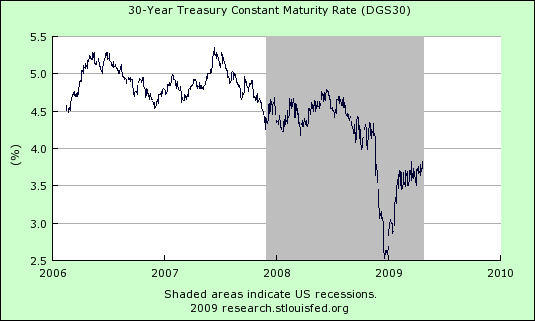
30 Year Goverment Bond Signaling Problems Ahead (Chart)


Thirty Year Government Bond, Daily Price.


The 30 year Treasury Bond yield is drifting slowly upwards. This indicates there is little interest in the bond. With a slew of government debt on the horizon this does not bode well.

The thirty year remains a good proxy of future inflation expectations and should be watched closely. This is exactly what we intend to do.


30 Year Treasury 424
Subscribe to All American Investor via Email


Bob DeMarco is a citizen journalist and twenty year Wall Street veteran. Bob has written more than 500 articles with more than 11,000 links to his work on the Internet. Content from All American Investor has been syndicated on Reuters, the Wall Street Journal, Fox News, Pluck, Blog Critics, and a growing list of newspaper websites. Bob is actively seeking syndication and writing assignments.


More from All American Investor


Follow All American Investor on Twitter

Tuesday, April 07, 2009

The 15 Biggest Holders of U. S. Government Debt


Ever wonder who are the biggest holders of U. S. Government debt?

Maybe you are thinking China? Nope. Luxembourg is number 15 at a paltry $87.2 Billion.

The biggest? This entity owns $4.806 Trillion.

Take a look at the slide show to see the 15 biggest holders.
Subscribe to All American Investor via Email

Friday, April 03, 2009

Government versus Civilian Employment, Which would you rather be? (graph)


Government employees enjoy a tremendous amount of job security. This is evidenced by the blue line on the chart.

The red line represents civilian employment. The bottom of the red line, current data, shows the loss of 5.1 million jobs.

While government employees often make less, there is an obvious compensating balance.

Government versus Civilian Employment 403
Subscribe to All American Investor via Email
Bob DeMarco is a citizen journalist and twenty year Wall Street veteran. Bob has written more than 500 articles with more than 11,000 links to his work on the Internet. Content from All American Investor has been syndicated on Reuters, the Wall Street Journal, Fox News, Pluck, Blog Critics, and a growing list of newspaper websites. Bob is actively seeking syndication and writing assignments.

Follow All American Investor on Twitter

Tuesday, March 03, 2009

Plan to Move Distressed Assets Could Move Stocks Higher


Put me down as a fan of this plan. It could end up being a stroke of genius. This definitely trumps the Resolution Trust Corporation (RTC) plan that was used to dispose of the assets from failed Savings and Loans.

Subscribe to All American Investor via Email
The Obama team announced its intention to partner with the private sector to buy $500 billion to $1 trillion of distressed assets as part of its revamping of the $700 billion bank bailout last month.

...private investment managers would run the funds, deciding which assets to buy and what prices to pay. The government would contribute money from the $700 billion bailout, with additional financing likely coming from the Federal Reserve and by selling government-backed debt. Other investors, such as pension funds, could also participate. To encourage participation, the government would try to minimize risk for private investors, possibly by offering non-recourse loans.

'Bad Bank' Funding Plan Starts to Get Fleshed Out


Bob DeMarco is a citizen journalist, blogger, and Caregiver. In addition to being an experienced writer he taught at the University of Georgia , was an Asociate Director and Limited Partner at Bear Stearns, was CEO of IP Group, and is a mentor. Bob currently resides in Delray Beach, FL where he cares for his mother, Dorothy, who suffers from Alzheimer's disease. Bob has written more than 500 articles with more than 11,000 links to his work on the Internet. His content has been syndicated on Reuters, the Wall Street Journal, Fox News, Pluck, BlogCritics, and a growing list of newspaper websites (15). Bob is actively seeking syndication and writing assignments.


Sunday, March 01, 2009

Another $30 Billion into the AIG Roach Motel


In AIG Whose Your Daddy? , I made the same point I have been making for a long time--there is no hope for AIG. Never mind me, it is going to cost the U.S. taxpayer another $30 billion to keep this "roach motel" of a company going.

AIG wrote more than $1 Trillion dollars of phony baloney paper--otherwise referred too as--credit default swaps (CDS). A Credit Default Swap is insurance on debt. In other words, if you own a bond (debt) you could buy insurance for that bond from AIG. For a tiny fee, AIG insured that if a company goes bankrupt and you own the worthless debt you get all your money back.
Subscribe to All American Investor via Email
Follow us on Twitter

The bad news for us taxpayers is that the CDS market is not regulated. So when AIG got in trouble and the regulators came in--lo and behold--they found that AIG had so much of this paper that if they went under the entire world financial system would come crashing down. This left no choice--bailout AIG.

At this point in this article I will suggest you take a look at the documentary--Inside the Meltdown--How the Economy went so Bad so Fast. There is a good description of the situation the regulators faced when they walked into AIG. When the regulators walked in the door they found out for the first time that AIG owed on a mountain of credit default swaps. Nobody had a clue beforehand. Put it this way, AIG made major bets-- they gambled-- against a scenario like we are seeing today. I guess you could say they hit the Powerball lottery 1000 times in reverse.

The mistake that AIG made was not running this so called portfolio of CDS like you run an insurance business. A typical insurance company might sell insurance in areas where hurricanes occur, as well as, locations all across the country. If there are a lot of hurricanes like we saw back in 2004-2005 insurance companies can lose a lot of money. However, they are still make money in other parts of their business not effected by hurricanes. What AIG did is the equivalent of the insuring the entire world against a natural disaster. Unfortunately for AIG, the entire world got hit by a natural disaster--a financial tsunami. AIG leveraged their balance sheet into near infinity via credit default swaps and now they are broke.

You probably didn't remember this, but, the original $85 billion we loaned to AIG back in September was supposed to be paid back in two years. Never.

Ok, count along with me, one potato--$85 Billion, two potato--another $38 Billion, three potato--a new deal for $150 Billion, four potato-- another $30 Billion, five potato Citigroup.....I think we are running out of potatoes.

AIG to Receive Additional $30 Billion in Federal Assistance

By DEBORAH SOLOMON and LIAM PLEVEN

American International Group Inc. will receive up to an additional $30 billion in federal assistance as part of the latest revamp of its government bailout, according to people familiar with the matter.

The new funding is intended to support AIG as it absorbs $60 billion in quarterly losses and operational and competitive upheaval. Under the plan, the insurer will repay much of the $40 billion it owes the Federal Reserve loan with equity stakes in two AIG units overseas -- Asia-based American International Assurance Co. and American Life Insurance Co, which operates in 50 countries.

Repayment was originally supposed to be in cash with interest. In addition, AIG will securitize $5-$10 billion in debt, backed with life insurance assets, to further reduce its debt burden.

Following these moves, the $60 billion Federal Reserve credit facility AIG received in November will be reduced to $25 billion. AIG has already drawn down $40 billion of those funds.

The plan reflects the deepening exposure of the U.S. taxpayer to the embattled insurer. The assets AIG is transferring to the government in lieu of cash repayment are difficult to value. A recent auction for AIA, for example, failed to draw any bids. The goal of the original AIG rescue in September was to achieve repayment within two years. The latest version will likely leave the U.S. government entangled with AIG for years to come.

AIG's board was meeting Sunday afternoon to vote on the plan and was expected to give its approval.

Major credit rating agencies have already signed off on the deal. Without the support of the credit rating agencies, AIG would have faced crippling cuts to its ratings. The downgrades would likely have forced it to post billions in collateral on an array of financial contracts. It would have also triggered the termination of many corporate insurance policies, costing AIG billions more.

Write to Deborah Solomon at deborah.solomon@wsj.com and Liam Pleven at liam.pleven@wsj.com

Bob DeMarco is a citizen journalist, blogger, and Caregiver. In addition to being an experienced writer he taught at the University of Georgia , was an Asociate Director and Limited Partner at Bear Stearns, was CEO of IP Group, and is a mentor. Bob currently resides in Delray Beach, FL where he cares for his mother, Dorothy, who suffers from Alzheimer's disease. Bob has written more than 500 articles with more than 11,000 links to his work on the Internet. His content has been syndicated on Reuters, the Wall Street Journal, Fox News, Pluck, BlogCritics, and a growing list of newspaper websites (15). Bob is actively seeking syndication and writing assignments.


More from All American Investor


Thursday, February 19, 2009

Recovery.gov


If you are interested in learning more about the recovery and where the money is going you can visit Recovery.gov


Subscribe to All American Investor via Email

Tuesday, January 27, 2009

Bailouts should be no fun


I wrote here before that it is my belief that if politicians are going to "invest" taxpayer dollars they should "invest" like a professional investor would do so. Throwing good money after bad just won't work. Right now, the only thing the bailout is likely to accomplish is push back the inevitable with companies like AIG, Citicorp, GM and Chrysler--bankruptcy. When in history did rewarding incompetent Boards of Directors and management teams with capital work? Isn't this what they do with state owned companies under socialism?

Under the capitalistic system it is the Board of Directors that is responsible for protecting the shareholder interests. How many time have you heard a politician say we should throw out the Board? If we are making major investments in public companies shouldn't we, the taxpayers, be getting Board seats or even Board control. This is a most fundamental principle in capitalism. How many times have you seen a very savvy, smart investor, trying to get Board control of a company so he could reorganize the company and help it function better in a competitive environment?

They put some perspective into bailouts over on Econbrowser.
Bailouts should be no fun
How do you solve the problem of unpayable existing obligations of institutions that otherwise have the resources to make a productive contribution to total economic surplus? That of course is the function that our bankruptcy system is intended to provide. In a typical bankruptcy, the company's owners and senior management get wiped out, some crumbs are left for creditors and workers, and hopefully the most valuable underlying assets get reallocated to alternative productive use.
Subscribe to All American Investor via Email

Saturday, April 21, 2007

Treasury Inflation Protected Securities (TIPS)


Treasury Inflation-Protected Securities, often called TIPS, are government issued securities whose value is linked to the inflation rate

Treasury Inflation Protected Securities (TIPS)

Treasury Inflation-Protected Securities, often called TIPS, are government issued securities whose value is linked to the inflation rate.
Treasury Inflation-Protected Securities, often called TIPS, are government issued securities whose value is linked to the inflation rate. Like Treasury bills, bonds and notes, TIPS are backed by the full faith and credit of the United States government. This make TIPS an ideal investment for those concerned about safety when investing. Treasuries are considered to be the safest investment in the world. TIPS are liquid securities that can be bought and then resold at any time on the open market or directly to the Treasury Department.

TIPS are very different than standard bonds. TIPS pay a stated interest rate like a typical bond (fixed interest rate); however, the principal is adjusted every six months based on the changes in the Consumer Price Index (CPI). If inflation rises the principal of the bond increases, if deflation occurs your principal decreases. Just like all government securities you can never receive less than par (100) if you hold the TIPS to maturity. One of the best features of TIPS is you receive the inflation adjusted principal or the original principal, whichever is greater when the bonds mature.

TIPS pay a fixed rate of interest. However, the interest is applied to the inflation-adjusted principal of the security. If inflation as measured by the CPI increase over the course of ownership of the TIPS every interest payment would rise. If deflation occurs then the interest payment would decline. The amount of interest paid is calculated by multiplying the inflation-adjusted principal (regardless of whether it is greater or less than the original face value) by one-half the fixed annual interest rate (TIPS pay interest every six months).

Unlike typical bonds where you pay a broker a fee, you can buy TIPS direct from the US Treasury. This means 100 percent of your investment goes to work from day one. It is not unusual to suffer a 25-50 basis point drop in yield when purchasing a bond from a broker (the commission you pay reduces the yield, something investors often fail to take into account). And, if you are purchasing a small amount of bonds, the “real” yield on your investment can be reduced by one or more percentage points. The ability to buy TIPS direct from the Treasury is certainly a feature that makes the bonds more attractive.

You can purchase TIPS with 5, 10 or 20 year maturities. This is accomplished by setting up an account with the Treasury online or through the mail; and then, by submitting your non-competitive bid amount at the time of the next auction (the amount you intend to invest). Since most Treasuries are purchased with non-competitive bids you can feel assured that you will receive a fair price at the time of the auction. If you are too busy to set up your own account your broker or bank will do it for you, but they will charge you a fee.