How to make money in the market...look beyond the obvious...spot the trends...and do your homework.
Showing posts with label rates. Show all posts
Thursday, June 17, 2010
Friday, July 31, 2009
Federal Government Receipts Dropping Uh Oh (Graph)
Investor pay attention. Federal government receipts are dropping. This is a negative especially on the dollar. It also means that shortfalls are likely to lead to bigger auctions of government securities down the road.
Once this series becomes more widely discussed in the media it is likely to create investor uncertainty about the future. This is never a good thing for the market.
With the S and P 500 near 1000, investors should start to assume a more cautious stance.
A short fall in government receipts is a negative on the dollar, will likely lead to higher long term interest rates, and could lead to crowding out in the corporate securities market.

Kindle: Amazon's 6"
Wireless Reading Device
Once this series becomes more widely discussed in the media it is likely to create investor uncertainty about the future. This is never a good thing for the market.
With the S and P 500 near 1000, investors should start to assume a more cautious stance.
A short fall in government receipts is a negative on the dollar, will likely lead to higher long term interest rates, and could lead to crowding out in the corporate securities market.

Subscribe to All American Investor via Email

Wireless Reading Device Tuesday, July 07, 2009
U.S. office vacancy hits 15.9 percent
Tip of the hat to our reader, Trader Kev.
US office market continues to spiral down--report
By Ilaina Jonas
NEW YORK, July 7 (Reuters) - The U.S. office market vacancy rate reached 15.9 percent in the second quarter, its highest in four years and rent fell by the largest amount in more than seven as demand from companies and other office renters remained weak, real estate research firm Reis said Inc.
"It's bad," Reis director of research Victor Calanog said. "It's decaying and getting worse. Given the depth and magnitude of the recession, you can argue that we are facing a storm of epic proportions and we're only at the beginning.
The weak demand helped push up the average weighted U.S. office vacancy rate 0.70 percentage points during the quarter and 2.7 percentage points compared with a year ago, according to the report released on Tuesday.
Asking rent during the quarter fell 1.4 percent to $28.43 per square foot. Factoring in rent-free months and improvement costs to landlords, effective rent -- the net amount of cash landlords take in -- fell 2.7 percent in the quarter to $23.42 per square foot. The second-quarter drop was more severe than the first quarter's 2.3 percent, dampening hopes the office market is bottoming out, Reis said.
Year over year, rent was down 6.7 percent, the largest one- quarter decline since the first quarter 2002.
"This is really only the third quarter that we've experienced negative effective rent growth," Calanog said. "Last time, the office sector had four years of negative effective rent growth."
Although the sector has experienced downturns before, the current one may be lethal for lenders and investors who bought property during the boom years of 2005 from 2007. Many of them based the price and the loan on the belief that rents would continue to post strong growth and occupancy increases.
"It's like taking on a lot of debt as an individual and now suddenly earning 10 percent 20 percent 30 percent less," he said.
The dwindling cash flow resulting from higher vacancy and lower rent weakens the ability to repay financing and pushes a borrower closer to defaulting on a loan.
The weak second-quarter performance prompted Reis to maintain its February forecast calling for the U.S. office vacancy rate to top out at 18.2 percent in 2010 and for rent to continue to fall through 2011. It also sees the commercial real estate default rate to reach 4.2 percent by the end of the year and peak at 5.2 percent in 2011.
The U.S. vacancy rate was at 12.5 percent in the third quarter of 2007, but has since risen 3.4 percentage points, Reis said.
Of the 79 markets that Reis tracks, vacancy rose in 65 and effective rent fell in 72, indicating the weakness is widespread.
Vacancy in the New York area, which includes all the New York City boroughs except Staten Island, rose 1.2 percentage points to 10.8 percent, the highest since 1996, and effective rent slid 5.2 percent
"As far as we can tell for New York, the next two years will be murder," Calanog said.
Boston and Orange County and San Jose California saw rent fall more than 5 percent.
Those results do not bode well for office landlords Brookfield Properties Corp (BPO.TO: Quote, Profile, Research, Stock Buzz), Vornado Realty Trust (VNO.N: Quote, Profile, Research, Stock Buzz), Boston Properties Inc (BXP.N: Quote, Profile, Research, Stock Buzz), SL Green Realty Corp (SLG.N: Quote, Profile, Research, Stock Buzz) and Maguire Properties Inc (MPG.N: Quote, Profile, Research, Stock Buzz).
About 20 million square feet of office space came on the market than was rented during the quarter, slightly less than the 25.2 million square feet in the prior quarter.
Year-to-date, a net of 45.2 million more square feet of space put onto the market than was rented, on track with Reis' earlier project of about 67.6 million square feet 2009. If the forecast holds true, 2009 will be the worst year for net absorption of office space since Reis began tracking it in 1980. (Reporting by Ilaina Jonas; editing by Andre Grenon)
More from All American Investor
Kindle: Amazon's 6"
Wireless Reading Device
- U.S. office vacancy hits 15.9 percent in Q2U.S.
- office rent falls 2.7 percent in Q2.
Subscribe to All American Investor via Email
US office market continues to spiral down--report
By Ilaina Jonas
NEW YORK, July 7 (Reuters) - The U.S. office market vacancy rate reached 15.9 percent in the second quarter, its highest in four years and rent fell by the largest amount in more than seven as demand from companies and other office renters remained weak, real estate research firm Reis said Inc.
"It's bad," Reis director of research Victor Calanog said. "It's decaying and getting worse. Given the depth and magnitude of the recession, you can argue that we are facing a storm of epic proportions and we're only at the beginning.
The weak demand helped push up the average weighted U.S. office vacancy rate 0.70 percentage points during the quarter and 2.7 percentage points compared with a year ago, according to the report released on Tuesday.
Asking rent during the quarter fell 1.4 percent to $28.43 per square foot. Factoring in rent-free months and improvement costs to landlords, effective rent -- the net amount of cash landlords take in -- fell 2.7 percent in the quarter to $23.42 per square foot. The second-quarter drop was more severe than the first quarter's 2.3 percent, dampening hopes the office market is bottoming out, Reis said.
Year over year, rent was down 6.7 percent, the largest one- quarter decline since the first quarter 2002.
"This is really only the third quarter that we've experienced negative effective rent growth," Calanog said. "Last time, the office sector had four years of negative effective rent growth."
Although the sector has experienced downturns before, the current one may be lethal for lenders and investors who bought property during the boom years of 2005 from 2007. Many of them based the price and the loan on the belief that rents would continue to post strong growth and occupancy increases.
"It's like taking on a lot of debt as an individual and now suddenly earning 10 percent 20 percent 30 percent less," he said.
The dwindling cash flow resulting from higher vacancy and lower rent weakens the ability to repay financing and pushes a borrower closer to defaulting on a loan.
The weak second-quarter performance prompted Reis to maintain its February forecast calling for the U.S. office vacancy rate to top out at 18.2 percent in 2010 and for rent to continue to fall through 2011. It also sees the commercial real estate default rate to reach 4.2 percent by the end of the year and peak at 5.2 percent in 2011.
The U.S. vacancy rate was at 12.5 percent in the third quarter of 2007, but has since risen 3.4 percentage points, Reis said.
Of the 79 markets that Reis tracks, vacancy rose in 65 and effective rent fell in 72, indicating the weakness is widespread.
Vacancy in the New York area, which includes all the New York City boroughs except Staten Island, rose 1.2 percentage points to 10.8 percent, the highest since 1996, and effective rent slid 5.2 percent
"As far as we can tell for New York, the next two years will be murder," Calanog said.
Boston and Orange County and San Jose California saw rent fall more than 5 percent.
Those results do not bode well for office landlords Brookfield Properties Corp (BPO.TO: Quote, Profile, Research, Stock Buzz), Vornado Realty Trust (VNO.N: Quote, Profile, Research, Stock Buzz), Boston Properties Inc (BXP.N: Quote, Profile, Research, Stock Buzz), SL Green Realty Corp (SLG.N: Quote, Profile, Research, Stock Buzz) and Maguire Properties Inc (MPG.N: Quote, Profile, Research, Stock Buzz).
About 20 million square feet of office space came on the market than was rented during the quarter, slightly less than the 25.2 million square feet in the prior quarter.
Year-to-date, a net of 45.2 million more square feet of space put onto the market than was rented, on track with Reis' earlier project of about 67.6 million square feet 2009. If the forecast holds true, 2009 will be the worst year for net absorption of office space since Reis began tracking it in 1980. (Reporting by Ilaina Jonas; editing by Andre Grenon)
Bob DeMarco is a citizen journalist and twenty year Wall Street veteran. Bob has written more than 700 articles with more than 18,000 links to his work on the Internet. Content from All American Investor has been syndicated on Reuters, the Wall Street Journal, Fox News, Pluck, Blog Critics, and a growing list of newspaper websites. Bob is actively seeking syndication and writing assignments. |
More from All American Investor
- Bond Vigilantes Take over in the Long End (Graph)
- Ten Year Treasury Yield in Orbit (Graph)
- Ten Year Interest Rates Rising (Chart)
- Option ARM--The Toxic Mortgage
- Systemic Risk Defined--Too Big to Fail
- Ray Dalio on the current state of affairs in the market
- Roubini Predicts U.S. Losses May Reach $3.6 Trillion
- 60 Minutes -- Cold Fusion
Wireless Reading Device Tuesday, June 09, 2009
The Housing and Credit Crisis Explained
This presentation on the Housing and Credit crisis is the best I have seen. It explains everything from soup to nuts.
Each slide contains a graph that is well explained.
They say a picture is worth a thousand words.
Once you get through this, you will understanding the current credit crisis in housing, and what to expect in the years ahead.
If you take the time to view and read this you will be fully informed.
Hit the full screen button in the upper right hand corner of the panel below.
T2 Partners Presentation on the Mortgage Crisis
More from All American Investor
Kindle: Amazon's 6" Wireless Reading Device
Follow All American Investor on Twitter
Each slide contains a graph that is well explained.
They say a picture is worth a thousand words.
Once you get through this, you will understanding the current credit crisis in housing, and what to expect in the years ahead.
If you take the time to view and read this you will be fully informed.
Hit the full screen button in the upper right hand corner of the panel below.
T2 Partners Presentation on the Mortgage Crisis
Publish at Scribd or explore others: Research Business & Economics Finance Non-fiction world culture
Subscribe to All American Investor via Email
Bob DeMarco is a citizen journalist and twenty year Wall Street veteran. Bob has written more than 500 articles with more than 11,000 links to his work on the Internet. Content from All American Investor has been syndicated on Reuters, the Wall Street Journal, Fox News, Pluck, Blog Critics, and a growing list of newspaper websites. Bob is actively seeking syndication and writing assignments. |
More from All American Investor
- Bond Vigilantes Take over in the Long End (Graph)
- Ten Year Treasury Yield in Orbit (Graph)
- Ten Year Interest Rates Rising (Chart)
- Option ARM--The Toxic Mortgage
- Systemic Risk Defined--Too Big to Fail
- Ray Dalio on the current state of affairs in the market
- Roubini Predicts U.S. Losses May Reach $3.6 Trillion
- 60 Minutes -- Cold Fusion
Kindle: Amazon's 6" Wireless Reading Device Follow All American Investor on Twitter
Saturday, June 06, 2009
Bond Vigilantes Take over in the Long End (Graph)

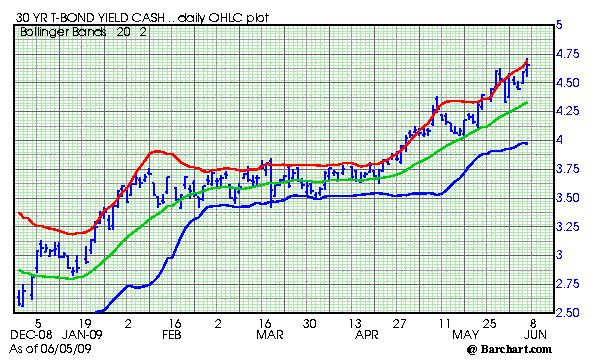
If you were around during the 1980s you know all about the bond vigilantes. When inflation is on the horizon they take over in the long end of the Treasury market.
The 30 year chart above shows that institutional investors are worried about the current policies of the Federal Reserve and Treasury. When this occurs, a interest rate risk premium gets built into the bond. In other words, investors want a bigger cushion to accept the risk of investing in long term Treasury Bonds.
These interest rates look high in comparison to recent history. However, if you are old enough you will remember when the long bond traded above 15 percent. Right now, if you told someone you believed that could happen again, they would tell you -- you are nuts.
They told me I was nuts when I wrote about fire not smoke, when the S and P 500 was in the 1250 area. Nobody thought we could see the stock market fall in half from those levels.
Over the next few years, talk about a downgrade of U.S. debt is going to increase. It appears right now that the downgrade is inevitable. However, it is probably two to four years in the future. The market will discount the downgrade before it happens.
Expect 30 year Treasury bond yields to continue to rise for the foreseeable future. Constant Treasury intervention to try and hold down long term interest rates will fail.
Remember when the Treasury intervened in the Gold market over and over to try and hold prices down?
More from All American Investor
Kindle: Amazon's 6" Wireless Reading Device
Follow All American Investor on Twitter
Over the next few years, talk about a downgrade of U.S. debt is going to increase. It appears right now that the downgrade is inevitable. However, it is probably two to four years in the future. The market will discount the downgrade before it happens.
Expect 30 year Treasury bond yields to continue to rise for the foreseeable future. Constant Treasury intervention to try and hold down long term interest rates will fail.
Remember when the Treasury intervened in the Gold market over and over to try and hold prices down?
Subscribe to All American Investor via Email
Bob DeMarco is a citizen journalist and twenty year Wall Street veteran. Bob has written more than 500 articles with more than 11,000 links to his work on the Internet. Content from All American Investor has been syndicated on Reuters, the Wall Street Journal, Fox News, Pluck, Blog Critics, and a growing list of newspaper websites. Bob is actively seeking syndication and writing assignments. |
More from All American Investor
- Top Hedge Fund Managers Make Billions in 2008
- Systemic Risk Defined--Too Big to Fail
- Ray Dalio on the current state of affairs in the market
- Roubini Predicts U.S. Losses May Reach $3.6 Trillion
- Option ARM--The Toxic Mortgage
- Warren Buffett's Annual Letter to Investors (Cliff Notes Version)
Kindle: Amazon's 6" Wireless Reading Device Follow All American Investor on Twitter
Ten Year Treasury Yield in Orbit (Graph)
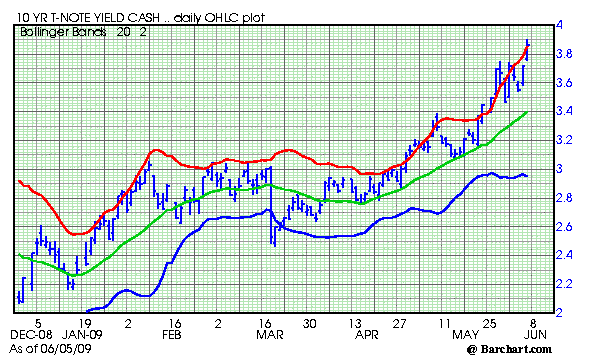
Our new song is, there ain't no stopping it now. Oh, the Treasury will come in and buy some size in longer dated Treasuries and mortgage back securities, forcing a short lived, temporary drop in rates from time to time.
As you can see if you look at the red line on the chart, this market continues to stay overbought. This is not a negative sign, quite the opposite, it signals the enormous strength of this trend up in interest rates.
Expect the Fed to defend the 4.00% with both hands and both feet. It will be interesting to see if they can stem the tide of rising interest rates in the longer end of the market.
This rise in ten year interest rates has lots of negative implications. However, the single biggest negative is simple --the refinancing boom is over. With mortgage rates well over 5 percent now, the economics won't work for the vast number of mortgage owners that refinanced in prior drops into the current area.
More from All American Investor
Kindle: Amazon's 6" Wireless Reading Device
Subscribe to All American Investor via Email
Bob DeMarco is a citizen journalist and twenty year Wall Street veteran. Bob has written more than 500 articles with more than 11,000 links to his work on the Internet. Content from All American Investor has been syndicated on Reuters, the Wall Street Journal, Fox News, Pluck, Blog Critics, and a growing list of newspaper websites. Bob is actively seeking syndication and writing assignments. |
More from All American Investor
- Ten Year Treasury Yield in Orbit (Graph)
- Ten Year Interest Rates Rising (Chart)
- Systemic Risk Defined--Too Big to Fail
- Ray Dalio on the current state of affairs in the market
- Roubini Predicts U.S. Losses May Reach $3.6 Trillion
- Option ARM--The Toxic Mortgage
- 60 Minutes -- Cold Fusion
Kindle: Amazon's 6" Wireless Reading Device Friday, May 01, 2009
Ten Year Treasury Should Worry Investors (Chart)
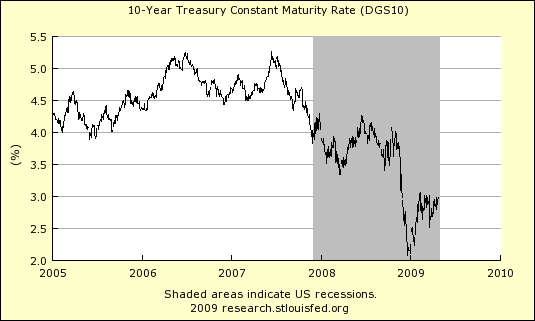
Ten Year Treasury Constant Maturity
For several weeks, I have been writing about longer dated Treasury securities and the importance of paying attention to interest rates if you are an investor.
The ten year Treasury interest rate is moving up fast. This week it challenged and broke the important 3.125 area. At the same time, the FOMC reaffirmed its intention of buying treasury securities in size.
Federal Reserve will buy up to $300 billion of Treasury securities by autumn.
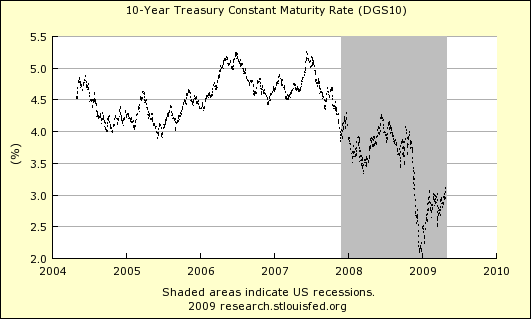
The Fed can hold down short term interest rates until inflation picks up. However, the Fed cannot hold down long term interest.
I also posted charts showing the growth of the Fed's balance sheet and the explosive growth in money supply.
The bond vigilantes are coming back. Soon this will be the talk of the town. And, discussion about inflation and risk premiums will bring new jitters into the stock market.
You heard it here first.

More from All American Investor
Follow All American Investor on Twitter
The bond vigilantes are coming back. Soon this will be the talk of the town. And, discussion about inflation and risk premiums will bring new jitters into the stock market.
You heard it here first.

Subscribe to All American Investor via Email
Bob DeMarco is a citizen journalist and twenty year Wall Street veteran. Bob has written more than 500 articles with more than 11,000 links to his work on the Internet. Content from All American Investor has been syndicated on Reuters, the Wall Street Journal, Fox News, Pluck, Blog Critics, and a growing list of newspaper websites. Bob is actively seeking syndication and writing assignments. |
More from All American Investor
- 30 Year Conventional Mortgage Rate (Chart)
- Top Hedge Fund Managers Make Billions in 2008
- Systemic Risk Defined--Too Big to Fail
- Ray Dalio on the current state of affairs in the market
- Roubini Predicts U.S. Losses May Reach $3.6 Trillion
- Option ARM--The Toxic Mortgage
- Warren Buffett's Annual Letter to Investors (Cliff Notes Version)
Follow All American Investor on Twitter
Saturday, April 25, 2009
10 Year Treasury Closes above 3 Percent (Graph)
Ten Year Treasury Daily Yield Chart

The ten year Treasury closed at 3.03 on Friday. It looks to me like interest rates are turning up in spite of the FEDs buying of treasuries and mortgage backed securities. This does not bode well for longer dated Treasury securities in the months ahead. Treasury supply is going to rise dramatically and right now there is little demand for the ten year as evidenced by the shape of the yield curve.
I expect the ten year to test the critical 3.125 area soon. If this area is broken the long term downtrend in ten year interest rates will have come to an end.
More from All American Investor
Follow All American Investor on Twitter

The ten year Treasury closed at 3.03 on Friday. It looks to me like interest rates are turning up in spite of the FEDs buying of treasuries and mortgage backed securities. This does not bode well for longer dated Treasury securities in the months ahead. Treasury supply is going to rise dramatically and right now there is little demand for the ten year as evidenced by the shape of the yield curve.
I expect the ten year to test the critical 3.125 area soon. If this area is broken the long term downtrend in ten year interest rates will have come to an end.
Subscribe to All American Investor via Email
Bob DeMarco is a citizen journalist and twenty year Wall Street veteran. Bob has written more than 500 articles with more than 11,000 links to his work on the Internet. Content from All American Investor has been syndicated on Reuters, the Wall Street Journal, Fox News, Pluck, Blog Critics, and a growing list of newspaper websites. Bob is actively seeking syndication and writing assignments. |
More from All American Investor
- 30 Year Conventional Mortgage Rate (Chart)
- Top Hedge Fund Managers Make Billions in 2008
- Systemic Risk Defined--Too Big to Fail
- Ray Dalio on the current state of affairs in the market
- Roubini Predicts U.S. Losses May Reach $3.6 Trillion
- Option ARM--The Toxic Mortgage
- Warren Buffett's Annual Letter to Investors (Cliff Notes Version)
Follow All American Investor on Twitter
Monday, March 30, 2009
Big Boys Buying Mortgages In Reaction to Treasury Plan
Big Boy Investors like PIMCO, TCW, and Fifth Third Asset Management are buying mortgage backed securities and favoring them over treasuries.
So far the plan which is designed to lower consumer interest rates by taking supply out of the market seems to be working. A contrarian might ask? Is this front running or the makings of a trend that can be sustained over a long period of time?
Interest rate spreads are clearly narrowing across most quality preferences. The spread between the ten year Treasury and Fannie Mae’s current-coupon 30- year fixed-rate narrowed to 118 basis points last week, down from 232 basis points in November. The spread on industrial corporates narrowed from 557 basis points to 468 basis point since the announcement.
These narrowing in the interest rate spreads can also be seen as a vote of confidence for the recently announced Fed plan.
Follow All American Investor on Twitter
A March 23 Ried, Thunberg & Co. survey said fund managers overseeing $1.19 trillion cut their government securities holdings to the least this year while they increased mortgage assets.This is in reaction to the Federal Reserves March 18 plan to buy Treasuries and $750 billion of mortgage-backed securities from Fannie Mae, Freddie Mac and Ginnie Mae.
So far the plan which is designed to lower consumer interest rates by taking supply out of the market seems to be working. A contrarian might ask? Is this front running or the makings of a trend that can be sustained over a long period of time?
Interest rate spreads are clearly narrowing across most quality preferences. The spread between the ten year Treasury and Fannie Mae’s current-coupon 30- year fixed-rate narrowed to 118 basis points last week, down from 232 basis points in November. The spread on industrial corporates narrowed from 557 basis points to 468 basis point since the announcement.
These narrowing in the interest rate spreads can also be seen as a vote of confidence for the recently announced Fed plan.
Follow All American Investor on Twitter
Tuesday, March 17, 2009
Credit Card Defaults at 20 Year High
The level of defaults are reaching a dangerous level. The big question right now--has the market already discounted this information? If not, a new leg down is coming after this consolidation.
By Juan Lagorio
NEW YORK (Reuters) - U.S. credit card defaults rose in February to their highest level in at least 20 years, with losses particularly severe at American Express Co (AXP) amid a deepening recession.
AmEx, the largest U.S. charge card operator by sales volume, said its net charge-off rate -- debts companies believe they will never be able to collect -- rose to 8.70 percent in February from 8.30 percent in January.
The credit card company's shares wiped out early gains and ended down 3.3 percent as loan losses exceeded expectations. Moshe Orenbuch, an analyst at Credit Suisse, said American Express credit card losses were 10 basis points larger than forecast.
In addition, Citigroup Inc (C) -- one of the largest issuers of MasterCard cards -- disappointed analysts as its default rate soared to 9.33 percent in February, from 6.95 percent a month earlier, according to a report based on trusts representing a portion of securitized credit card debt.
"There is a continued deterioration. Trends in credit cards will get worse before they start getting better," said Walter Todd, a portfolio manager at Greenwood Capital Associates.
U.S. unemployment -- currently at 8.1 percent -- is seen approach 10 percent as the country endures its worst recession since World War Two, leaving more than 13 million Americans jobless, according to a Reuters poll of economists.
However, not all were bad surprises. JPMorgan Chase & Co (JPM) and Capital One reported higher credit card losses, but they were below analysts expectations.
Chase -- a big issuer of Visa cards -- reported its charge-off rate rose to 6.35 percent in February from 5.94 percent in January. The loss rate for the first two months of the quarter is 126 bps from the previous quarterly average compared to an estimate of a 145 bp increase, Orenbuch said.
Capital One Financial Corp's (COF)default rate increased to 8.06 percent in February from 7.82 percent in January.
MORE PAIN AHEAD
Analysts estimate credit card chargeoffs could climb to between 9 and 10 percent this year from 6 to 7 percent at the end of 2008. In that scenario, such losses could total $70 billion to $75 billion in 2009.
"People underestimated the severity of the downturn we are experiencing and I wouldn't be surprised to see them north of 10 percent," said Todd, who added American Express was most exposed to higher credit card losses, given its sole reliance on the industry.
Credit card lenders are trying to protect themselves by tightening credit limits, rising standards, and closing accounts. They have also been slashing rewards, raising interest rates and increasing fees to cushion further losses.
Meredith Whitney, one of Wall Street's best known and most bearish bank analysts, estimates that Americans' credit card lines will be cut by $2.7 trillion, or 50 percent, by the end of 2010 -- and fewer Americans will be offered new cards.
"We believe that the US credit card industry will feel additional credit pain over the next 12-18 months. Until lenders like Capital One show stabilization, followed by trend-bucking improvement over a several-month period, we will continue to remain bearish on credit card lenders," said John Williams, an analyst at Macquarie Research.
Todd said credit card issuers shares -- which are down up to 60 percent in 2009 -- will remain under pressure until the end of 2009, or early next year, when bad loans could start to redeem.
(Reporting by Juan Lagorio, editing by Bernard Orr)
Follow All American Investor on Twitter
More from All American Investor
U.S. credit card defaults rose in February to their highest level in at least 20 years, with losses particularly severe at American Express Co (AXP) and Citigroup (C) amid a deepening recession.
AmEx, the largest U.S. charge card operator by sales volume, said its net charge-off rate -- debts companies believe they will never be able to collect -- rose to 8.70 percent in February from 8.30 percent in January.
Subscribe to All American Investor via Email
U.S. credit card defaults rise to 20 year-high
By Juan Lagorio
NEW YORK (Reuters) - U.S. credit card defaults rose in February to their highest level in at least 20 years, with losses particularly severe at American Express Co (AXP) amid a deepening recession.
AmEx, the largest U.S. charge card operator by sales volume, said its net charge-off rate -- debts companies believe they will never be able to collect -- rose to 8.70 percent in February from 8.30 percent in January.
The credit card company's shares wiped out early gains and ended down 3.3 percent as loan losses exceeded expectations. Moshe Orenbuch, an analyst at Credit Suisse, said American Express credit card losses were 10 basis points larger than forecast.
In addition, Citigroup Inc (C) -- one of the largest issuers of MasterCard cards -- disappointed analysts as its default rate soared to 9.33 percent in February, from 6.95 percent a month earlier, according to a report based on trusts representing a portion of securitized credit card debt.
"There is a continued deterioration. Trends in credit cards will get worse before they start getting better," said Walter Todd, a portfolio manager at Greenwood Capital Associates.
U.S. unemployment -- currently at 8.1 percent -- is seen approach 10 percent as the country endures its worst recession since World War Two, leaving more than 13 million Americans jobless, according to a Reuters poll of economists.
However, not all were bad surprises. JPMorgan Chase & Co (JPM) and Capital One reported higher credit card losses, but they were below analysts expectations.
Chase -- a big issuer of Visa cards -- reported its charge-off rate rose to 6.35 percent in February from 5.94 percent in January. The loss rate for the first two months of the quarter is 126 bps from the previous quarterly average compared to an estimate of a 145 bp increase, Orenbuch said.
Capital One Financial Corp's (COF)default rate increased to 8.06 percent in February from 7.82 percent in January.
MORE PAIN AHEAD
Analysts estimate credit card chargeoffs could climb to between 9 and 10 percent this year from 6 to 7 percent at the end of 2008. In that scenario, such losses could total $70 billion to $75 billion in 2009.
"People underestimated the severity of the downturn we are experiencing and I wouldn't be surprised to see them north of 10 percent," said Todd, who added American Express was most exposed to higher credit card losses, given its sole reliance on the industry.
Credit card lenders are trying to protect themselves by tightening credit limits, rising standards, and closing accounts. They have also been slashing rewards, raising interest rates and increasing fees to cushion further losses.
Meredith Whitney, one of Wall Street's best known and most bearish bank analysts, estimates that Americans' credit card lines will be cut by $2.7 trillion, or 50 percent, by the end of 2010 -- and fewer Americans will be offered new cards.
"We believe that the US credit card industry will feel additional credit pain over the next 12-18 months. Until lenders like Capital One show stabilization, followed by trend-bucking improvement over a several-month period, we will continue to remain bearish on credit card lenders," said John Williams, an analyst at Macquarie Research.
Todd said credit card issuers shares -- which are down up to 60 percent in 2009 -- will remain under pressure until the end of 2009, or early next year, when bad loans could start to redeem.
(Reporting by Juan Lagorio, editing by Bernard Orr)
Bob DeMarco is a citizen journalist and twenty year Wall Street veteran. Bob has written more than 500 articles with more than 11,000 links to his work on the Internet. Content from All American Investor has been syndicated on Reuters, the Wall Street Journal, Fox News, Pluck, Blog Critics, and a growing list of newspaper websites. Bob is actively seeking syndication and writing assignments. |
Follow All American Investor on Twitter
More from All American Investor
- Systemic Risk Defined--Too Big to Fail
- Ray Dalio on the current state of affairs in the market
- Roubini Predicts U.S. Losses May Reach $3.6 Trillion
- Six Errors on the Path to the Financial Crisis
- Who Caused the Financial Crisis?
- Option ARM--The Toxic Mortgage
- Debt Binge--The Perfect Financial Storm
- Warren Buffett's Annual Letter to Investors (Cliff Notes Version)
Friday, January 30, 2009
Is the next shoe ready to drop in the Housing market?
The Wall Street Journal is reporting that defaults on so called 'Option ARM' mortgages are rising fast.

'Option ARMs' are particularly toxic because they allow the borrower to make a small minimum payment each month with the unpaid part of the monthly payment being added to principle of the mortgage outstanding. In other words, these mortgages are subject to severe negative amortization. The amount you owe on the mortgage loangoes up each and every month.
Let's say, for example, that the monthly payment is set at $1500. The homeowner decides to elect the minimum payment (the option) and pays $1000. The unpaid $500 is immediately added to the mortgage's principle balance outstanding. It only gets worse. Not only does the amount owed grow each month; this higher loan balance is immediately reflected in the next month's calculation. In effect, the option arm owner is borrowing more money each month and then ends up paying interest on interest. Sounds a little like loan sharking--doesn't it.
It is easy to see that the amount owed on an option ARM mortgage could grow fast. Imagine watching the amount you owe on your mortgage double over time as you sit back and make the minimum payment. Next, imagine what you might do when you see the amount you owe on your mortgage going up each month; while the value of the house in the market place is going down each month. Easy decision for many Americans--walk away, stop paying, go to foreclosure.
Original content:Is the next shoe ready to drop in the Housing market?

As of December, 28% of option ARMs were delinquent or in foreclosure, according to LPS Applied Analytics, a data firm that analyzes mortgage performance.
Nearly 61% of option ARMs originated in 2007 will eventually default, according to a recent analysis by Goldman SachsThis is sobering news and indicates the bad news from the housing market is far from over.
Subscribe to All American Investor via EmailAn 'Option ARM' is typically a 30-year adjustable rate mortgage that initially offers the borrower four monthly payment options: a specified minimum payment, an interest-only payment, a 15-year fully amortizing payment, or a 30-year fully amortizing payment. These types of loans are also called "pick-a-payment" or "pay-option" ARMs.
'Option ARMs' are particularly toxic because they allow the borrower to make a small minimum payment each month with the unpaid part of the monthly payment being added to principle of the mortgage outstanding. In other words, these mortgages are subject to severe negative amortization. The amount you owe on the mortgage loangoes up each and every month.
Let's say, for example, that the monthly payment is set at $1500. The homeowner decides to elect the minimum payment (the option) and pays $1000. The unpaid $500 is immediately added to the mortgage's principle balance outstanding. It only gets worse. Not only does the amount owed grow each month; this higher loan balance is immediately reflected in the next month's calculation. In effect, the option arm owner is borrowing more money each month and then ends up paying interest on interest. Sounds a little like loan sharking--doesn't it.
It is easy to see that the amount owed on an option ARM mortgage could grow fast. Imagine watching the amount you owe on your mortgage double over time as you sit back and make the minimum payment. Next, imagine what you might do when you see the amount you owe on your mortgage going up each month; while the value of the house in the market place is going down each month. Easy decision for many Americans--walk away, stop paying, go to foreclosure.
Nearly $750 billion of option adjustable-rate mortgages, or option ARMs, were issued from 2004 to 2007, according to Inside Mortgage Finance, an industry publication. Rising delinquencies are creating fresh challenges for companies such as Bank of America Corp., J.P. Morgan Chase & Co. and Wells Fargo & Co. that acquired troubled option-ARM lenders.Another example of Dumb and Dumber. Who is Dumb and Who is Dumber?

Original content:
Labels:
adjustable,
blog,
default,
mortgage,
option arm,
rates
Thursday, January 08, 2009
Commercial Real Estate Delinquency Rates Soar
Delinquencies on mortgages for hotels, shopping malls and office buildings were sharply higher in the fourth quarter.

The share of commercial real estate loans in smaller banks (below the top 100) has been rising steadily over the last decade rising in some banks to 50 percent of portfolio. A crunch in the commercial real estate markets could remind people of the S and L debacle of the 1980s. Southeast and California savings and loans loaded up on real estate and when these investments proved to be uneconomical most of these banks failed. There could be storm clouds on the horizon.
While I am not forecasting impending doom, if you are invested in small and regional banks you would be wise to look at the portfolios of those financial institutions. If the bank portfolio is heavily weighted in commercial real estate loans or commercial mortgages this should be viewed as a red flag.
Delinquency rates on these kinds of loans are forecast to rise in the year ahead. It is unlikely that the markets has discounted this news. Most of the focus has been on "other things".
If you have a subscription to the Wall Stree Journal you should read this article,

New data from Deutsche Bank show that delinquencies on commercial mortgages packaged and sold as bonds, which represent nearly a third of the commercial real-estate debt market, nearly doubled during the past three months, to about 1.2%. A weaker economy threatens to cause losses for investors in this $3.4 trillion market.
The share of commercial real estate loans in smaller banks (below the top 100) has been rising steadily over the last decade rising in some banks to 50 percent of portfolio. A crunch in the commercial real estate markets could remind people of the S and L debacle of the 1980s. Southeast and California savings and loans loaded up on real estate and when these investments proved to be uneconomical most of these banks failed. There could be storm clouds on the horizon.
While I am not forecasting impending doom, if you are invested in small and regional banks you would be wise to look at the portfolios of those financial institutions. If the bank portfolio is heavily weighted in commercial real estate loans or commercial mortgages this should be viewed as a red flag.
Delinquency rates on these kinds of loans are forecast to rise in the year ahead. It is unlikely that the markets has discounted this news. Most of the focus has been on "other things".
If you have a subscription to the Wall Stree Journal you should read this article,
Commercial Property Loses Shelter
Labels:
commercial real estate,
delinquency,
malls,
office buildings,
rates
Subscribe to:
Posts (Atom)


