Showing posts with label yield. Show all posts

Thursday, September 13, 2012

Total System Services (TSS) 2012 Review


Total System Services, TSS, is a major processor of credit, debit and private label card transactions for institutions in North America.

TSS has grown dividends and profits at a 10-20% annual pace for the past 10 years earning a 15-20% return on equity. Despite a drop in revenue resulting from a tightening of consumer purse strings in the recent recession, management has structured a return to above average growth by:

(1) an improving economy leads to an increase in cardholder transactions,

(2) acquisitions [the company has a strong cash position],

(3) ongoing share buyback program,

(4) streamlining its operations and aggressive cost cutting.

Negatives:

(1) TSS is in a highly competitive industry,

(2) falling interest rates have a negative impact on income,

(3) new regulations may slower growth in cardholder accounts and higher operating costs.

Total is rated B++ by Value Line, carries a 4% debt to equity ratio and its stock yields 1.7%.

Statistical Summary

Stock Yield Dividend Growth Rate Payout Ratio # Increases Since 2002
TSS 1.7% 6% 28% 6
IND 2.0 9 26 NA


Debt/Equity ROE EPS Down Since 2002 Net Margin Value Line Rating
TSS 4% 18% 3 13% B++
IND 31 21 NA 17 NA


Chart

Note: TSS stock has made steady progress off its November 2008 low, surpassing the down trend off its May 2007 high (straight red line) and the November trading high (green line). TSS is in a long term trading range; the blue line is the lower boundary. However, it is an intermediate term up trend (purple lines). The wiggly red line is the 50 day moving average. The Dividend Growth Portfolio owns a 50% position in TSS. Shares would be Added at $12. The lower boundary of its Sell Half Range is $28.


http://finance.yahoo.com/q?s=TSS


Steve Cook received his education in investments from Harvard, where he earned an MBA, New York University, where he did post graduate work in economics and financial analysis and the CFA Institute, where he earned the Chartered Financial Analysts designation in 1973. His 40 years of investment experience includes institutional portfolio management at Scudder, Stevens and Clark and Bear Stearns. Steve's goal at Strategic Stock Investments is to help other investors build wealth and benefit from the investing lessons he learned the hard way.

Wednesday, September 12, 2012

T Rowe Price (TROW) 2012 Review


T. Rowe Price Group Inc, TROW, provides investment advisory and administrative services to an assortment of no load funds, sponsored investment products and private accounts.

T Rowe Price has generated a 18-20%+ return on equity and a 10-15% growth rate in earnings and dividends over the 10 years. 

While TROW suffered a decline in assets under management due primarily to the late 2008-early 2009 decline in stock prices, a recovery occurred in 2010 and should continue as a result of:

(1) the excellent track record of its funds as well as recent investor optimism has increased the value of current assets under management as well as attracting new customers,

(2) the introduction of new products such as country funds,

(3) an aggressive cost cutting program.

VF Corp (VFC) 2012 Review


VF Corporation, VFC,  is an apparel maker and distributor and a leader in jeans wear, sportswear, image wear and work wear. It has raised its dividend every year for the last 20 years.

Its brands include Lee, Wrangler, Jansport, Nautica, The North Face, Vans, Napaplin, Timberland, John Varvatos and Reef. The company has grown its profits and dividend at a 9-11% rate over the last 10 years earning a 15-18% return on equity.

It has raised its dividend every year for the last 20 years. Despite tough conditions in many of its product categories in 2009, management negotiated this period with barely a hiccup and set the company on a course to continue to grow earnings by:

(1) the strength of VFC’s brand management strategy provides a competitive advantage with regard to distribution as well as benefiting it tough economic periods,

(2) its long history of manufacturing and engineering expertise produces cost and service benefits,

(3) a successful acquisition program focusing on companies with global growth opportunities. The recent acquisitions of [a] Timberland will spur growth in its outdoor and sportswear businesses and [b] Rock and Republic Enterprises will increase its competitive position in premium jeans.

Tuesday, September 11, 2012

Reliance Steel (RS) 2012 Review


Reliance Steel, RS,  provides value-added metals processing services and distributes more than 100,000 metal products. 

The company has grown profits and dividends at a 13-15% rate and earned a 7-19% return on equity over the last ten years. RS operations were under significant pressure from declining volume and increasing price competition in 2009. However, profits begun growing again as a result of:

(1) despite slow economic growth, it is witnessing improvement in its core customer base (aerospace and energy) resulting in both rising demand and prices,

(2) acquisitions (latest: McKey and National Specialty Alloys),

(3) an excellent cost control discipline.


Marathon Oil (MRO) 2012 Review


Marathon Oil , MRO,  is an oil and natural gas production company, having recently spun off its refining operations. 

As a newly separated entity, it has no available historical data. However, future profit and dividend increases are expected in the 8-13% range and ROE is estimated in the 12-15% area. Looking ahead both earnings and dividends will be driven by:

(1) expanding activity in Texas’ Eagle Ford shale,

(2) acquisitions,

(3) strong inventory of development projects [Indonesia, Iraq, Poland].

Monday, September 10, 2012

General Mills (GIS) 2012 Review


General Mills Inc., GIS, processes and markets such well known products as Cheerios, Wheaties, Total, Chex, Betty Crocker, Bisquick, Hamburger Helper, Yoplait and Progresso. 

The company has grown profits and dividends at a 7-10% pace over the last ten years earning a 20%+ return on equity. This performance should continue as a result of:

(1) an outstanding portfolio of fast growing brands

(2) a steady pipeline of new products which enhance sales and take market share,

(3) an aggressive cost cutting program,

(4) expansion into emerging markets which should account for 70% of food growth though 2012,

(5) acquisitions (latest: Yoplait Int’l, Parampara Foods [India], Yoki [Brazil])

(6) management is committed to enhancing shareholder value via increasing dividends and share buy backs.


Thursday, June 14, 2012

Automatic Data Processing (ADP) 2012 Review


Automatic Data Processing (ADP) provides payroll and tax filing services, brokerage services, comprehensive human resource services and financial services to auto and truck dealerships.

The company has grown profits and dividends 7-14% over the last 10 years and has earned an 18-20% return on equity. While the 2008-2009 recession impacted ADP somewhat, it did very well relative to other companies. Long term, the company should continue to prosper based:

(1) the economic recovery has led to an increase in both customers and the number of checks processed,

(2) the contribution from the recent acquisitions [8 in the last year],

(3) a dedicated effort to technological upgrades,

(4) its stock buy back program.

Thursday, March 08, 2012

Ross Stores (ROST) 2012 Review


Ross Stores (ROST) operates a chain of off price retail stores offering high quality, in season name brand and designer apparel, shoes, cosmetics, accessories and home merchandise at discounts of 20-60% below mainstream retailers.

The company has grown profits and dividends at a 15-20% annual rate over the past 10 years, earning a 25%+ return on equity. While current retail environment experienced difficulties in the recent recession, ROST’s off price business model continued to produce above average results because:

Tuesday, June 16, 2009

Mortgage Interest Rates Go Verticle (Graph)


The negative implications of the sharp rise in mortgage interest rates are to many to list. When interest rates rise house get more expensive. This is likely to slow the economic recovery in housing -- a real negative. Another likely outcome is the end of the refinancing boom.

Let's not forget, the Treasury has been in the markets buying Treasury securities and mortgage backed securities. As we have pointed out for many months, the Treasury balance sheet is exploding with no end in sight. Rates continue to rise against this background.

It should be clear that there is little or nothing that the FED and Treasury can do to stem the rise in longer dated securities.

Here is another little noticed fact that we will be writing about soon. Since June 1, the two year treasury has risen 26 basis points, while the ten year treasury has dropped 4 basis points. This means the yield curve is flattening. Go here for the Daily Treasury Yield Curve Rates.

My guess is in the next 12-18 months the market will realize that stagflation is the name of the game.

This is the worst thing that can happen to the dollar. The only thing that could stem a run on the dollar is FED tightening.
Subscribe to All American Investor via Email

Bob DeMarco is a citizen journalist and twenty year Wall Street veteran. Bob has written more than 500 articles with more than 11,000 links to his work on the Internet. Content from All American Investor has been syndicated on Reuters, the Wall Street Journal, Fox News, Pluck, Blog Critics, and a growing list of newspaper websites. Bob is actively seeking syndication and writing assignments.


More from All American Investor


Follow All American Investor on Twitter

Saturday, June 06, 2009

Ten Year Treasury Yield in Orbit (Graph)


Ten Year Treasury Yield in Orbit (Graph)

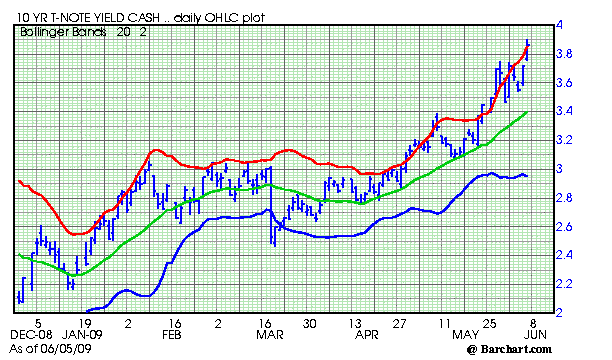
The sharp rise in the Ten Year Treasury note yield will come as no surprise to readers of this blog. We forecasted this development, based on Federal Reserve and Treasury policy, several months ago when we pointed out that once the yield exceeded 3.125 percent, it was up up and away on our beautiful, beautiful money machine.

Our new song is, there ain't no stopping it now. Oh, the Treasury will come in and buy some size in longer dated Treasuries and mortgage back securities, forcing a short lived, temporary drop in rates from time to time.

As you can see if you look at the red line on the chart, this market continues to stay overbought. This is not a negative sign, quite the opposite, it signals the enormous strength of this trend up in interest rates.

Expect the Fed to defend the 4.00% with both hands and both feet. It will be interesting to see if they can stem the tide of rising interest rates in the longer end of the market.

This rise in ten year interest rates has lots of negative implications. However, the single biggest negative is simple --the refinancing boom is over. With mortgage rates well over 5 percent now, the economics won't work for the vast number of mortgage owners that refinanced in prior drops into the current area.
Subscribe to All American Investor via Email


Bob DeMarco is a citizen journalist and twenty year Wall Street veteran. Bob has written more than 500 articles with more than 11,000 links to his work on the Internet. Content from All American Investor has been syndicated on Reuters, the Wall Street Journal, Fox News, Pluck, Blog Critics, and a growing list of newspaper websites. Bob is actively seeking syndication and writing assignments.


More from All American Investor


Kindle: Amazon's 6" Wireless Reading Device

Sunday, April 26, 2009

Conoco Phillips (COP) great yield, great chart


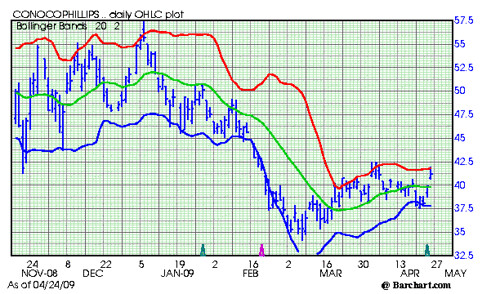
Conoco Phillips (Cop) yields 4.60 percent. The chart looks good and a close over 42.50 would confirm the change in trend. The stock traded near 57.50 on January 9. I started thinking about this stocks after hearing Jim Cramer tout it on Mad Money.

Conoco Phillips 426


Subscribe to All American Investor via Email


Bob DeMarco is a citizen journalist and twenty year Wall Street veteran. Bob has written more than 500 articles with more than 11,000 links to his work on the Internet. Content from All American Investor has been syndicated on Reuters, the Wall Street Journal, Fox News, Pluck, Blog Critics, and a growing list of newspaper websites. Bob is actively seeking syndication and writing assignments.


More from All American Investor


Follow All American Investor on Twitter

Monday, January 26, 2009

Will the Fed Try to 'Rig' the Long Term Treasury Market?


It appears that Fed policy makers are exploring the purchase of longer-dated Treasury securities in an effort to push up their price and bring down their yield. This reminded me immediately of the Treasuries effort to manipulate the price of gold in the late 1970s. In an attempt to do this, the Treasury started periodic sales of gold. As I recall, they started selling gold into the market around $175 an ounce. They finally gave up when gold reached well into the $400s. They sold not a single ounce as gold soared up and over $800. My point here is simple--you cannot 'rig' the markets no matter how hard you try. Eventually the rubber band breaks and most times the resulting equal and opposite reaction is chaos.
Subscribe to All American Investor via Email


My guess is that the only thing the Fed will accomplish is to bring wild and crazy swings into the Treasury market. In other words, volatility. In the late 1970s and early 80s it was not unusual to see the long bonds move 2 or more points in a day. The daily trading ranges often exceeded 3 points. Around the same time it was not unusual to see short term rates, treasury bills, move in trading ranges greater than one percent a week. So far interest rates have been relatively tame.

It seems that nothing much changes. The "new new" thing here is to use taxpayer money or federal balance sheet leverage to cure the "sick patient". Will this work, I doubt it. My guess is we take our medicine and eventually things smooth out and then we get on a rehab program. All of this takes time. There are no overnight solutions. You can take your three antibiotic pills a day for ten days and soon enough you will be feeling better. But guess what, if you take all 30 in a single day they won't work and worse, you'll suffer from a very nasty and negative reaction.

It should be apparent that Federal regulators are running out of bullets. My suggestion is we get these guys into the Economics 101 course to revisit the laws of supply and demand. In my opinion, understanding the supply/demand equation is the real long term answer to our current economic woes.

Bernanke Risks ‘Very Unstable’ Market as He Weighs Buying Bonds

Friday, January 16, 2009

10-Year Treasury Constant Maturity Rate