Economics
This Week’s Data
Other
John Taylor (Taylor Rule) on the recovery (medium):
http://johnbtaylorsblog.blogspot.com/2012/08/its-still-recovery-in-name-only-real.html
No sign of recession (medium):
http://mjperry.blogspot.com/2012/08/no-signs-of-recession-from-five.html
The banksters, aided and abetted by the political class, f**k the public once again (medium):
http://www.zerohedge.com/news/guest-post-tbtf-banks-laughing-all-way-home-thanks-harp
Weekly update on gasoline prices (short):
http://advisorperspectives.com/dshort/updates/Gasoline-Update.php
Economic indicators turning more positive (short):
http://www.bespokeinvest.com/thinkbig/2012/8/6/economic-indicators-turning-more-positive.html
Showing posts with label banks. Show all posts
Showing posts with label banks. Show all posts
Tuesday, August 07, 2012
Wednesday, July 25, 2012
Wall Street Legend Weill Break Up the Big Banks
Former Citigroup Chairman & CEO Sanford Weill, the man who invented the financial supermarket, called for the break up of big banks in an interview on CNBC.
All American Investor
“What we should probably do is go and split up investment banking from banking, have banks be deposit takers, have banks make commercial loans and real estate loans, have banks do something that’s not going to risk the taxpayer dollars, that’s not too big to fail,” Weill told CNBC’s “Squawk Box.” “If they want to hedge what they’re doing with their investments, let them do it in a way that’s going to be market-to-market so they’re never going to be hit.”
Tuesday, July 21, 2009
Real Estate Loans at All Commercial Banks (Three Looks, Graph)
When I looked at this chart, I thought no way. This trend cannot be sustained in this environment.

So I decided to take a look from a different perspective. Percent change from a year ago.

Sure enough, this gives a more realistic view of what is going on in the real estate loan market. Notice that the peaks are getting lower. The peak in 2007 should come as no surprise.
The big question? Is lending going to turn negative? And what effect would that have on the economy and stocks? It would scare people to death for sure.
Next I decided to look at the 20 year view?

Hmm. This is really interesting. Look at the long downtrend that started after the stock market crash of 1987. Straight into 1993. I wonder why we didn't need TARP in those days?
No wonder houses were so cheap in the second half of the 90s. In some parts of the country (Florida, Texas) they were giving houses away. And obviously, they weren't building many new houses.
I think its time to buy a house. Looks like a real opportunity to me. Especially if you know how to go into a bank and negotiate for a house that is currently stuck in their roach motel of homes.
I also think you should be careful. It appears to me that the trend down in loans is going to continue for a while. So stay away from the temptation to buy anything associated with housing.
Look for the real opportunities.
Kindle: Amazon's 6"  Wireless Reading Device
So I decided to take a look from a different perspective. Percent change from a year ago.
Sure enough, this gives a more realistic view of what is going on in the real estate loan market. Notice that the peaks are getting lower. The peak in 2007 should come as no surprise.
The big question? Is lending going to turn negative? And what effect would that have on the economy and stocks? It would scare people to death for sure.
Next I decided to look at the 20 year view?
Hmm. This is really interesting. Look at the long downtrend that started after the stock market crash of 1987. Straight into 1993. I wonder why we didn't need TARP in those days?
No wonder houses were so cheap in the second half of the 90s. In some parts of the country (Florida, Texas) they were giving houses away. And obviously, they weren't building many new houses.
I think its time to buy a house. Looks like a real opportunity to me. Especially if you know how to go into a bank and negotiate for a house that is currently stuck in their roach motel of homes.
I also think you should be careful. It appears to me that the trend down in loans is going to continue for a while. So stay away from the temptation to buy anything associated with housing.
Look for the real opportunities.
Wireless Reading Device 

Thursday, May 21, 2009
Nonperforming Loans Chart -- Get Under Your Desk
NonPerforming Loans, Banks, Chart
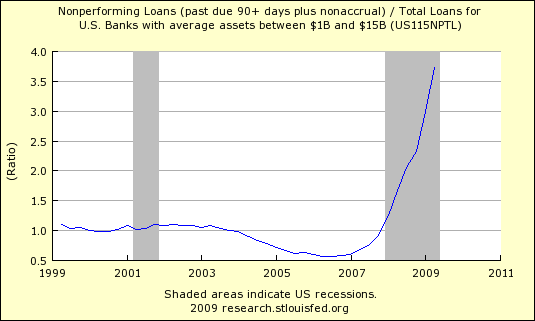
Nonperforming loans have more than doubled, year over year.
Wonder why stocks are shaky and gold is soaring. This is one reason.
This is not the kind of information that creates confidence. When uncertainty creeps into the market, stocks go down.
Kindle: Amazon's Wireless Reading Device (Latest Generation)
Follow All American Investor on Twitter
Subscribe to All American Investor via EmailWhen I looked at this chart this thought came to my mind -- get under your desk.
Nonperforming loans have more than doubled, year over year.
Wonder why stocks are shaky and gold is soaring. This is one reason.
This is not the kind of information that creates confidence. When uncertainty creeps into the market, stocks go down.
 Bob DeMarco is a citizen journalist and twenty year Wall Street veteran. Bob has written more than 500 articles with more than 11,000 links to his work on the Internet. Content from All American Investor has been syndicated on Reuters, the Wall Street Journal, Fox News, Pluck, Blog Critics, and a growing list of newspaper websites. Bob is actively seeking syndication and writing assignments. Bob DeMarco is a citizen journalist and twenty year Wall Street veteran. Bob has written more than 500 articles with more than 11,000 links to his work on the Internet. Content from All American Investor has been syndicated on Reuters, the Wall Street Journal, Fox News, Pluck, Blog Critics, and a growing list of newspaper websites. Bob is actively seeking syndication and writing assignments. |
Follow All American Investor on Twitter
Friday, April 17, 2009
Bank Stress Test Results due May 4
It appears the results of the bank stress tests will be released on May 4. Regulators also plan to release a paper describing the methodology next week, April 24.
The goal of the stress testing for banks is to raise public confidence. It will be interesting to see the reaction in the markets.
The goal of the stress testing for banks is to raise public confidence. It will be interesting to see the reaction in the markets.
Subscribe to All American Investor via Email
Wednesday, April 15, 2009

Monday, April 13, 2009
Roubini: Stress Test Results are Meaningless

The word on the street is that all 19 banks subject to stress testing will pass. Nouriel Roubini has a long article on the assumptions underneath the testing and why they are bogus or no longer meaningful.
The purpose of the stress testing, as I see it, is to create confidence in banks. As a result, the perception in the market place is going to be critical for the direction of the stock market. Will the stress tests create confidence or more uncertainty?
Uncertainty is not good for stocks, and would likely send us back for a retest of the lows.
Roubini has a lot of detail in this report and it is worth reading, digesting, and considering. If he is right, sooner or later it is going to be very ugly in the stock market.
The stock market has good technical resilance right now and I have been writing about this often. However, the bull run from the bottom is getting a little long in the touch and the risk/reward ratio is starting to turn negative.
Stress Testing the Stress Test Scenarios
Subscribe to All American Investor via Email

Follow All American Investor on Twitter
Tuesday, April 07, 2009
Whitney: Banks Improve, Housing down another 30 Percent
Banking analyst Meredith Whitney talks about the outlook for financials.
Cliff notes:
- First five minutes of the tape on Banks
- Gets to the drop in housing prices at the five minute, thirty second mark.
- "I think you’ll see a directional turn," Whitney said in a live interview. "Banks will make a little money, as little as a penny a share, but they won’t lose money."
- Said she expected home prices to fall another 30 percent, contrary to some predictions that housing may have bottomed.(link refers to Diana Olick--yikes)
Banks' 1st-Quarter Results May Show Improvement: Whitney
Subscribe to All American Investor via Email
Saturday, March 21, 2009
Is the new Toxic Asset Plan a Mirage?
More and more, it appears the new toxic asset plan is a mirage--it is being done with smoke and mirrors.
Current talk is that the Treasury is going to buy $1 trillion in troubled mortgages and related assets from financial institutions. It should be noted that this means we, the taxpayers, are going to be buying these toxic assets.
The plan is being designed to rescue the nation’s banking system by taking the toxic assets off their balance sheets. Does that sound familiar?
Nouriel Roubini has been writing about this for some time, and if he is right the numbers are staggering. More than the $2 trillion that is currently being forecast.
It appears the plan has three parts:
There is one big wild card. Will the banks be willing to sell the mortgages at prices substantially below the prices they paid for these securities. Stay tuned--I doubt it.
Current talk is that the Treasury is going to buy $1 trillion in troubled mortgages and related assets from financial institutions. It should be noted that this means we, the taxpayers, are going to be buying these toxic assets.
The plan is being designed to rescue the nation’s banking system by taking the toxic assets off their balance sheets. Does that sound familiar?
Nouriel Roubini has been writing about this for some time, and if he is right the numbers are staggering. More than the $2 trillion that is currently being forecast.
It appears the plan has three parts:
- The FDIC will set up investment partnerships and lend 85 percent of the money needed to buy up troubled assets that banks want to sell. This will be accomplished with low interest, non-recourse loans, and lots of taxpayer money. It remains to be seen how purchased assets will be priced. Incidentally, this is how the Resolution Trust Corporation ( RTC) unloaded much of the real estate from the savings and loan crisis--non recourse loans.
- The Treasury will hire four or five investment management firms, matching the private money that each of the firms puts up on a dollar-for-dollar basis with government money. If this turns out to be part of the package then one can assume they have the managers lined up.
- The Treasury plans to expand lending through the Term Asset-Backed Securities Loan Facility. The plan is to buy up as many toxic assets as possible so that banks can get back to lending. The available monies to the Treasury will be running out of money soon so the key word here is--leverage. We never learn.
There is one big wild card. Will the banks be willing to sell the mortgages at prices substantially below the prices they paid for these securities. Stay tuned--I doubt it.
Subscribe to All American Investor via Email
Condition of Banks Continues to Deteriorate (Chart)

The Report of Condition and Income for All Insured U.S. Commercial Banks continues to deteriorate and is worrisome.
This really calls into question if the new bank bailout plan is going to work. The newest proposal is similar, if not the same, as the plan that was put into effect in September. However, if conditions continue to deteriorate it is likely that banks will need to be seized by the Federal government much like what happened during the Savings and Loan crisis.
Right now the hope remains that banks can earn their way out of the problem. This explains, in part, why the Federal Reserve is keeping interest rates artificially low and is buying Treasury securities. This strategy worked for the banks in the 1992-1993 period. It is not well known but many banks were "technically" insolvent at the time.
It appears that bank failures, a bank panic, and bank nationalizations are all still real possibilities.
We will continue to watch this situation at All American Investor.
Sidenote: Federal regulators Friday seized control of the two largest wholesale credit unions — U.S. Central Federal Credit Union and Western Corporate Federal Credit Union — which together had $57 billion in assets. This went virtually unnoticed.
Subscribe to All American Investor via Email
| Bob DeMarco is a citizen journalist and twenty year Wall Street veteran. Bob has written more than 500 articles with more than 11,000 links to his work on the Internet. Content from All American Investor has been syndicated on Reuters, the Wall Street Journal, Fox News, Pluck, Blog Critics, and a growing list of newspaper websites. Bob is actively seeking syndication and writing assignments. |
Follow All American Investor on Twitter
Sunday, March 15, 2009
Bernanke Says Overhaul Regulatory System

"Government rescues of too-big-to fail firms can be costly to taxpayers, as we have seen recently," Bernanke said. "Indeed in the present crisis, the too-big-to-fail issue has emerged as an enormous problem."
Subscribe to All American Investor via Email
(AP) America's financial regulatory system must be overhauled to strengthen oversight of banks, mutual funds and large financial institutions whose collapse would put the entire economy in peril, Federal Reserve Chairman Ben Bernanke said Tuesday.
"We must have a strategy that regulates the financial system as a whole, in a holistic way, not just its individual components," Bernanke said in a speech to the Council on Foreign Relations.
In his most extensive remarks on the subject, Bernanke built upon previous suggestions to bolster mutual funds and a program that insures bank deposits - and repeated his call for Congress to create a system to cushion fallout from the failure of a big financial institution.
The Fed chief's remarks come as the Obama administration and Congress are starting to crafting their overhaul strategies. For the administration, critical work on that front will be carried out among global finance officials this weekend in London. That will help set the stage for a meeting of leaders from the world's 20 major economic powers in April.
Revamping the U.S. financial rule book - a patchwork that dates to the Civil War - is a complex task. Congress, the administration and the Fed are involved because they want to strengthen the system to prevent a repeat of the financial crisis - the worst since the 1930s- that has plunged the U.S. and many other countries' economies into recession.
Bernanke said the U.S. recession could end this year only if the government is successful in getting financial markets to operate more normally again. The recession, now in its second year and already the longest in a quarter-century, has turned out to be more severe than the Fed had anticipated, he acknowledged in fielding questions after his speech.
To guide the regulatory overhaul, Bernanke laid out four key elements. One is for Congress to enact legislation so the failure of a huge financial institution can be handled in an orderly way - similar to how bank failures are handled by the Federal Deposit Insurance Corp. - to minimize fallout to the financial system and to the national economy.
Moreover, such "too big to fail" companies must be subject to more rigorous supervision to prevent them from taking excessive risk, Bernanke said. The Fed is trying to identify "best practices" that can help companies detect trouble spots and best manage their risks.
The government over the past year has been forced to rescue major financial companies so interwoven with other players and the global financial system that their collapse would put the entire economy in danger. The bailouts of insurance giant American International Group Inc., Citigroup Inc., Bank of America Corp., and mortgage finance companies Fannie Mae and Freddie Mac have put billions of taxpayers' dollars at risk and angered the American public.
"Government rescues of too-big-to fail firms can be costly to taxpayers, as we have seen recently," Bernanke said. "Indeed in the present crisis, the too-big-to-fail issue has emerged as an enormous problem."
Bernanke also said the nation's financial plumbing - the infrastructure and policies that govern financial transactions- must be strengthened to ensure that it will perform under stress.
Policymakers should consider ways to bolster money market mutual funds that are susceptible to runs by investors, he said. One approach would be to impose tighter restrictions on the financial instruments that money markets can invest in. Another idea is to develop a limited system of insurance for funds that seek to maintain a stable net asset value.
In addition, Bernanke called for a review of regulatory policies and accounting rules to make sure they don't "overly magnify the ups and downs in the financial system and the economy." For instance, he suggested that a larger financial buffer to support the FDIC's insurance program for bank deposits be built up during good economic times so that it could be drawn down when conditions worsen.
Finally, the government should consider creating an authority specifically responsible for monitoring financial risks and protecting the country from crises like the current one. Some in Congress - and the previous Bush administration - have proposed that the Fed take on this role of super financial cop.
As a lender of last resort to troubled financial companies, the Fed already has a major role in trying to put out financial fires.
"Effectively identifying and addressing systemic risks would seem to require the involvement of the Federal Reserve in some capacity, even if not in the lead role," Bernanke said.
| Bob DeMarco is a citizen journalist and twenty year Wall Street veteran. Bob has written more than 500 articles with more than 11,000 links to his work on the Internet. Content from All American Investor has been syndicated on Reuters, the Wall Street Journal, Fox News, Pluck, Blog Critics, and a growing list of newspaper websites. Bob is actively seeking syndication and writing assignments. |
Follow All American Investor on Twitter
More from All American Investor
- Systemic Risk Defined--Too Big to Fail
- Ray Dalio on the current state of affairs in the market
- Roubini Predicts U.S. Losses May Reach $3.6 Trillion
- Six Errors on the Path to the Financial Crisis
- Who Caused the Financial Crisis?
- Option ARM--The Toxic Mortgage
- Debt Binge--The Perfect Financial Storm
- Warren Buffett's Annual Letter to Investors (Cliff Notes Version)


Monday, March 09, 2009
Roubini Video on Insolvent, Zombie Banks
Nouriel Roubini,(aka Dr. Doom), proclaims that unless drastic action is taken soon, the world as we know it is about to come crashing down (Part One).
Subscribe to All American Investor via Email
Friday, February 27, 2009
The Case For and Against Bank Nationalization
These paragraphs were extracted from Nouriel Roubini's GlobalEconoMonitor. The article contains a discussion of insolvency and the Pros and Cons of nationalization. Must reading for the well informed.
Follow us on Twitter
More from All American Investor
As an example, consider the poster child for the “freebie” programs, the Temporary Liquidity Guarantee Program, started in late November of 2008. For a cost of 0.75%, it allows banks to issue bonds backed by the government, i.e., essentially risk free. The banks have accessed this market 97 times for $190 billion!
The biggest pig at the trough - Bank of America 11 times for $35.5 billion. But close behind, JP Morgan at $30 billion, GE Capital $27 billion, Citigroup $24 billion, Morgan Stanley $19 billion, Goldman Sachs $19 billion and Wells Fargo $6 billion. A not so surprising correlation with their respective writedowns (including merged entities), Bank of America $96 billion, JP Morgan $75 billion, Citigroup $88 billion, Morgan Stanley $22 billion, Goldman Sachs $7 billion and Wells Fargo $115 billion.
In terms of helping us move forward out of the financial crisis, this program has many problems. It charges the same amount for each institution, so it hardly separates the solvent from the insolvent institutions. It charges a fee which is grossly below what these institutions could issue in the marketplace given their current balance sheets, distorting the system. Wasn’t this the Fannie Mae and Freddie Mac problem? And it makes it less likely to cleanse the system of the toxic assets because these institutions can continue their way out-of-the-money option and hope that the prices of the toxic assets increase. In effect, the access to this capital allows them to continue to make the original bet.
Subscribe to All American Investor via Email
Follow us on Twitter
| Bob DeMarco is a citizen journalist, blogger, and Caregiver. In addition to being an experienced writer he taught at the University of Georgia , managed on Wall Street at Bear Stearns, was CEO of IP Group, and is a mentor. Bob currently resides in Delray Beach, FL where he cares for his mother, Dorothy, who suffers from Alzheimer's disease. Bob has written more than 500 articles with more than 11,000 links to his work on the Internet. His content has been syndicated on Reuters, the Wall Street Journal, Fox News, Pluck, BlogCritics, and a growing list of newspaper websites (15). Bob is actively seeking writing assignments and syndication. |
More from All American Investor
- Ray Dalio on the current state of affairs in the market
- Homebuyer Credit Won’t Stabilize Market, Analysts Say
- Roubini Predicts U.S. Losses May Reach $3.6 Trillion
- Six Errors on the Path to the Financial Crisis
- Who Caused the Financial Crisis?
- Option ARM--The Toxic Mortgage
- Debt Binge--The Perfect Financial Storm
Wednesday, February 25, 2009
Stress Test Good, Could lead to a Bottom in the Stock Market
This is one of the better articles I have read on the stress test--Stress Test for Banks Exposes Rift on Wall St. It has me thinking about the long term direction of the stock market.
I think if you read this article carefully you might conclude that much of what is being written about banks is getting discounted in the stock market. I am not saying everything is beautiful. Quite the contrary, we are teetering on the brink of disaster. But, I find myself asking myself constantly--has the market discounted the news. It is always hard when things look bleak to see the light at the end of the tunnel. However, the market always discounts the future long before the future gets here. The market always bottoms when things look bleakest to the herd. The herd tends to focus on the recent past, rarely looking forward into the future.
 I am reminding myself that back in 1990-91 Ross Perot was shorting Citibank stock. If you had bought the stock back then you could have made more than 30 times your money by 2006.
At the time of the 1991 recession there were many that felt the banks were going to go broke. Remember, we were just coming through the S and L Crisis and the failure of some major banks in the southwest. The stock market had crashed in 1987 and we were entering a recession. The time really looked bleak. Most investors had thrown in the towel and were focusing on the past.
If you are old enough, you might remember that from 1966 to 1982 the market traded in a broad trading range that was capped by Dow 1060. Up and down, up and down, The Dow did crash down to the 550 area in 1973, and the 750 area in 1980.
Most of you are too young to remember that the S an P 500 traded around 102 in 1973 and again in 1982 (you read that right 102). It turned out that August, 1982 was the bottom of a long term consolidation and the beginning of the bull market. The Dow crashed through the ceiling and the market soared.
I am starting to believe we are nearing a major low in the market. So put me down the way I have been for some time--long term bullish, short term bearish. Not quite ready to the jump all the way into the pool. It is a good time to stick your foot in the water and check the temperature.
These hot flash day rallies in this stock market downturn are not making me feel like I am missing out on anything. I do find it amusing that every time we have a nice up day the talking heads on television get all excited and start talking bull market.
The market rarely goes up or down in a straight line. The rallies right now are for suckers who think every tiny piece of news is what is going to make the market go up or down long term. Each piece of news is like a piece of the puzzle. It is not the puzzle.
These hot interpretations of every little blip on the news screen makes the market go up and down like a yo-yo. But, it is the long term trend of the market that is most important; and, the big picture fundamentals set the stage for the big big moves. You make the big bucks by spotting the long term trends and being patient once they get underway.
I'll leave with two things. First, read the article about stress testing banks--to me this is a good thing and might be an event that could put in the bottom for the stock market. I am thinking we could be in for a 20-30 percent rally soon. Second, the major trend of the stock market is still down--so it is very risky to have the boat loaded. Foot in the water--good, water up to your neck--not good. Chicken on hill, maybe.
Stress Test for Banks Exposes Rift on Wall St
The New York Times
By ERIC DASH
Big banks keep insisting that they have all the capital they need — a claim that might strike many people as absurd at a time the government is spending billions of taxpayer dollars to prop up the financial industry.
So here is a surprise: By some common measures, the banks do have enough capital.
The problem is, it is not the kind of capital investors think the banks need.
For years, the question of what constitutes a bank’s capital, and how to measure it, was largely academic. But the issue is coming to the fore as federal regulators start administering a tough new “stress test” to 20 large banks on Wednesday to determine how the banks would withstand a severe economic downturn.
Investors in the stock market and the banks are increasingly at odds over how to assess the health of financial institutions. Where regulators side could determine the fate of many lenders, particularly big banks like Citigroup and Bank of America, whose share prices have plummeted this year on fears the government will increase its ownership of them.
Until the financial system deteriorated last fall, investors focused on what is known as Tier 1 capital, which consists of common stock, preferred stock and hybrid debt-equity instruments.
Now, however, they are focusing on what is called tangible equity capital, which includes only common stock, saying it is a better way to measure the risk in bank shares.
The difference might sound like something only an accountant would worry about, but it lies at the heart of two questions confounding both Washington and Wall Street: Are the nation’s banks sound? And are bank shares a good barometer for the health of the financial system?
Sheila C. Bair, the head of the Federal Insurance Deposit Corporation, said on Tuesday that the nation’s banking industry was safe. “All these large banks exceed regulatory standards for being well capitalized, so for right now, they’re fine,” Ms. Bair said on CBS television’s “The Early Show.”
“I think the big issue is how much of an additional buffer they have to withstand more adverse economic situations and that’s something we’re going to try to figure out with a stress test.”
But Citigroup, which maintains that it is well capitalized by its regulators’ standards, was nonetheless locked in negotiations with the government on Tuesday over a third rescue. Under the plan, the government is expected to raise its stake in Citigroup to 30 to 40 percent, from about 8 percent now. The deal, which was moving toward completion and could be announced as early as Wednesday, would bolster the level of common stock that investors are focused on.
At Bank of America, Kenneth D. Lewis, the chief executive, assured the bank’s employees on Monday that Bank of America has enough capital, including common stock. “I have said repeatedly that our company does not need further assistance today and I don’t believe we’ll need any more in the future,” Mr. Lewis wrote in a memorandum.
Like regulators, investors are struggling to determine how much additional capital banks might require if the recession deepens and unemployment rises, developments that would almost certainly lead to new, heavy losses at banks.
Institutions that fail the stress test will be required to raise new capital, probably through more money from the government.
Beaten-down financial shares rallied on Tuesday after Ben S. Bernanke, the chairman of the Federal Reserve, seemed to rebuff suggestions that banks might be nationalized outright. Even so, Mr. Bernanke offered a sober assessment of the economy to Congress on Tuesday.
Details of the bank stress test are scant, but federal regulators are expected to examine the ability of banks to cope with a situation in which unemployment rose to 10 to 12 percent and home prices declined by an additional 20 percent, according to Treasury Department and Federal Reserve officials. While officials say they don’t expect such a severe downturn, some economists aren’t ruling one out.
In recent weeks, federal regulators were planning to continue to demand that banks maintain Tier 1 capital equivalent of at least 6 percent of total assets adjusted for risk. Regulators also want at least half of it in common stock, but have given banks some leeway.
On Monday, the federal banking regulators issued a statement saying that if the stress test indicated an “additional capital buffer” was necessary for some institutions, it “did not imply a new capital standard and is not expected to be maintained.”
But stock investors are homing in on tangible common equity. Whereas Tier 1 capital gives regulators comfort because it captures a bank’s ability to weather a financial storm, stock investors, who suffer the first losses, are worried about their own exposure. Tangible common equity, or T.C.E., they argue, is the best measure for them.
Until last fall, there was little difference between the two measures. But when the government made big investments of preferred stock to shore up banks, common shareholders became more vulnerable.
John McDonald, an analyst at Sanford C. Bernstein & Company, compared the move to an army reinforcing its troops from the back. “Any reinforcements improve the chances of winning the battle,” he said. But if you are a stockholder, “you are still the guy taking the first hit on the front line.”
Regulators worry that banks’ depositors and trading partners might interpret more bad news for banks — including a continued decline in share prices — as a sign confidence is flagging. As a result, regulators, too, are focusing more on tangible equity.
“If our banking system looks frail and hobbled, we care since there could be a loss of confidence” Mr. McDonald said. “But the stock price may very well not be a reflection of the broader risk.”
Louise Story contributed reporting.
More from All American Investor

I think if you read this article carefully you might conclude that much of what is being written about banks is getting discounted in the stock market. I am not saying everything is beautiful. Quite the contrary, we are teetering on the brink of disaster. But, I find myself asking myself constantly--has the market discounted the news. It is always hard when things look bleak to see the light at the end of the tunnel. However, the market always discounts the future long before the future gets here. The market always bottoms when things look bleakest to the herd. The herd tends to focus on the recent past, rarely looking forward into the future.
 I am reminding myself that back in 1990-91 Ross Perot was shorting Citibank stock. If you had bought the stock back then you could have made more than 30 times your money by 2006.
At the time of the 1991 recession there were many that felt the banks were going to go broke. Remember, we were just coming through the S and L Crisis and the failure of some major banks in the southwest. The stock market had crashed in 1987 and we were entering a recession. The time really looked bleak. Most investors had thrown in the towel and were focusing on the past.
If you are old enough, you might remember that from 1966 to 1982 the market traded in a broad trading range that was capped by Dow 1060. Up and down, up and down, The Dow did crash down to the 550 area in 1973, and the 750 area in 1980.
Most of you are too young to remember that the S an P 500 traded around 102 in 1973 and again in 1982 (you read that right 102). It turned out that August, 1982 was the bottom of a long term consolidation and the beginning of the bull market. The Dow crashed through the ceiling and the market soared.
I am starting to believe we are nearing a major low in the market. So put me down the way I have been for some time--long term bullish, short term bearish. Not quite ready to the jump all the way into the pool. It is a good time to stick your foot in the water and check the temperature.
These hot flash day rallies in this stock market downturn are not making me feel like I am missing out on anything. I do find it amusing that every time we have a nice up day the talking heads on television get all excited and start talking bull market.
The market rarely goes up or down in a straight line. The rallies right now are for suckers who think every tiny piece of news is what is going to make the market go up or down long term. Each piece of news is like a piece of the puzzle. It is not the puzzle.
These hot interpretations of every little blip on the news screen makes the market go up and down like a yo-yo. But, it is the long term trend of the market that is most important; and, the big picture fundamentals set the stage for the big big moves. You make the big bucks by spotting the long term trends and being patient once they get underway.
I'll leave with two things. First, read the article about stress testing banks--to me this is a good thing and might be an event that could put in the bottom for the stock market. I am thinking we could be in for a 20-30 percent rally soon. Second, the major trend of the stock market is still down--so it is very risky to have the boat loaded. Foot in the water--good, water up to your neck--not good. Chicken on hill, maybe.
Subscribe to All American Investor via Email
The New York Times
By ERIC DASH
Big banks keep insisting that they have all the capital they need — a claim that might strike many people as absurd at a time the government is spending billions of taxpayer dollars to prop up the financial industry.
So here is a surprise: By some common measures, the banks do have enough capital.
The problem is, it is not the kind of capital investors think the banks need.
For years, the question of what constitutes a bank’s capital, and how to measure it, was largely academic. But the issue is coming to the fore as federal regulators start administering a tough new “stress test” to 20 large banks on Wednesday to determine how the banks would withstand a severe economic downturn.
Investors in the stock market and the banks are increasingly at odds over how to assess the health of financial institutions. Where regulators side could determine the fate of many lenders, particularly big banks like Citigroup and Bank of America, whose share prices have plummeted this year on fears the government will increase its ownership of them.
Until the financial system deteriorated last fall, investors focused on what is known as Tier 1 capital, which consists of common stock, preferred stock and hybrid debt-equity instruments.
Now, however, they are focusing on what is called tangible equity capital, which includes only common stock, saying it is a better way to measure the risk in bank shares.
The difference might sound like something only an accountant would worry about, but it lies at the heart of two questions confounding both Washington and Wall Street: Are the nation’s banks sound? And are bank shares a good barometer for the health of the financial system?
Sheila C. Bair, the head of the Federal Insurance Deposit Corporation, said on Tuesday that the nation’s banking industry was safe. “All these large banks exceed regulatory standards for being well capitalized, so for right now, they’re fine,” Ms. Bair said on CBS television’s “The Early Show.”
“I think the big issue is how much of an additional buffer they have to withstand more adverse economic situations and that’s something we’re going to try to figure out with a stress test.”
But Citigroup, which maintains that it is well capitalized by its regulators’ standards, was nonetheless locked in negotiations with the government on Tuesday over a third rescue. Under the plan, the government is expected to raise its stake in Citigroup to 30 to 40 percent, from about 8 percent now. The deal, which was moving toward completion and could be announced as early as Wednesday, would bolster the level of common stock that investors are focused on.
At Bank of America, Kenneth D. Lewis, the chief executive, assured the bank’s employees on Monday that Bank of America has enough capital, including common stock. “I have said repeatedly that our company does not need further assistance today and I don’t believe we’ll need any more in the future,” Mr. Lewis wrote in a memorandum.
Like regulators, investors are struggling to determine how much additional capital banks might require if the recession deepens and unemployment rises, developments that would almost certainly lead to new, heavy losses at banks.
Institutions that fail the stress test will be required to raise new capital, probably through more money from the government.
Beaten-down financial shares rallied on Tuesday after Ben S. Bernanke, the chairman of the Federal Reserve, seemed to rebuff suggestions that banks might be nationalized outright. Even so, Mr. Bernanke offered a sober assessment of the economy to Congress on Tuesday.
Details of the bank stress test are scant, but federal regulators are expected to examine the ability of banks to cope with a situation in which unemployment rose to 10 to 12 percent and home prices declined by an additional 20 percent, according to Treasury Department and Federal Reserve officials. While officials say they don’t expect such a severe downturn, some economists aren’t ruling one out.
In recent weeks, federal regulators were planning to continue to demand that banks maintain Tier 1 capital equivalent of at least 6 percent of total assets adjusted for risk. Regulators also want at least half of it in common stock, but have given banks some leeway.
On Monday, the federal banking regulators issued a statement saying that if the stress test indicated an “additional capital buffer” was necessary for some institutions, it “did not imply a new capital standard and is not expected to be maintained.”
But stock investors are homing in on tangible common equity. Whereas Tier 1 capital gives regulators comfort because it captures a bank’s ability to weather a financial storm, stock investors, who suffer the first losses, are worried about their own exposure. Tangible common equity, or T.C.E., they argue, is the best measure for them.
Until last fall, there was little difference between the two measures. But when the government made big investments of preferred stock to shore up banks, common shareholders became more vulnerable.
John McDonald, an analyst at Sanford C. Bernstein & Company, compared the move to an army reinforcing its troops from the back. “Any reinforcements improve the chances of winning the battle,” he said. But if you are a stockholder, “you are still the guy taking the first hit on the front line.”
Regulators worry that banks’ depositors and trading partners might interpret more bad news for banks — including a continued decline in share prices — as a sign confidence is flagging. As a result, regulators, too, are focusing more on tangible equity.
“If our banking system looks frail and hobbled, we care since there could be a loss of confidence” Mr. McDonald said. “But the stock price may very well not be a reflection of the broader risk.”
Louise Story contributed reporting.
More from All American Investor
- Ray Dalio on the current state of affairs in the market
- Homebuyer Credit Won’t Stabilize Market, Analysts Say
- Roubini Predicts U.S. Losses May Reach $3.6 Trillion
- Six Errors on the Path to the Financial Crisis
- Who Caused the Financial Crisis?
- Option ARM--The Toxic Mortgage
- Debt Binge--The Perfect Financial Storm

Monday, February 23, 2009
Stress Test for Banks the Best Medicine
There are growing doubts about banks and there can be little doubt we are on the edge of a "run on banks". Bank of America and Citigroup are at the top of the lists. I have to admit, I have an account at both banks--yikes.

As doubt and angst grows , the Obama administration is announcing that a review of 20 major banks is forthcoming. This review of banks is often known as a stress test. Stress testing has a lot of people worried. They reason that stress testing will likely scare the heck out of investors. If Nouriel Roubini is right this will leave no choice but to nationalize. Roubini, who coined the term Zombie bank, has been saying for sometime that the banks are broke. I don't think there is much doubt that if all assets were marked to the market this would prove to be true.
One problem with pricing toxic assets and distressed assets in banks is that no one knows the real price. The system is basically frozen with little trading taking place. Sooner or later, something has to to give.
Toxic assets, nationalization, Zombie bank, these are all terms that are hanging over banks like a tornado cloud just waiting to touch down.
What do I think? Let's get it all out in the open. Obama is taking heat from the likes of Bill Clinton for being too pessimistic. I think the American public is very pessimistic. Markets don't go up when investors are uncertain or pessimistic. The only way out of this trap is to bring it all up on to the table and let us take a look at this ugly situation.
My guess is that once the true extent of the problem is known it will be quickly discounted in the stock market. Once that occurs we can go about solving that problems instead of letting the problems hang out their like an impending guillotine over our heads.
The market is going down until it fully discounts the economic problems we are facing. For me, the sooner it happens the better. I am starting to feel very bullish long term on stocks (still very bearish short term). But, I learned a long time ago that you make a lot better returns in the stock market when times are certain, rather than uncertain. Who wants to stand in front of a roaring freight train--not me.
I get the feeling that President Obama is going to let it all hang out. I bet he will receive lots of criticism from people suffering from Rick Santelli syndrome--better know as the "ignorance is bliss syndrome". Many are going to attack President Obama for telling too much. Well I think he said he intends to make things transparent. It is time for us to get our heads out of the sand and get back to doing the kinds of things that made America great. Get out the spoon--we all need a great big dose of Castor oil.
U.S. bank stress tests to show capital needs: source
By David Lawder
WASHINGTON (Reuters) - Financial regulators will soon launch a series of "stress tests" to determine which of the largest U.S. banks should get bigger capital cushions in case of a deeper recession, a person familiar with Obama administration plans said on Saturday.
The person, speaking on condition of anonymity, said if institutions were found to need additional capital, financial authorities would provide them with an "extra cushion of support."
Banks are expected to receive additional information about the tests in the coming week from regulators.
The largest U.S. banks are "well capitalized" for current conditions, the source said, but the Obama administration wants to ensure they can withstand a more severe economic climate and play an important role in helping restart the flow of credit.
Initial plans for the stress tests were announced on February 10 as part of Treasury Secretary Timothy Geithner's bank stabilization plan, but the source on Saturday for the first time linked the tests to additional government support for large banks. That person did not specify what form any extra capital cushion may take.
Little is known about the form of the stress tests, but the person described them as "consistent, forward looking and conservative."
The Obama administration tried on Friday to ease market fears the government was poised to nationalize some large banks that are struggling with losses and a lack of confidence, notably Citigroup and Bank of America.
Bank shares fell sharply, with Citigroup plunging 22 percent to below the $2 fee of a typical automated teller machine, or ATM, and Bank of America trading around the $4 level.
White House spokesman Robert Gibbs said on Friday, "This administration continues to strongly believe that a privately held banking system is the correct way to go."
That was quickly echoed by a statement from the U.S. Treasury.
INVESTORS LOSE CONFIDENCE
Citigroup and Bank of America have each received $45 billion in government capital in recent months and guarantees against losses on portfolios of illiquid mortgage assets -- aid that now exceeds their market value.
With investors losing confidence in the sector as recessionary losses on real estate and commercial loans mount, analysts say the government may have to do more to prop up the largest banks.
But rather than opting for a sweeping takeover, the government may act more incrementally, demanding a little more control every time Bank of America or Citigroup seeks more capital, analysts said.
Major interventions in financial institutions, such as Bear Stearns 11 months ago, American International Group in September and a second-round investment in Citigroup, occurred just after major drops in share prices made it clear they could not raise private capital.
The government "will try to do everything they can before they nationalize banks, but they may ultimately do it," said Lee Delaporte, director of research at Dreman Value Management, which has $10 billion under management.
"The bank stocks are telling you nationalization is going to happen," Delaporte added.
Thus far, the Treasury has put up about $235 billion for banks largely by purchasing only preferred shares to avoid diluting common shareholders. Under Geithner's revamp, those injections could come in the form of shares that could be converted to common equity if necessary.
The lack of detail in Geithner's bank plan, particularly about a $500 billion to $1 trillion public-private fund to soak up toxic assets, has fueled investor concerns that bank takeovers could become an option. Geithner did not specify how much money would be earmarked for bank capital injections under the plan, which mapped out how the second $350 billion of the $700 billion bailout fund would be spent.
Geithner has devoted $50 billion to modify troubled mortgages and $100 billion to support a $1 trillion Federal Reserve asset-backed securities lending facility aimed at unblocking frozen consumer credit markets.
Lawmakers have pressed Geithner on whether and when he will return to seek more funding to shore up the banking system. Geithner told Congress on February 11 that as the "design elements" of his plan were fleshed out, he would have a better handle on the ultimate risks and costs for the program.
(Additional reporting by Dan Wilchins in New York; Editing by Peter Cooney)
More from All American Investor

As doubt and angst grows , the Obama administration is announcing that a review of 20 major banks is forthcoming. This review of banks is often known as a stress test. Stress testing has a lot of people worried. They reason that stress testing will likely scare the heck out of investors. If Nouriel Roubini is right this will leave no choice but to nationalize. Roubini, who coined the term Zombie bank, has been saying for sometime that the banks are broke. I don't think there is much doubt that if all assets were marked to the market this would prove to be true.
One problem with pricing toxic assets and distressed assets in banks is that no one knows the real price. The system is basically frozen with little trading taking place. Sooner or later, something has to to give.
Toxic assets, nationalization, Zombie bank, these are all terms that are hanging over banks like a tornado cloud just waiting to touch down.
What do I think? Let's get it all out in the open. Obama is taking heat from the likes of Bill Clinton for being too pessimistic. I think the American public is very pessimistic. Markets don't go up when investors are uncertain or pessimistic. The only way out of this trap is to bring it all up on to the table and let us take a look at this ugly situation.
My guess is that once the true extent of the problem is known it will be quickly discounted in the stock market. Once that occurs we can go about solving that problems instead of letting the problems hang out their like an impending guillotine over our heads.
The market is going down until it fully discounts the economic problems we are facing. For me, the sooner it happens the better. I am starting to feel very bullish long term on stocks (still very bearish short term). But, I learned a long time ago that you make a lot better returns in the stock market when times are certain, rather than uncertain. Who wants to stand in front of a roaring freight train--not me.
I get the feeling that President Obama is going to let it all hang out. I bet he will receive lots of criticism from people suffering from Rick Santelli syndrome--better know as the "ignorance is bliss syndrome". Many are going to attack President Obama for telling too much. Well I think he said he intends to make things transparent. It is time for us to get our heads out of the sand and get back to doing the kinds of things that made America great. Get out the spoon--we all need a great big dose of Castor oil.
Subscribe to All American Investor via Email
By David Lawder
WASHINGTON (Reuters) - Financial regulators will soon launch a series of "stress tests" to determine which of the largest U.S. banks should get bigger capital cushions in case of a deeper recession, a person familiar with Obama administration plans said on Saturday.
The person, speaking on condition of anonymity, said if institutions were found to need additional capital, financial authorities would provide them with an "extra cushion of support."
Banks are expected to receive additional information about the tests in the coming week from regulators.
The largest U.S. banks are "well capitalized" for current conditions, the source said, but the Obama administration wants to ensure they can withstand a more severe economic climate and play an important role in helping restart the flow of credit.
Initial plans for the stress tests were announced on February 10 as part of Treasury Secretary Timothy Geithner's bank stabilization plan, but the source on Saturday for the first time linked the tests to additional government support for large banks. That person did not specify what form any extra capital cushion may take.
Little is known about the form of the stress tests, but the person described them as "consistent, forward looking and conservative."
The Obama administration tried on Friday to ease market fears the government was poised to nationalize some large banks that are struggling with losses and a lack of confidence, notably Citigroup and Bank of America.
Bank shares fell sharply, with Citigroup plunging 22 percent to below the $2 fee of a typical automated teller machine, or ATM, and Bank of America trading around the $4 level.
White House spokesman Robert Gibbs said on Friday, "This administration continues to strongly believe that a privately held banking system is the correct way to go."
That was quickly echoed by a statement from the U.S. Treasury.
INVESTORS LOSE CONFIDENCE
Citigroup and Bank of America have each received $45 billion in government capital in recent months and guarantees against losses on portfolios of illiquid mortgage assets -- aid that now exceeds their market value.
With investors losing confidence in the sector as recessionary losses on real estate and commercial loans mount, analysts say the government may have to do more to prop up the largest banks.
But rather than opting for a sweeping takeover, the government may act more incrementally, demanding a little more control every time Bank of America or Citigroup seeks more capital, analysts said.
Major interventions in financial institutions, such as Bear Stearns 11 months ago, American International Group in September and a second-round investment in Citigroup, occurred just after major drops in share prices made it clear they could not raise private capital.
The government "will try to do everything they can before they nationalize banks, but they may ultimately do it," said Lee Delaporte, director of research at Dreman Value Management, which has $10 billion under management.
"The bank stocks are telling you nationalization is going to happen," Delaporte added.
Thus far, the Treasury has put up about $235 billion for banks largely by purchasing only preferred shares to avoid diluting common shareholders. Under Geithner's revamp, those injections could come in the form of shares that could be converted to common equity if necessary.
The lack of detail in Geithner's bank plan, particularly about a $500 billion to $1 trillion public-private fund to soak up toxic assets, has fueled investor concerns that bank takeovers could become an option. Geithner did not specify how much money would be earmarked for bank capital injections under the plan, which mapped out how the second $350 billion of the $700 billion bailout fund would be spent.
Geithner has devoted $50 billion to modify troubled mortgages and $100 billion to support a $1 trillion Federal Reserve asset-backed securities lending facility aimed at unblocking frozen consumer credit markets.
Lawmakers have pressed Geithner on whether and when he will return to seek more funding to shore up the banking system. Geithner told Congress on February 11 that as the "design elements" of his plan were fleshed out, he would have a better handle on the ultimate risks and costs for the program.
(Additional reporting by Dan Wilchins in New York; Editing by Peter Cooney)
More from All American Investor
- Ray Dalio on the current state of affairs in the market
- Homebuyer Credit Won’t Stabilize Market, Analysts Say
- Roubini Predicts U.S. Losses May Reach $3.6 Trillion
- Six Errors on the Path to the Financial Crisis
- Who Caused the Financial Crisis?
- Option ARM--The Toxic Mortgage
- Debt Binge--The Perfect Financial Storm
Bailout Nation: U.S. May Draw Citi Into Tighter Embrace
Bank nationalization is hanging over the market. But as far as taxpayers go the last thing we want is common stock. The reverse should be happening: common stock holders and existing debt holders should be getting crammed down in any reorganization that includes bailout funds, that is, taxpayer dollars. 
U.S. May Draw Citi Into Tighter Embrace
For the third time in four months, Citigroup is looking for government help to shore up its capital.
The question is whether more government involvement above and beyond the $45 billion the bank has already taken in two installments in October and November, not to mention the guarantee against losses on $300 billion of assets, would do anything to restore confidence.
Fears that Citigroup would succumb to the fate of American International Group and be outright nationalized sent its stock into a tailspin last week, ending Friday at a paltry $1.95. That gives Citi a market capitalization of just over $10 billion. One year ago, it had a market value of over $137 billion, and even that was considerably less than in Citi's glory days.
Though the deal believed to be under discussion would incur no additional costs to taxpayers, it would hammer common stockholders. News reports Sunday evening had the bank, either voluntarily or at the behest of the government, converting preferred shares held by the government into common shares, which would dilute existing stockholders. The government could end up holding 40% of the company's equity.
Citigroup wouldn't comment on the reports, except to reiterate a statement it made last week when the nationalization rumors were making the rounds. "Citi's capital base is very strong and our Tier 1 capital ratio as measured at the end of the fourth quarter was 11.9%, among the highest in the industry. We continue to focus and make progress on reducing the assets on our balance sheet, reducing expenses and streamlining our business for future profitable growth," a spokesman said.
Citi, reeling from $18 billion in losses for 2008 and massive exposure to the consumer loan market, is already in the process of splitting itself in two. It's taking more than $800 billion of unwanted assets and businesses, like mortgage lending and consumer finance, and segregating them in a new business unit with its own management, who will spend their time selling the assets or otherwise disposing of them.
It also sold a majority of its crown jewel, Smith Barney, to a joint venture with Morgan Stanley.
The rest of Citi, which is returning to its pre-1998 name Citicorp, will continue on and presumably perform better without those money-losing assets and noncritical businesses. The remaining businesses will include corporate and retail banking, private banking and wholesale services around the world.
Announcing the plan in January, CEO Vikram Pandit explained, "This new structure will provide a wide range of options going forward to continue strengthening our core franchise."
But Citi faces a stress test by the government, and the results might not be pretty. Like many other banks, Citi faces mounting consumer loan losses, which are only being exacerbated by rising unemployment.
The stress testing, which is mandatory for the 15 biggest U.S. banks with more than $100 billion of assets, begins in the coming weeks. The Treasury Department, which is running the program, wants to find out whether the banks would have the capital they needed to continue to lend and absorb more losses if the economy were to weaken more than expected. Some think this stress testing, which is part of the Treasury's new Financial Stability Plan, means the government is imposing stricter capital standards on banks.
The fear is that any testing scenario will create a situation where there are clear winners (banks that don't have to take additional capital from the government but will likely be forced to anyway in a "voluntary" program to give the plan legitimacy), and clear losers (banks that will get capital injections that come with all sorts of additional restrictions on executive compensation, among other things).
Banks that go through a stress test will get access to a Treasury-provided "capital buffer" (an additional preferred equity stake) to bridge the time until the bank can raise the capital on the private markets. Given the restrictions that will likely accompany additional government injections, most see banks favoring raising capital in the private markets, if at all possible.
Citi has a number of wealthy constituents backing it, including Saudi Arabia's Prince Alwaleed bin Talal, whose fund has taken a major hit in the last few months. Other investors include the Abu Dhabi Investment Authority, the Government of Singapore Investment Corporation and the Kuwait Investment Authority. Some executives at Citi get stock awards that vest if the stock improves by a multiple of three in the next four years. Pandit, along with some other senior executives, didn't participate in the awards.
More from All American Investor
Fears that Citigroup would succumb to the fate of American International Group and be outright nationalized sent its stock into a tailspin last week, ending Friday at a paltry $1.95. That gives Citi a market capitalization of just over $10 billion. One year ago, it had a market value of over $137 billion, and even that was considerably less than in Citi's glory days.
Though the deal believed to be under discussion would incur no additional costs to taxpayers, it would hammer common stockholders. News reports Sunday evening had the bank, either voluntarily or at the behest of the government, converting preferred shares held by the government into common shares, which would dilute existing stockholders. The government could end up holding 40% of the company's equity.
Subscribe to All American Investor via Email
For the third time in four months, Citigroup is looking for government help to shore up its capital.
The question is whether more government involvement above and beyond the $45 billion the bank has already taken in two installments in October and November, not to mention the guarantee against losses on $300 billion of assets, would do anything to restore confidence.
Fears that Citigroup would succumb to the fate of American International Group and be outright nationalized sent its stock into a tailspin last week, ending Friday at a paltry $1.95. That gives Citi a market capitalization of just over $10 billion. One year ago, it had a market value of over $137 billion, and even that was considerably less than in Citi's glory days.
Though the deal believed to be under discussion would incur no additional costs to taxpayers, it would hammer common stockholders. News reports Sunday evening had the bank, either voluntarily or at the behest of the government, converting preferred shares held by the government into common shares, which would dilute existing stockholders. The government could end up holding 40% of the company's equity.
Citigroup wouldn't comment on the reports, except to reiterate a statement it made last week when the nationalization rumors were making the rounds. "Citi's capital base is very strong and our Tier 1 capital ratio as measured at the end of the fourth quarter was 11.9%, among the highest in the industry. We continue to focus and make progress on reducing the assets on our balance sheet, reducing expenses and streamlining our business for future profitable growth," a spokesman said.
Citi, reeling from $18 billion in losses for 2008 and massive exposure to the consumer loan market, is already in the process of splitting itself in two. It's taking more than $800 billion of unwanted assets and businesses, like mortgage lending and consumer finance, and segregating them in a new business unit with its own management, who will spend their time selling the assets or otherwise disposing of them.
It also sold a majority of its crown jewel, Smith Barney, to a joint venture with Morgan Stanley.
The rest of Citi, which is returning to its pre-1998 name Citicorp, will continue on and presumably perform better without those money-losing assets and noncritical businesses. The remaining businesses will include corporate and retail banking, private banking and wholesale services around the world.
Announcing the plan in January, CEO Vikram Pandit explained, "This new structure will provide a wide range of options going forward to continue strengthening our core franchise."
But Citi faces a stress test by the government, and the results might not be pretty. Like many other banks, Citi faces mounting consumer loan losses, which are only being exacerbated by rising unemployment.
The stress testing, which is mandatory for the 15 biggest U.S. banks with more than $100 billion of assets, begins in the coming weeks. The Treasury Department, which is running the program, wants to find out whether the banks would have the capital they needed to continue to lend and absorb more losses if the economy were to weaken more than expected. Some think this stress testing, which is part of the Treasury's new Financial Stability Plan, means the government is imposing stricter capital standards on banks.
The fear is that any testing scenario will create a situation where there are clear winners (banks that don't have to take additional capital from the government but will likely be forced to anyway in a "voluntary" program to give the plan legitimacy), and clear losers (banks that will get capital injections that come with all sorts of additional restrictions on executive compensation, among other things).
Banks that go through a stress test will get access to a Treasury-provided "capital buffer" (an additional preferred equity stake) to bridge the time until the bank can raise the capital on the private markets. Given the restrictions that will likely accompany additional government injections, most see banks favoring raising capital in the private markets, if at all possible.
Citi has a number of wealthy constituents backing it, including Saudi Arabia's Prince Alwaleed bin Talal, whose fund has taken a major hit in the last few months. Other investors include the Abu Dhabi Investment Authority, the Government of Singapore Investment Corporation and the Kuwait Investment Authority. Some executives at Citi get stock awards that vest if the stock improves by a multiple of three in the next four years. Pandit, along with some other senior executives, didn't participate in the awards.
More from All American Investor
- Ray Dalio on the current state of affairs in the market
- Homebuyer Credit Won’t Stabilize Market, Analysts Say
- Roubini Predicts U.S. Losses May Reach $3.6 Trillion
- Six Errors on the Path to the Financial Crisis
- Who Caused the Financial Crisis?
- Option ARM--The Toxic Mortgage
- Debt Binge--The Perfect Financial Storm
Sunday, February 22, 2009
NOURIEL ROUBINI: The "N" Word

This interview and article is one of the best so far on Nouriel Roubini.
"Between guarantees, liquidity support, and capitalization, the government has provided between $7 trillion to $9 trillion of help to the financial system. De facto, the government is already controlling a good chunk of the banking system. The question is: Do you want to move to the de jure step."
There's another reason why the concept should appeal to (fiscal) conservatives, he explains. "The idea that government will fork out trillions of dollars to try to rescue financial institutions, and throw more money after bad dollars, is not appealing because then the fiscal cost is much larger. So rather than being seen as something Bolshevik, nationalization is seen as pragmatic. Paradoxically, the proposal is more market-friendly than the alternative of zombie banks."
'Nationalize' the Banks'
Crafting a Bank Plan...No 'Lehman Weekends'
As I mentioned previously, Steve Liesman is one of my favorites. He has a good article up on the current government posture toward banks.
While markets appear to be waiting for the hammer of government to come crashing down on the nation’s two largest banks, several government officials in interviews with CNBC on Sunday described a process in the works that is far more deliberative.
Some details will be made available this week, but parts of the plan will take weeks, months and even more than a year to play out as the Obama administration puts together a program that they hope will return banks to long-term health.
What is clear is that they are specifically trying to avoid “Lehman Weekends,” referring to the furious efforts in September when Lehman Bros. went bankrupty and AIG was bailed out. Officials stressed that there were no separate meetings going on surrounding Bank of America or Citigroup specifically and that the two banks would be treated under the broad plan now in the works.
Neither bank has asked for increased government assistance and one official said such assistance is not needed at this time.
Officials would not rule out increased or even outright government ownership of large banks at the end of the process, but they say their intent is to avoid that outcome and that it is anything but certain. They say the government does not want to be running these companies.
If the banks end up in government hands, officials say, the intent would be to get them into private hands quickly and do so in a way that is not much different from how the Federal Deposit Insurance Corp. currently resolves bank insolvencies, which typically take place over the weekend. The extent of government ownership, they say, will depend on the size of the losses at the banks, the access of banks to private capital and how the recession plays out.
Said one high-level official, “I think the market is missing that the whole intent of this process is to show that the banks have enough capital for even worse outcomes than we currently envision and to show there’s a program in place to give banks access to that capital if they need it.”
Several officials conceded that they have done a poor job in explaining the process to markets and that markets have, understandably, spun the darkest possible outcomes in the absence of information.
New details on the so-called bank stress test could be made available as soon as tomorrow, officials say. This process will gauge bank capital levels under worst-case economic scenarios than are currently seen. Details on those scenarios are likely to be made public on Wednesday.
Officials say there will also be some information about the “capital-access program” that will explain how banks can obtain government capital in the event of worst-case economic scenarios. Separate details of the public-private partnership will also be made available soon, but the timing is less clear.
The key misunderstanding in markets, officials believe, is how the public-private partnership will work and the way that new government capital, in the form of mandatory convertible preferred shares will become common equity.
One official said the public-private partnership will be voluntary so there will not be no mandate that banks offload assets at a loss. The official added that additional government capital will go into the banks as mandatory convertible preferred. Those shares remain preferred until realized losses and capital needs trigger conversion to common. As a result, the official said, the government may end up with a large stake in a given bank over a period of time, but it wont’ happen overnight.
As Wall Street braced for the worst, Bank of America lost 32 percent last week, closing at $3.79, a more than 24-year low.
Citigroup tumbled 46 percent last week to end at $1.95, an 18-year low.
Slideshow: Bank Failures of 2008
© 2009 CNBC, Inc. All Rights Reserved
URL: http://www.cnbc.com/id/29332236/
More from All American Investor
New details on the so-called bank stress test could be made available as soon as tomorrow, officials say. This process will gauge bank capital levels under worst-case economic scenarios than are currently seen. Details on those scenarios are likely to be made public on Wednesday.

Officials say there will also be some information about the “capital-access program” that will explain how banks can obtain government capital in the event of worst-case economic scenarios. Separate details of the public-private partnership will also be made available soon, but the timing is less clear.
Subscribe to All American Investor via Email
Crafting a Bank Plan...No 'Lehman Weekends'
While markets appear to be waiting for the hammer of government to come crashing down on the nation’s two largest banks, several government officials in interviews with CNBC on Sunday described a process in the works that is far more deliberative.
Some details will be made available this week, but parts of the plan will take weeks, months and even more than a year to play out as the Obama administration puts together a program that they hope will return banks to long-term health.
What is clear is that they are specifically trying to avoid “Lehman Weekends,” referring to the furious efforts in September when Lehman Bros. went bankrupty and AIG was bailed out. Officials stressed that there were no separate meetings going on surrounding Bank of America or Citigroup specifically and that the two banks would be treated under the broad plan now in the works.
Neither bank has asked for increased government assistance and one official said such assistance is not needed at this time.
Officials would not rule out increased or even outright government ownership of large banks at the end of the process, but they say their intent is to avoid that outcome and that it is anything but certain. They say the government does not want to be running these companies.
If the banks end up in government hands, officials say, the intent would be to get them into private hands quickly and do so in a way that is not much different from how the Federal Deposit Insurance Corp. currently resolves bank insolvencies, which typically take place over the weekend. The extent of government ownership, they say, will depend on the size of the losses at the banks, the access of banks to private capital and how the recession plays out.
Said one high-level official, “I think the market is missing that the whole intent of this process is to show that the banks have enough capital for even worse outcomes than we currently envision and to show there’s a program in place to give banks access to that capital if they need it.”
Several officials conceded that they have done a poor job in explaining the process to markets and that markets have, understandably, spun the darkest possible outcomes in the absence of information.
New details on the so-called bank stress test could be made available as soon as tomorrow, officials say. This process will gauge bank capital levels under worst-case economic scenarios than are currently seen. Details on those scenarios are likely to be made public on Wednesday.
Officials say there will also be some information about the “capital-access program” that will explain how banks can obtain government capital in the event of worst-case economic scenarios. Separate details of the public-private partnership will also be made available soon, but the timing is less clear.
The key misunderstanding in markets, officials believe, is how the public-private partnership will work and the way that new government capital, in the form of mandatory convertible preferred shares will become common equity.
One official said the public-private partnership will be voluntary so there will not be no mandate that banks offload assets at a loss. The official added that additional government capital will go into the banks as mandatory convertible preferred. Those shares remain preferred until realized losses and capital needs trigger conversion to common. As a result, the official said, the government may end up with a large stake in a given bank over a period of time, but it wont’ happen overnight.
As Wall Street braced for the worst, Bank of America lost 32 percent last week, closing at $3.79, a more than 24-year low.
Citigroup tumbled 46 percent last week to end at $1.95, an 18-year low.
Slideshow: Bank Failures of 2008
© 2009 CNBC, Inc. All Rights Reserved
URL: http://www.cnbc.com/id/29332236/
More from All American Investor
- Ray Dalio on the current state of affairs in the market
- Homebuyer Credit Won’t Stabilize Market, Analysts Say
- Roubini Predicts U.S. Losses May Reach $3.6 Trillion
- Six Errors on the Path to the Financial Crisis
- Who Caused the Financial Crisis?
- Option ARM--The Toxic Mortgage
- Debt Binge--The Perfect Financial Storm
Friday, February 20, 2009
TARP money aimed at wrong target
 We need to get some people in Washington that understand how things work. Obama has surrounded himself with a lot of bright people that are mostly ex-academics. Not a bad thing, but, he needs some people with hands on experience that understand had banks operate.
For reasons that remain unclear, the Troubled Asset Relief Program has channeled aid to bank holding companies rather than banks. The Obama administration’s new Financial Stability Plan will have more influence on bank lending if it actually directs its support to banks.
Banks take deposits and make loans to consumers and corporations. Bank holding companies own or control these banks. The big holding companies also own other businesses, including ones that execute trades both on their clients’ behalf and for themselves.
OP-ED CONTRIBUTORS
The Bailout Is Robbing the Banks
By JOHN C. COATES and DAVID S. SCHARFSTEIN
Cambridge, Mass.
MANY Americans are angry at banks for taking bailout money while still cutting back on lending. But the government is also to blame. For reasons that remain unclear, the Troubled Asset Relief Program has channeled aid to bank holding companies rather than banks. The Obama administration’s new Financial Stability Plan will have more influence on bank lending if it actually directs its support to banks.
To see why, it’s important to understand the distinction between banks and bank holding companies. Banks take deposits and make loans to consumers and corporations. Bank holding companies own or control these banks. The big holding companies also own other businesses, including ones that execute trades both on their clients’ behalf and for themselves.
It would seem obvious that helping banks, not holding companies, would be the most direct way to stimulate bank lending. But when TARP purchased preferred stock and warrants, it bought them from holding companies, not their bank subsidiaries.
While TARP has been generous with bank holding companies, these companies have not been so generous with their banks. Four large holding companies — JP Morgan, Citigroup, Bank of America and Wells Fargo — initially received a total of $90 billion in TARP money in the fall, but by the end of 2008 they had contributed less than $15 billion in equity capital to their subsidiary banks.
The holding companies seem to have invested most of their TARP money in their other businesses or else retained the option to do so by keeping it in deposit accounts, even as the capital of their banks decreased. At the same time the banks, which provide the majority of loans to large corporate borrowers, drastically reduced lending to new borrowers.
It’s easy to see why holding companies would withhold capital from their troubled banks. If a bank is insolvent — as many are now believed to be — and the government has to take it over, the holding company loses any capital it gave to the bank. Rather than take that risk, the holding company can opt to spend its money elsewhere, perhaps on trading of its own.
But this is not a good use of scarce capital. We might end up with too much of this proprietary trading and too little lending. It also means that when it comes time to recapitalize banks there is a bigger hole to fill, and when banks fail there is less capital available to meet the government’s obligations to insured depositors and other creditors. Keeping money at the holding company may benefit its shareholders, but it is costly for taxpayers.
Bailouts, at the very least, should reach their target. When Washington wanted to help Chrysler, it gave money to Chrysler. It did not write a blank check to Cerberus, the private equity firm that owns Chrysler, in the hope that the money would somehow find its way to the carmaker and not to the other companies Cerberus owns.
Some politicians, frustrated that the government’s costly interventions have not had their desired effect, have wanted to mandate higher levels of bank lending. Others have tried shaming chief executives of financial institutions into lending more, as when Representative Mike Capuano of Massachusetts admonished eight of them who came before the House Financial Services Committee: “Start loaning the money that we gave you. Get it on the street!”
It would be more effective to simply ensure that the Financial Stability Plan is directed at banks. When the government buys stock, it should buy bank stock. And if it chooses to buy stock in holding companies, it should at least require that the new capital reaches the bank and non-bank subsidiaries that the government wishes to support. If the government chooses to help private investors buy toxic bank assets, as the planned Public-Private Investment Fund is supposed to do, it should not allow the banks to send those investments to their holding companies. And if the government decides to guarantee debt, it should guarantee the debt of banks, not of holding companies.
The Obama administration seems to understand that reviving bank lending is key to economic recovery. Now it needs to make sure that the banks get the money.
John C. Coates is a professor at Harvard Law School. David S. Scharfstein is a professor of finance at Harvard Business School.
Subscribe to All American Investor via Email
More from All American Investor
- Ray Dalio on the current state of affairs in the market
- Homebuyer Credit Won’t Stabilize Market, Analysts Say
- Roubini Predicts U.S. Losses May Reach $3.6 Trillion
- Six Errors on the Path to the Financial Crisis
- Who Caused the Financial Crisis?
- Option ARM--The Toxic Mortgage
- Debt Binge--The Perfect Financial Storm
Tuesday, February 17, 2009
Good Morning--It's a Bad Day--Stocks down, Gold up
Not a surprise, the major U.S. stock indexes are down two or more percent this morning (futures). Gold continues to mystify many and is up at a new high for 2009 above $960 a troy ounce. Is Gold becoming the world's second reserve currency?
The markets are awakening to a the new reality--massive amounts of debt securities are coming to the market this year. Is this a surprise? No. But, it does leave one with a bit of uneasiness--the Italians call it 'agita'.
This morning the world markets are facing a new reality--widening credit spreads and the real possibility of defaults by major Japanese companies.
One part of the new reality could be the buying of gold by Central Banks. It appears that the central bank in Russia is purchasing gold. World central banks have been selling gold for than a decade--are they about to turn buyers?
The markets are awakening to a the new reality--massive amounts of debt securities are coming to the market this year. Is this a surprise? No. But, it does leave one with a bit of uneasiness--the Italians call it 'agita'.
This morning the world markets are facing a new reality--widening credit spreads and the real possibility of defaults by major Japanese companies.
One part of the new reality could be the buying of gold by Central Banks. It appears that the central bank in Russia is purchasing gold. World central banks have been selling gold for than a decade--are they about to turn buyers?
I have been telling people for years that I expect the Chinese to become massive buyers of gold. I am old enough to remember when massive new orders for gold by Chinese came pouring out of Hong Kong each morning--that was in 1978-1980. Gold soared from $135 and ounce to over $800. Asian demand helps gold break $960
Also see:
S&P heads to first quarter ever of negative earnings
Global Stocks Retreat, Led by Banks; Gold, Treasuries Advance
Bailed-Out Banks Charge Taxpayers Highest Fees in FDIC Sales
Also see:
S&P heads to first quarter ever of negative earnings
Global Stocks Retreat, Led by Banks; Gold, Treasuries Advance
Bailed-Out Banks Charge Taxpayers Highest Fees in FDIC Sales
Subscribe to All American Investor via Email
Subscribe to:
Posts (Atom)